Can there truly be an anti-war film? At the Philadelphia Film Festival, some films are trying
Amid ongoing global violence, film festivals have a role beyond selecting works which speak truth to power. They need to make space for challenging conversation.
How does cinema frame violence in a violent world?
In 2026, amid multiple wars — not to mention state-backed ICE abductions in our very city — the question of how to use cinema to argue against oppression is an urgent one. At this week’s Philadelphia Film Festival, a number of the selections either explicitly or indirectly engage that question, though finding a clear answer remains complicated.
In her 1968 essay, “The Movies Make Heroes of Them All,” New York Times film critic Renata Adler contended that truly anti-war films would not contain any graphic images of war, since the camera makes a spectacle of everything it captures, claiming “no matter what filmmakers intend, film always argues yes.”
Marie-Clementine Dusabejambo’s narrative feature Ben’Imana screens on Sunday and Monday and is among the festival’s most affecting examples of what a film can do without depicting brutality. The story takes place in 2012, among a group of women navigating the fraught landscape of truth and reconciliation that the Rwandan government has mandated two decades after the 1994 civil war and genocide. The protagonist is Vénéranda (Clémentine U. Nyirinkindi), a Tutsi survivor who has chosen to “forgive” the neighbor who murdered nearly her entire family. She is now leading workshops encouraging other women to do the same. Yet her sister Tina (Kesia Kelly Nishimwe) does not express the same grace — having lost all her children — and pushes Vénéranda to more directly acknowledge her hidden, complex motivations.
When Vénéranda’s daughter Suzanne (Isabelle Kabano) gets involved with a Hutu man, the generational trauma in the family reaches a boiling point. Against the historical backdrop of deep, violent rivalry between the two ethnic groups, Tina says, “Forgiveness is personal. It cannot be forced or bought.”
Though Ben’Imana is very much about the long-term despair caused by widespread rape and murder in this community, Dusabejambo does not include scenes of the perpetrators committing those acts. The impacts of the actions are felt viscerally and constantly nevertheless. During one of Vénéranda’s workshops, as things get heated between Tutsi and Hutu women, one laments that “damn white people divided us,” referring to an even older legacy of violence and the codification of ethnic differences under German and Belgian colonial rule.
What goes unspoken in Adler’s essay is the history of the camera, which emerged alongside colonialism and has long been used as a tool to justify imperial violence against Black, brown, and Indigenous people. The British, for instance, used their Colonial Film Unit, established in 1932, to spread racist propaganda about Africans across the world and justify colonization.
Israeli filmmakers Yuval Abraham and Rachel Szor’s Naza, a documentary screening at the festival on Sunday and Monday, highlights this ongoing function of film and photography. Co-produced by the Guardian, it features interviews with 24 Israeli intelligence officers and military members who recount their own actions — including widespread surveillance — that contributed to the killing of tens of thousands of people in Gaza.
Instead of showing us this carnage, which is familiar to anyone who has been on social media or watched the news in the past three years, the directors allow the architects of this mass violence to indict themselves. The interviews are shot on rooftops in mostly darkness, maintaining the anonymity of the participants. The conversations are intercut with footage of the people of Tel Aviv in high-rise apartments, often watching state propaganda on their TVs. At one point, the filmmakers focus their camera on a cinematheque playing a tribute to Claude Lanzmann, the famed director of Shoah, a 1985 oral history-based documentary about the Holocaust.
It feels fair to question whether or not the filmmakers allow the Israeli officers to escape accountability by remaining unseen while they unburden themselves. Does the screen make heroes even of faceless perpetrators? At the same time, this choice has the larger effect of implicating the entire social infrastructure around the military too.
We see new buildings being built in Tel Aviv alongside the occasional pause in traffic as people get out of their cars to watch a missile skitter across the sky. In Abraham and Skor’s film, the participants describe Israel’s actions at different times as “intentional killings” and “mass murder.” They specifically detail how they created “mass graves.”
When one officer is asked “Do you think it’s a genocide?,” they answer quickly: “Yes. Completely.” And while hearing them admit this is disturbing, it also makes one consider why Palestinians using the same description across years of films hasn’t been enough to convince the world to stop them. Do we need testimonies of perpetrators to verify what we have already been told by survivors?
(Editor’s note: The IDF has said Naza presents “a distorted, misleading, and disingenuous picture of the IDF’s target planning and striking process.” The Israeli government has threatened to strip the filmmakers of their citizenship and has ordered investigation and prosecution of the soldiers interviewed in the film.)
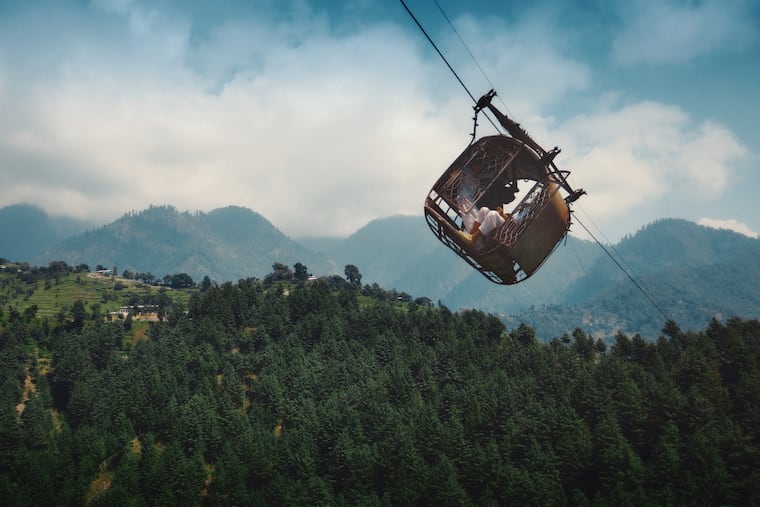
In a similar fashion to Ben’Imana, Abinash Bikram Shah’s Elephants in the Fog, a thriller about transphobia in a Nepalese village haunted by killer elephants, also does not visualize the terror that hovers at the edges of its protagonist’s life.
The story instead follows Pirati (Pushpa Thing Lama), the matriarch of a Kinnar household, as she searches for a missing daughter, Apsara (Aliz Ghimire), and pines for romance in a society that both reveres Pirati for having healing powers and demeans her for being part of a third gender community. Though there are nightly patrols and a local police force nearby, Pirati is forced to beg for any kind of support or investigation into Apsara’s disappearance.
When violence does briefly appear in the film, it is in the form of righteous anger on the part of the disregarded Kinnar women.
Adler, in her essay, went on to argue that there was a kind of hierarchy to the effectiveness of movie violence; a “clean collision” was preferable to “protracted dismemberment” in her eyes. Yet perhaps it matters more who is doing that violence; against whom and for what reason.
Arie and Chuko Esiri’s Clarissa, also screening at the festival, is a retelling of Virginia Woolf’s Mrs. Dalloway set in present day Lagos, Nigeria. Like Woolf’s novel, the directors weave together the story of Clarissa (Sophie Okonedo) — a sad upper class woman preparing for a party while longing for the queerness of her youth (her younger self is played by India Amarteifio) — and Septimus, a young soldier who battles PTSD after returning home, in this version, from fighting Boko Haram.
The film languidly explores the decisions that wealthy families like Clarissa’s have made and their impacts on poorer people like Septimus, as well as how both groups feel trapped by the hierarchy of the society they live within (where, it’s worth noting, queerness is criminalized).
There is, however, a single more explicitly violent scene in Clarissa that lingers in the mind. It shows us the source of Septimus’ depression and troubling visions, and the choice to include the visual is somewhat at odds with the rest of the film, which is submerged in a slow-building sensuality.
On one hand seeing gun violence takes away from the film’s other pleasures — particularly as there are not any similarly explicit sex scenes — though this may also be intentional. After all, Clarissa and crew’s exalted status, also linked to colonialism, is built on the suffering of others, something which the Esiris’ remind us of through transitional shots of everyday Nigerians navigating a less glamorous life in Lagos.
All of these films, in various ways and to differing degrees of success, have a point-of-view that challenges existing power structures. Yet an “anti-war film” always suggests to me the existence of its opposite too: work that is “neutral” or pro-war. And, if one were to adopt Adler’s perspective on depictions of violence, most of what we’re watching might actually fall into this latter camp.
For instance, despite Odysseus’ guilty conscience around killing others, Christopher Nolan’s The Odyssey — with its awe-inspiring images — is inspiring thousands of Ithacan military costumes this Halloween.
In a climate of ongoing global violence, film festivals, as platforms for art, have a role beyond selecting some works which speak truth to power.
An individual film’s merit is always up for debate, but the container in which the work is presented, the political statement that this makes, feels more discernible. This might be observed in the makeup of the full lineup — for instance, do Palestinian filmmakers get to speak about Gaza themselves?
But as the Philadelphia Film Festival continues through Oct. 25, even a single screening presents an opportunity for intentional framing, for making space for challenging conversation, and ensuring that those most impacted by violence can speak and imagine their liberation in that space.
“Ben’Imana” plays at Film Society East Sun, Oct. 18, 5 p.m. and Mon, Oct. 19 1:15 p.m. “Naza” plays at Film Society Bourse, Sun, Oct. 18 5 p.m. and Mon, Oct. 19 6:30 p.m. “Elephants in the Fog” plays at Film Society Bourse Sun, Oct. 25, 5:15 p.m. “Clarissa” plays at Film Society East Tue, Oct. 20, 8:15 p.m.