Philadelphia Ballet’s three takes on speed and extremes make for an exhilarating program
With works by Wayne McGregor, Christopher Wheeldon, and Twyla Tharp, the dancers never stopped moving.
A week after its season premiere, Philadelphia Ballet was back at the Academy of Music, opening an impressive program about speed and extremes on Thursday night.
Called “Dance at Great Velocity,” the name of the program refers to the second piece on the program, Christopher Wheeldon’s DGV: Danse à Grande Vitesse.
The program comprised three ballets the company has danced before and usually dances well.
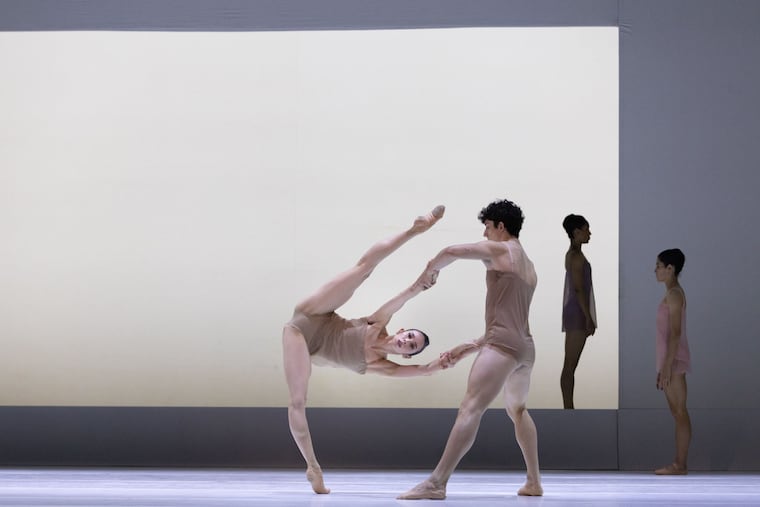
It opened with Wayne McGregor’s Chroma, set to music by Joby Talbot and John White III. It was danced wearing pastel costumes on a stark white stage with lighting that changed throughout the piece.
This is a work of extreme movements, fluidity, and flexibility. All the dancers looked like superhumans stretching their legs well past 180 degrees, arching their backs in impossible positions, and jumping and turning faster, higher, stronger (as the Olympic motto goes). Three men partnered each other.
But while the dance was stunning and the work awe inspiring, I was not surprised to hear that Oksana Maslova and Jack Thomas would be replaced (by Yuka Iseda and Jorge Garcia Alonso) in the next piece, DGV, because Maslova had sustained an injury. Her duet with Thomas included many of the most extreme positions and most complicated partnering.
DGV, set to music by Michael Nyman, is a Christopher Wheeldon ballet about a high-speed train. Here, as the name suggests, the piece focused on quickness, but also on tricky, clean technique.
It’s a beautiful piece with four principal couples as well as a corps that often mimics the tricky steps. Dayesi Torriente and Sterling Baca had the first duet, full of swoops, arcs, and bends and strong partnership.
Iseda and Garcia Alonso were especially impressive having been thrown into the roles at the last minute. Their duet features a lot of moves that require balance and trust, and they were solid. (They were scheduled to dance every other performance, but the second cast doesn’t always get as much rehearsal time and this was not their scheduled performance.)
The program closed with Twyla Tharp’s In the Upper Room, set to music by Philip Glass and danced in black-and-white striped pajamalike outfits that some dancers swap out for red costumes during the piece. All are designed by Norma Kamali.
This is a fun piece and another work of extremes, with the dancers moving constantly. (Everyone got their steps!) But it was choreographed in 1986, so the movements are different. All limbs are kept nearer to their sockets, with arabesques closer to the 90-degree level. Some of the motions look like old-school aerobics, while others look like tap dance. Some of the movements lean into illusion, with groups of dancers leaning to one side than the other.
The orchestra was conducted by Ming Luke, one of seven guest conductors this season during the search to replace Beatrice Jona Affron (who got a job with New York City Ballet).
The first two pieces also featured percussionists playing in boxes on either side of the stage and were as fun to watch as the dancers.
At the end of the evening, artistic director Angel Corella came on stage and announced that he was promoting Pau Pujol — an artist Corella had known since Pujol was a young boy in Spain — to principal dancer. So an already exhilarating evening ended on a festive note.
Philadelphia Ballet in “Dance at Great Velocity.” Through Sunday at the Academy of Music. $24.25-$269.08. 215-893-1999 or philadelphiaballet.org