Gambling addiction mural debuts in South Philly
City unveils gambling addiction mural in heart of Asian-American community
NOTE: This story has been updated to reflect the changed date of the mural's unveiling.
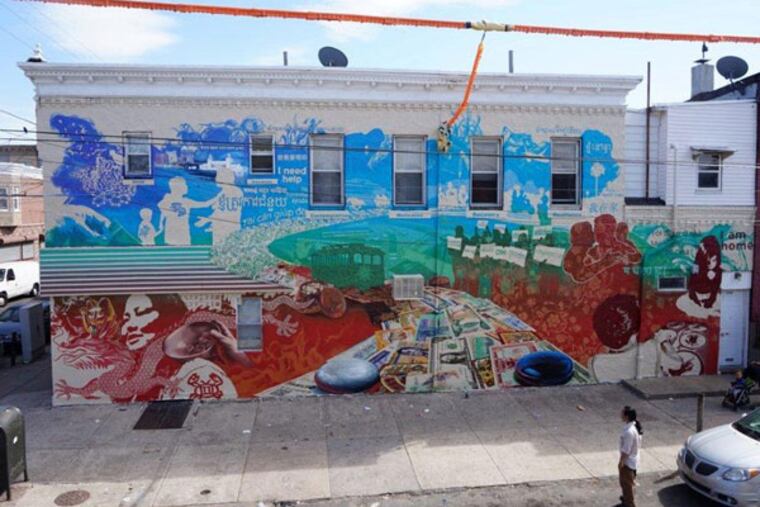
A NEW MURAL depicting the path to recovery for Asian-American gambling addicts called "Fables of Fortune" will be unveiled July 1 on Wolf Street near 7th, a few blocks from a trolleybus route to the SugarHouse Casino.
"Gambling is a problem across cultures, but some research shows that casinos target Asian-Americans," said Dr. Catherine Williams, program and operations director at the city's Department of Behavioral Health and Intellectual disAbility Services.
Williams said the mural project, located in the heart of Philadelphia's Asian-American community, began four years ago when members of the agency's gambling task force reported that casinos use special ethnic-specific promotions to attract Asian-Americans, putting them at risk for gambling addiction.
"When the casino was being debated in City Council, Asian-Americans marched from the gates of Chinatown to City Hall and they were there all day," Williams said. "I was there, too."
She noted the passion with which the protesters spoke out against casinos. That led to her creating a gambling task force, which led to the new mural.
As a city agency, Williams said, "We're not for or against gambling. The mural is not anti-gambling.
"It shows that should you or a family member become addicted to gambling, there is hope for recovery because we have the services and can translate into whatever language is needed," she said.
Eric Okdeh, an artist from the city's Mural Arts Program who created "Fables of Fortune," said he met with groups of Asian immigrants, who shared their cultural stories about gambling, before he designed the project.
"The mural was a tricky thing because it's a loaded topic," Okdeh said. "I had to approach it with sensitivity from a holistic mental health angle."
Okdeh's gambling conversations ranged from talking with individuals at a kiosk he set up at a Chinatown Night Market to conducting group discussions with a wide range of Asian-Americans.
"I knew that it would make people more comfortable if I could talk about my own experiences," Okdeh said. "I have a family member who was, and still is, a problem gambler. When I shared that experience, people felt more comfortable about opening up."
Okdeh painted a white stone and a black stone from the ancient Chinese game "Go" as the mural's entryway.
A trolley travels down a road paved with multicultural money that turns into a casino carpet. On one side of the road, a family is torn apart by addictive gambling. On the other side, a family is restored.
Above these scenes are the words "Contemplation," "Motivation," "Recovery" and "Resilience."
Okdeh and Williams agreed that the mural's message is: The city offers services to help gambling addicts recover and be restored to their families. All they have to do is ask.