Girls' dreams germinate in science lab
An enrichment program helps low-income female students learn about the sciences and empowers them to seek careers in the field.
Slipping on the too-big blue lab coat, Evelyn Ogden was transformed – literally. In the moment it took her to get the thin cotton over her shoulders, she morphed from giggly 15-year-old to scientist.
That's the goal. Ogden is part of WINS – Women in Natural Sciences – a scientific enrichment program for low-income female public school students in Philadelphia. Sponsored by the Academy of Natural Sciences, a Philadelphia museum, it gives girls hands-on science classes, scientific literacy and skill-building activities, and opportunities for personal growth they don't get anywhere else.
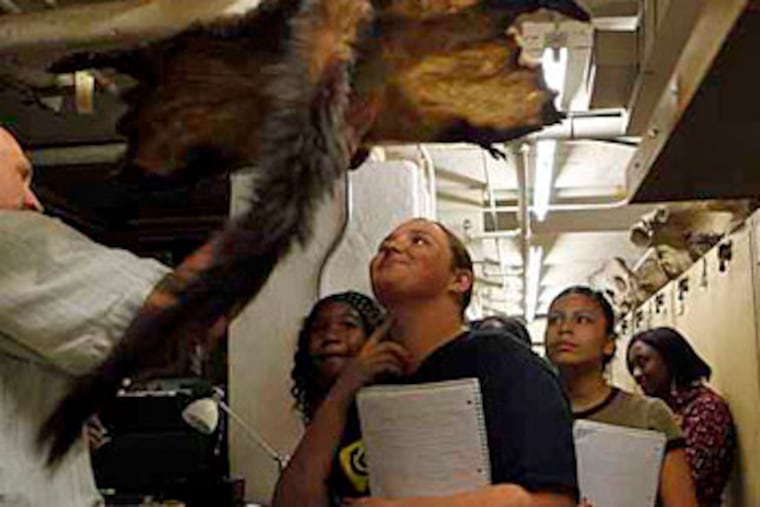
When Ned Gilmore, the collection manager of vertebrate zoology at the Academy, selected Ogden to don lab coat and gloves, reach inside a specimen jar and extract an Indian fruit bat, she didn't hesitate. Her shoulders squared, and she worked with a look of concentration.
"This bat died over 100 years ago," Gilmore told Ogden and a group of 10 other girls who crowded in to watch. "See how durable it is? The alcohol preserves it."
Suddenly, said Ogden, a freshman at Girls' High, she could see herself doing this kind of work.
"Science is becoming a fun subject," she said. "I like doing stuff with animals, mixing things."
And the bat?
"The bones were so fragile," she said in wonder. "It felt like if you pushed it or pulled it, the bones would break."
Promising girls are recommended in eighth grade and go through a rigorous selection process. Last year, 270 young women applied for 32 spots. The summer before they begin 9th grade, they spend three days a week in classes and workshops and a week in the Poconos. During the school year, they come to the Academy one day a week, after school, for classes, and take a field trip one Saturday a month.
The program provides whatever support it takes for girls to keep their grades up, their motivation sharp. If they do well in school, they can go on to WINS 2 – one to three more years of working at the museum and doing actual research with Academy scientists. Some go on to outside summer programs, and all participate in monthly college- and work-prep programs.
In ways large and small, WINS has changed lives. Some pick science careers because of it. Others who never saw themselves as college material realize their potential.
"I've seen girls who worked on research projects get to the point where their work is being considered for publication, where they are listed as authors," said Najwa Smith, program director.
She estimates that WINS, which celebrates its 25th anniversary this year, has produced 600 students. Ninety-eight percent of those who go on to the second WINS program go to college, a staggering number given the public schools' rate.
On a recent weekday, Smith taught the girls about Carolus Linnaeus and binomial nomenclature. But really she was teaching them to ask questions, to push the limits of what they have been told is possible.
As Smith drilled the girls on animal classifications, one shy girl raised her hand. Why is the egg-laying platypus a mammal, she asked her teacher?
"I'm mad at you," Smith said, breaking into a smile. "But I'm also proud of you. A platypus is the only mammal that lays eggs. It slipped into that classification somehow."
She divided the class of 32 girls into two groups. One – including Ogden - went with Gilmore to explore the collection he manages, and the other stayed behind for a lesson.
Brittany Studevan, 14, a freshman at Bodine High, had a confession.
"I didn't really used to like science. Now, it's really interesting," she said. Now, she'd like to become a doctor.
Katreena Thomas, 14, a freshman at Central High, likes to figure out how things work – she wants to become a mechanical engineer.
Participating in WINS helps her dream big, Thomas said.
"Even if you get a wrong answer, no one yells," she said. "And no one calls you a nerd here."
Thomas also relishes the idea of breaking into a field where women and minorities are historically underrepresented.
"You don't see women and girls in science. You see men. This is, like, empowering for girls and women," she said.
Smith teaches the WINS lessons, but truly, she says, she learns every time she's with the girls.
"Teenagers can come off as kind of tough; it's that outer thing," she said. "But everything they're learning here is teaching them to go out into the world better, stronger, and smarter."