History in the archives of Merion Golf Club
John G. Capers III hefts the club with strong, tanned arms that hit a golf ball nearly every day. "This may be the most valuable thing we have. It's an Old Tom Morris iron especially made for blasting out of wagon ruts. Spectators used to come in wagons 100 years ago, and it was necessary."
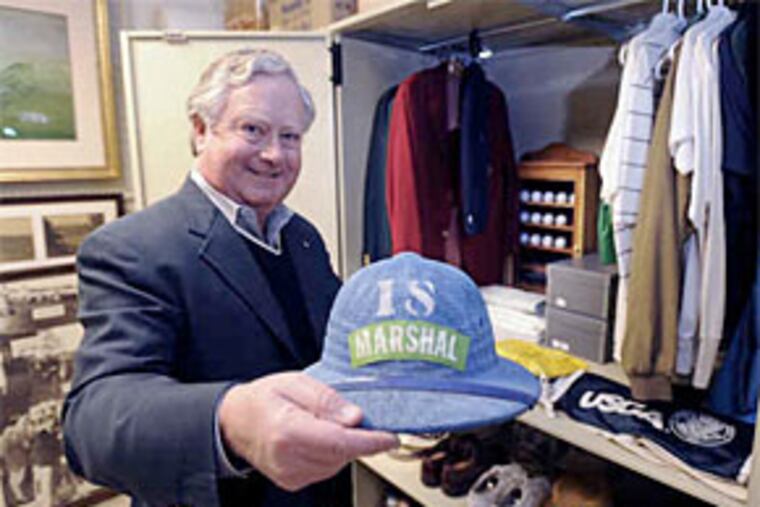
John G. Capers III hefts the club with strong, tanned arms that hit a golf ball nearly every day. "This may be the most valuable thing we have. It's an Old Tom Morris iron especially made for blasting out of wagon ruts. Spectators used to come in wagons 100 years ago, and it was necessary."
Capers, the historian-archivist for Merion Golf Club in Ardmore, is surrounded by clubs, balls, bags, tees, gloves, badges, trophies, photographs, and cabinets holding club records, newspaper clippings, architectural drawings, and other documents going back to 1896, when the original course was laid out.
"We also have 20,000 digital files," Capers adds. "The temperature of this archives is controlled at 68, humidity is kept at 50, there is no natural light, all containers are acid-free, and the floor is linoleum to keep dust minimal."
There's a lot to preserve at Merion, and the archive is only the beginning. The course and clubhouse are a kind of gallery of golf history, and the entire place seems drenched in time.
Merion is to golf what Yankee Stadium was to baseball - only it's older and still open. "What we have here is 126 acres of grass, tradition, and history," says Capers.
History is about to boil over again at Merion. It will be the venue for the 42d Walker Cup Match for three days beginning Sept. 11. The competition pits the best American amateurs against a team from Britain and Ireland. It is named for George Herbert Walker, grandfather of President George Herbert Walker Bush and great-grandfather of President George Walker Bush.
It will be another link in the chain of history first forged in 1904 when Merion hosted the U.S. Women's Amateur Tournament. The 2009 Walker Cup will be the 18th championship sanctioned by the United States Golf Association to be held here. No other American golf club has hosted as many.
Capers gingerly opens a file folder to reveal a yellowing sheet. "This is the original plan for the locker room when the club opened in 1912."
Golf actually came to the club in 1895 when the board of Merion Cricket Club voted to consider "golf and the playing of same." A course was laid out the following year, but within 10 years it was obsolete because of the advent of a livelier ball. But the golf bug had bitten the membership, and in 1910 the board decided to build a new course on a site in Ardmore.
The task was assigned to Hugh Irvine Wilson, a 32-year-old member whose pleasant visage smiles down from a framed photograph in the archives.
"Wilson had never designed a course," says Capers. "He went to the British Isles in the spring of 1912 after the Merion course had been laid out and seeded. He brought back with him many ideas that were incorporated here. One of them was the large, deep bunkers that today are known as the 'white faces of Merion.' "
The golf club was part of Merion Cricket Club until 1942, when Merion Golf Club became an entity unto itself. Capers bristles when anyone calls it a country club. "This is a golf club. No tennis. No swimming. No croquet. Golf, period."
Two paddle-tennis courts at the end of the parking lot went by the wayside 20 years ago, though bridge is still played in the clubhouse.
Capers says all new staff members are given an educational tour of the archives "so they understand the lore of Merion." New members also are requested to make the tour. "This really seems to work because we find that it's the younger and newer members who are most insistent about upholding Merion traditions. You whip out a cell phone anywhere on the premises and you'll catch it."
A photograph shows Bobby Jones approaching Merion's 11th green on Sept. 27, 1930. Behind him, a huge crowd stretches to the horizon. An estimated 15,000 to 18,000 people watched one of the greatest events in golf history - Jones' clinching of the U.S. Amateur to win the Grand Slam of four major championships, though it wasn't called the Grand Slam in those days. Rather, it was the "Impregnable Quadrilateral of Golf." No one has done it since.
"Every year we hold a special dinner to honor Jones' immortal feat," says Capers. "We walk behind a bagpiper down to the 11th hole and have a champagne toast." There, a plaque attached to a boulder commemorates golf's only Grand Slam.
There's another enduring albeit less glorious link in Merion lore attached to the 11th hole. It was here in the 1934 U.S. Open that Bobby Cruickshank mis-hit his shot into Cobbs Creek. Miraculously, the ball hit a rock and ricocheted onto the green. To celebrate this stroke of luck, Cruickshank tossed his club up and yelled, "Thank you, Lord." Seconds later the club came down and hit him on the head. Cruickshank, a Scot, was leading at the time. "He never recovered from that bizarre incident and finished in third place," says Capers.
Capers, a 66-year-old retired sales and advertising executive, began coming to Merion more than 50 years ago to watch his mother play. She won 11 club championships. Capers has won 15. "I grew up knowing the place was special, and I decided about 10 years ago that we needed an archives."
The top golfer among current members is George "Buddy" Marucci Jr., the reigning USGA senior amateur champion. He is this year's Walker Cup captain, and was a Walker Cup participant in 1995 and 1997.
"I think it will be nice to be at Merion," Marucci says of the coming tournament. "However, I am not sure it is that big of an advantage."
If he were playing on rather than coaching the Walker Cup team, surely it would have been. "I do play well at Merion," he says, "but I do not think I have played my best golf there."
Still, as courses go, he says, Merion "is as good as it gets."
Capers, in his quest for archives material, is an eBay addict, and he recently purchased a contestant's badge from the 1934 Open.
"We began working on the archives in 2001, and the core of our collection was found in cardboard boxes in an attic over a barn on the property," he says. "I try to add things that are important, and right now I'm looking for a contestant's badge from the 1981 Open."
The most famous photograph in the archives is probably the most famous image in all of golf. The photo, taken by Life magazine's Hy Peskin on Merion's 18th fairway, shows Ben Hogan's follow-through after he hit his approach shot in the 1950 U.S. Open.
Hogan decided to compete despite suffering grievous injuries in a car accident just 16 months earlier. On the 72d and final hole of the tournament, Hogan was in extreme leg pain and needed to hit a shot of more than 200 yards into the wind to force a playoff. He did it and went on to win.
Assessing his career to a biographer, Hogan said that "Merion meant the most because I proved I could still win." A plaque on the 18th fairway commemorates his courageous victory.
Capers hauls out a tray of worn golf balls and plucks one. "We fished this out of Darby Creek the other day. It's an old bramble ball, and it probably dates back to the 1920s, at least." He replaces the ball carefully. "They were called bramble balls because they resembled the fruit found on brambles in the English countryside. They're important in golf history because they are the beginning of the dimpled ball as we know it today."
There is one Merion artifact that even Capers despairs of ever finding: the rubber snake that Lee Trevino playfully tossed at Jack Nicklaus to break the tension at the first tee in an 18-hole playoff for the U.S. Open title in 1971.
"Trevino won," says Capers, "but it's sometimes forgotten that in the previous round Nicklaus missed a 10-foot put on the 18th that would have won him the title and avoided the playoff. Nicklaus, by the way, said Merion, 'acre for acre, may be the best test of golf in the world.' "
Capers maintains close contact with players having important links to Merion. He lifts a club that was leaning against the wall and takes an imaginary putt.
"This is the bull's-eye putter that David Graham used when he won the Open here in '81. It just came in." Graham's finishing round at Merion is considered one of the most outstanding in the history of the Open. "He was down by 3 shots when he started the final day," Capers notes.
There has not been an Open at Merion since 1981, but the club is scheduled to host the Grand Slam tournament in 2013. It will be Merion's fifth U.S. Open.
"You realize what this means?" asks Capers without waiting for, or expecting, an answer. "There will have been a USGA event here for 12 consecutive decades. We have another 15 years or so to come up with one for the 13th."
Capers steps out of the archives and carefully locks the door. "There are only two keys. I have this one, and the club has one. There are no others." He arches his eyebrows to underline his words.
2009 Walker Cup
The 42d Walker Cup Match is scheduled for Sept. 12-13 at Merion Golf Club, with practice rounds Sept. 11. The event, first held in 1922 and played alternate years, pits top amateur golfers from Britain and Ireland against those from the United States.
George "Buddy" Marucci Jr., a Villanova resident and Merion member, will captain the U.S. team, as he did for the 2007 U.S. victory at Royal County Down. Colin Dalgleish will be captain of the Britain and Ireland team.
The United States leads the series, 33-7-1.
For ticket information, call 484-708-1050 or go to www.2009walkercup.org
EndText