Ed Rendell: Don’t judge the entire redesign plan for South Broad Street based on one traffic island
The focus isn’t, and shouldn’t be, on one median. It should, rather, be to make South Broad into a place that people — both Philadelphians and visitors — and businesses want to be, writes Ed Rendell.

Ed Rendell served as the 96th mayor of Philadelphia (1992-2000) and the 45th governor of Pennsylvania (2003-2011).
When I served as mayor of Philadelphia, I saw a need for a revitalized South Broad Street. I knew it had the potential to be a thriving district with a concentration of performing arts venues and a powerful economic engine for the city. I established Avenue of the Arts Inc. (AAI) to do just this, engaging philanthropists, city leaders, businesses, and advocates to partner in fulfilling this vision.
Through decades of public-private partnership, AAI created the pathways for the Avenue of the Arts to become a hub for arts, culture, and tourism with the expansion of hotels like the Doubletree and Ritz Carlton, cultural spaces including the Brandywine Workshop and the Freedom Theater, luxury residential buildings like Arthaus, and the crown jewel of the Avenue — the $275 million Kimmel Center.
The results were transformative. More than 10,000 performing arts seats, second only to New York City’s Broadway; more theater, music, dance, and film events annually than all the home games for our professional sports teams combined; and newly injected vitality on a previously neglected corridor. The investments changed the way Philadelphians — and the world — viewed the city.
The Avenue of the Arts has undergone great transformations before. It’s time for the next one.
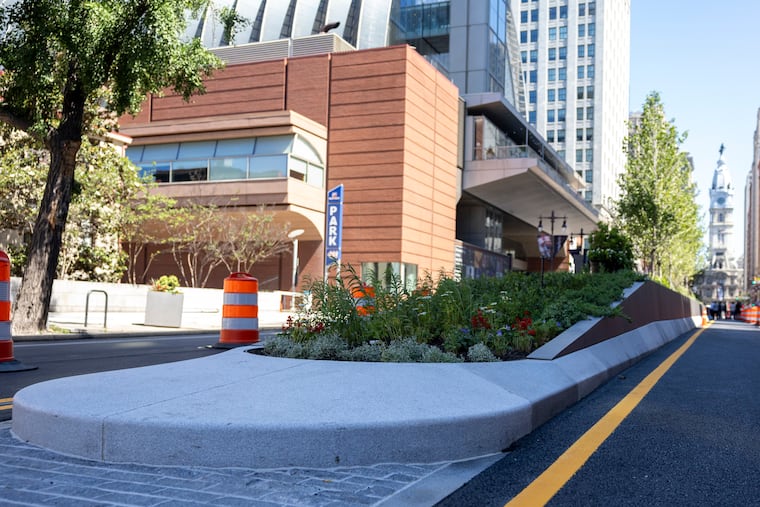
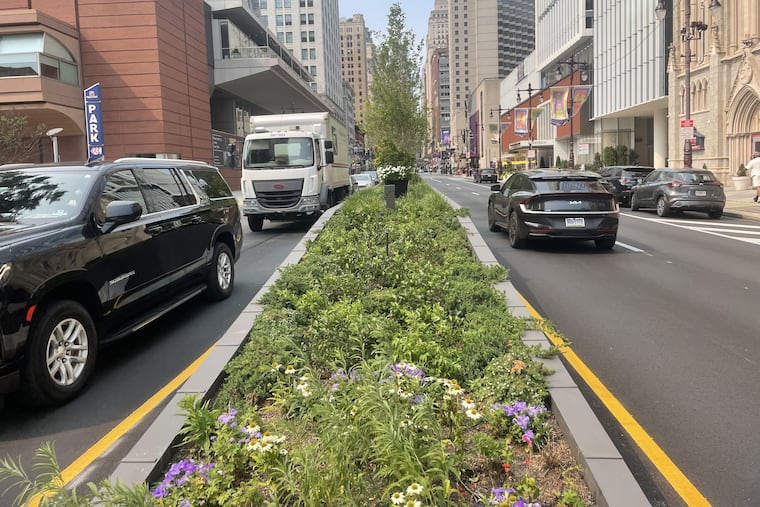
The plan to green South Broad has only just begun with the median and planned sculpture and planters between Spruce and Pine. The project is designed to give each block a chance to determine its unique needs with the long-term goal of a 10-block stretch of art, greenery, and public space.
Judging the project by its first 230 feet is like reviewing a play after the overture.
» READ MORE: Broad Street’s pricey new median planters take the Avenue of the Arts in the wrong direction | Inga Saffron
But the focus isn’t, and shouldn’t be, on one median. It should, rather, be to make South Broad into a place that people — both Philadelphians and visitors — and businesses want to be.
We’re seeing this happen in real time. Temple is establishing a foothold in the former UArts Terra Hall. The historic Bellevue Hotel is ever-expanding with new dining and lifestyle offers. Tenants and organizations along South Broad are clamoring to be the next beautified block. We can’t lose sight of the bigger picture, which is a bolder, greener, energized Avenue of the Arts.
It would be a mistake to squander this forward momentum.
Judging the project by its first 230 feet is like reviewing a play after the overture.
The new median between Spruce and Pine is more than a box for trees and flowers. It’s a statement to Philadelphians and visitors that we are investing in what’s possible. If the summer of 2026 has taught us one thing, it’s that Philadelphia is truly a global destination, and we can pull off big ideas.
The work AAI has done and is doing benefits not only the city’s vibrancy, but its economic wellbeing. An impact study by Econsult Solutions, estimated that for every $1 spent by Avenue of the Arts Inc., $226 in economic output is created. Making South Broad a greener, more inviting space to spend time will only amplify that output, contributing to the positive community flywheel of developing the Avenue.
Vision and dogged commitment from private sector leaders like Carl Dranoff, Ira Lubert, Brook Lenfest, and Lindsey Scannapieco are moving us in the right direction. The investments we make now will pay dividends in the future if we give bold ideas, like AveArts 2.0, a chance to grow.
I remember when we did the original layout for the Avenue of the Arts in the 1990s. People questioned if this amount of investment would be a good idea. No one questions that today. The spending paid off for Philadelphia, making the Avenue a leading factor in the city’s comeback.
» READ MORE: How Philly’s new Broad Street planters will turn what could be a grand urban avenue into a highway | Opinion
This is not an accident. Between 2000 and 2016, the city was selected to be the site for two major political party conventions. This cemented Philadelphia’s role as one of the top cities in the country and prepared it to take off over the last 25 years.
The time has come to refresh the Avenue of Arts. If developed properly, it can continue to play a leading role in the city’s success.
Progress is both big and small. But it is progress, nonetheless. We cannot let naysayers throw cold water on a new idea before it has a chance to take root.
Let the trees grow. Let the next blocks follow. With continuous progress, Philadelphia’s Avenue of the Arts can become the great street our city has always deserved.
About guest essays
Guest essays, or op-eds, are commentary pieces that present the opinion or perspective of the author. Many are submitted to us by Inquirer readers and writers with insight on the news, but we also solicit op-eds from authors on specific topics. For more information visit our guidelines.