The roots of the religious right are a lot older than most people know
The alliance between conservative Catholics and evangelical Protestants dates not to the 1970s, but to popular radio broadcasters in the 1940s who brought them together to fight Godless Communism.
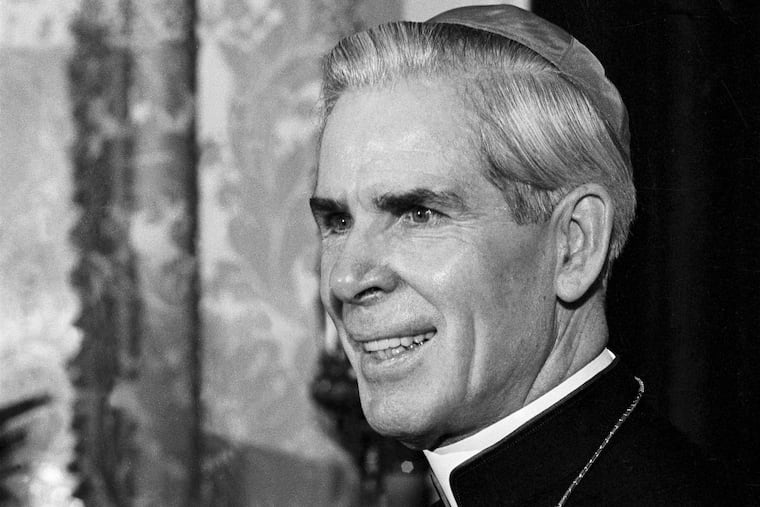
On Sept. 24, the Catholic Church beatified Fulton Sheen, leaving him one step from sainthood. Many Americans remember Sheen as a television bishop in the 1950s, the host of Life Is Worth Living.
While television made Sheen a recognizable face, his radio broadcasts from the 1940s would sound especially familiar today. They captured the moment when conservative Catholics and evangelical Protestants, long rivals, began to fear secularism more than each other — and the first hints of the rise of the contemporary religious right.
Most accounts cite the 1970s as the moment when these two religious groups joined together politically, and most credit fights over the Equal Rights Amendment, abortion and gay rights for bringing Catholic and evangelical activists into common cause.
However, the growing alliance between the two religious groups could already be heard a generation earlier, in the 1940s, on Sheen’s radio show The Catholic Hour and fundamentalist preacher Charles Fuller’s Old Fashioned Revival Hour.
The two radio programs sounded nothing alike. Sheen’s Catholic choirs sang Latin motets while Fuller’s quartet sang evangelical gospel songs.
But from their radio pulpits, both men named the same enemies: communism abroad and secularism at home. What’s equally important, neither man attacked the other’s faith on the air. This approach helped enable a political alliance across denominational lines that represented a significant break from the past.
Anti-Catholic suspicion ran deep during the early 20th century.
In 1922, for example, Oregon voters, urged on by the Ku Klux Klan, approved a law requiring children to attend public schools, a direct blow to Catholic education. (The Supreme Court struck it down in 1925.)
At the root of such laws was Protestant suspicion that Catholics were not loyal Americans. Many Protestants believed that Catholics owed their first loyalty to the pope, a foreign ruler, and saw the millions of Catholic immigrants from Ireland, Italy and Eastern Europe as a threat to the nation.
Even so, the groups shared some political causes and concerns.
Birth control was one of them. Around 1930, liberal Protestant denominations endorsed contraception; several did so out of fear that immigrants, many of them Catholic, were outbreeding native-born white Protestants.
Yet, the Southern Baptist Convention refused to join their push, despite its fierce anti-Catholicism. Fewer Catholic immigrants lived in the South, so white Southern Baptists did not share Northern Protestants’ fear of being outnumbered, and they rejected the social gospel reform movement that led liberal churches to back birth control. By the mid-1930s, Southern Baptist and Southern Presbyterian writers openly remarked on the new, narrow alliance with the Catholic Church.
Radio gave both evangelicals and Catholics a new way to promote their faith, and despite ongoing tensions between them, after the Second World War, Catholic and evangelical broadcasters joined together in their hatred of communism and secularism.
No one pounded this message home more than Sheen, who had been a prominent voice on the airwaves since 1930, when the National Council of Catholic Men launched The Catholic Hour.
On Jan. 26, 1947, for example, after a Brooklyn choir finished a dirgelike motet, Sheen stepped to the microphone. His sermon, “Signs of Our Times,” opened a series on what he called “the question of communism.” He juxtaposed brothers in Christ against comrades in anti-Christ and quoted the German poet Heinrich Heine as saying “the future smells of Russian leather, blood, godlessness, and many whippings.”
In the same sermon, Sheen warned against the loss of a belief in God — which could trigger societal decline. “If there is no heaven there is no hell, if there is no hell there is no sin, if there is no sin there is no judge, and if there is no judgment then evil is good and good is evil.” The warning was clear: godless communism posed a mortal threat.
These weren’t unusual warnings for Sheen; his political messages were explicit, and he urged action from his listeners. On Easter Sunday 1948, for example, ahead of Italy’s April election, the monsignor asked listeners to write to friends in Italy. “If Italy goes communistic on the eighteenth of April,” he warned, “it is possible that the head of the Christian world may be beaten by a hammer and the heart of the Christian world pierced by a sickle.”
With so much at stake, Sheen knew that Catholics couldn’t afford doctrinal disputes with other Christians. He closed “Signs of Our Times” by asking Protestants and Catholics, as well as Jews, to “strike together for [the] moral betterment of the world.” In a print piece in 1948, he observed that the three faiths “may not be able to meet in the same pew,” but they could all join together “on our knees.”
Those who didn’t believe in God, not members of other religions, were the enemy. Sheen’s audience was predominantly Catholic, but his message reached for allies well beyond the Church. Sheen’s appeal to Jews reflected a popular postwar ideal of a “Judeo-Christian” America united against communism.
While Catholic listeners tuned their radios to Sheen, millions of evangelicals tuned in to Fuller’s Old Fashioned Revival Hour. Fuller built his broadcasts on nostalgia. The program’s very name promised listeners the faith of an earlier America.
Fuller preached live from the Municipal Auditorium in Long Beach, Calif., often before crowds of more than 5,000. At his peak in the 1940s, he was heard on more than 400 stations, and he claimed 20 million listeners each Sunday night.
Every broadcast opened with the gospel hymn “Jesus Saves.” Fuller connected hymns to ideas of family and friendship. In one 1947 show, for example, he dedicated “What a Friend We Have in Jesus” “for all the grandmothers sitting by the radio in rocking chairs” and “Sweet Hour of Prayer” “for the lonely hearts.”
Although Fuller’s musicians sang familiar gospel hymns that listeners could join and Sheen’s trained choirs sang in Latin — the language of the Mass — both preachers broadcast a similar political message.
Critically, Fuller was just as willing to set aside doctrinal disputes as his Catholic radio counterpart. Most fundamentalists of the period did not count Catholics among those “in Christ,” but Fuller kept such questions off the air. “We are allied with no denomination,” he told listeners in 1937.
Old religious conflicts undoubtedly lingered. For instance, in 1949, Paul Blanshard’s best-selling American Freedom and Catholic Power attacked the Church by likening the Vatican to the Kremlin. Fuller’s broadcasts, however, avoided such bromides and kept the focus on non-believers and the gospel.
Meanwhile, Sheen moved to television in 1951, joining Protestant evangelists such as Billy Graham in using the new medium to speak out against communism.
While Sheen and Fuller differed sharply in theology and style, they shared a common message and purpose: to honor the Christian traditions that they feared were in jeopardy. Their music served that purpose, too. Juxtaposed against the potential catastrophe of a Godless future, both the 16th century motets on Sheen’s program and the gospel hymns featured by Fuller offered the sounds of a comforting Christian past.
By the 1970s, this approach had become the playbook for the emerging religious right, when, for instance, Catholic activist Phyllis Schlafly and evangelical singer Anita Bryant led parallel battles against the ERA and gay rights. Schlafly emphasized common beliefs and enemies. She urged her followers to put doctrinal differences aside and focus on what they agreed upon.
Today, communism, secularism and liberal ideas about gender and sexuality still serve as a rallying cry on the political right — causes that bring together conservative evangelicals and Catholics. In June 2026, President Donald Trump told a Faith and Freedom Coalition audience of evangelicals and Catholics in Washington that “these ruthless communists will attack all religions, but in particular Christianity.”
Yet, while many see this as a legacy of the work done by architects of the religious right in the 1970s like Schlafly, Bryant and evangelical preacher Jerry Falwell, it’s also a continuation of the coalition that could already be heard on Sheen’s and Fuller’s broadcasts. The roots of the alliance are much deeper, which helps to explain why it is so durable.
It rests on shared enemies, and those enemies can shift — from communism to the ERA and gay rights to secularism — without the coalition having to change. Catholics and evangelicals still rarely meet in the same pew, but they have stood on the same side of the culture wars for nearly 80 years.
Chase Castle is a music historian and a Kluge Fellow at the Library of Congress. His first book, The Gospel in Black and White: Race and Popular Culture in American Hymns, is under contract with the University of North Carolina Press.
Made by History takes readers beyond the headlines with articles written and edited by professional historians. Opinions expressed do not necessarily reflect the views of The Inquirer.