Disgraced Philadelphia officer Daniel Castro faces sentencing
As a member of the Philadelphia Police Department, the now-disgraced Daniel Castro often went beyond the call of duty to help the city's communities, some residents say. He was the type of officer who visited the family of a young rape victim, who became a surrogate father to a child whose parents had died, and who arranged for a boy with terminal cancer to meet Phillie Chase Utley.
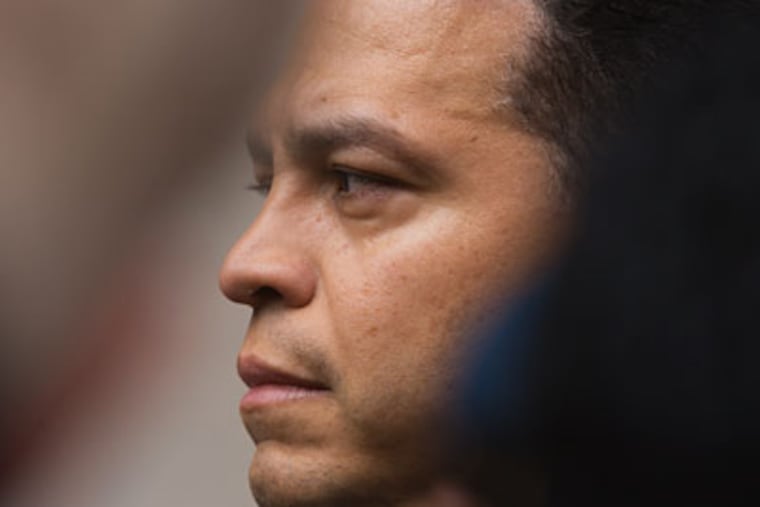
As a member of the Philadelphia Police Department, the now-disgraced Daniel Castro often went beyond the call of duty to help the city's communities, some residents say. He was the type of officer who visited the family of a young rape victim, who became a surrogate father to a child whose parents had died, and who arranged for a boy with terminal cancer to meet Phillie Chase Utley.
On Tuesday, when Castro is sentenced in U.S. District Court for conspiring to commit extortion, his lawyer, Brian McMonagle, will use nearly two dozen letters of support from Castro's family, former colleagues, jurors from his April trial, three Philadelphia councilwomen, and others to argue that Castro's 25-year record of service should outweigh his involvement in a scheme to strong-arm a business associate into repaying a debt.
Castro, 48, faces up to three years in federal prison. McMonagle will ask U.S. Judge Harvey Bartle III to let him remain free. At the time of his arrest, Castro was a police inspector, three levels below Police Commissioner Charles H. Ramsey.
"Sending Daniel Castro to prison would be an unspeakable tragedy," McMonagle wrote in a memorandum filed last week. "He and his family have suffered enough from this horrible situation. He has endured the devastating loss of his career and his good name. This is not a case about a corrupt cop. It is a case about a good man who briefly lost his way."
Castro pleaded guilty to one count of conspiracy in June after a jury trial two months earlier ended in a deadlock, 10-2 in his favor, on most other charges against him.
According to filings in the case, federal prosecutors plan to ask Bartle to impose the stiffest possible sentence. Castro must serve as a "cautionary tale" to other police officers who believe they are above the law, according to the memorandum filed by Assistant U.S. Attorney Louis D. Lappen.
"Castro brought shame and disgrace to the Philadelphia Police Department," Lappen wrote in the filing. "The vast majority of honest and law-abiding police officers should not have to suffer the consequences of losing credibility because of 'bad apples' like Daniel Castro."
Lappen's filing describes Castro as a criminal whose actions were a reflection of his character, not a well-intentioned public servant who was led astray.
"Castro knew better than to engage in a series of extortions, and at each step along the way, he fundamentally and far too easily made the wrong choice," the filing states. "This is not the conduct of someone who had a bad day - not even close."
Castro, believed to be the highest-ranking Philadelphia police officer to face criminal charges in several decades, was arrested in November 2010 on charges of plotting earlier last year to shake down a business partner who owed him $90,000. It was a stunning downfall for a charismatic and ambitious officer who had designs on one day becoming police commissioner.
Castro's trial in April centered on the testimony of an FBI informant who planned the extortion with Castro and recorded their conversations over several months. On tapes played for jurors, Castro was heard agreeing to allow strong-arm enforcers to "scare" his former associate, and, later, authorizing the use of violence. No extortion actually took place, but prosecutors said Castro believed it had.
On the stand, Castro admitted his involvement, but he said authorities had entrapped him by using the informant to talk him into it.
After the jury could not reach a verdict, federal prosecutors planned to retry the case. They agreed to drop the remaining charges in exchange for Castro's plea.
McMonagle's filing includes letters from several of Castro's former colleagues, praising his dedication to the city as "exemplary." When an 11-year-old girl was raped in Kensington in 2009, Castro, then the district's captain, visited her and her family. According to the girl's father, he counseled her, gave her a toy, and told her to call him if she ever needed anything.
City Council members Donna Reed Miller, Maria Quiñones-Sánchez, and Jannie Blackwell wrote accounts of their experiences with Castro as a mentor to families and victims of crime, and as a policeman who worked hard to clean up drug-ridden neighborhoods.
Castro's mother, siblings, and fiancée also submitted letters asking for leniency. His mother, Maria Virginia Cartagena, said he had devoted his life to his career.
"He woke up early and went to bed late, he spent weekends dedicated to his work so that he can make a better life for him and our family," she wrote. "He had a great dream to become police commissioner one day, to make a lot of positive changes in Philadelphia."
Three jurors asked the court for leniency, one saying justice would not be served by imprisoning Castro.
In the state's memorandum, Lappen noted also that the extortion scheme was not Castro's first brush with trouble. As an officer, Castro was the subject of several Internal Affairs investigations, he said.
The best-known of those involved Castro's pressuring subordinates to doctor incident reports in his West Philadelphia district in 1999 in order to create the impression that the area was safer than it was. Castro was demoted but was later given a second chance by John Timoney, who was police commissioner at the time.
"Such conduct could have resulted in a reduced number of officers on patrol in a dangerous area with the obvious effect of increasing the danger to the members of this community," Lappen wrote. "But Castro did not care. He put himself above others."