A respite all too temporary
The line starts forming outside the Lutheran Church of the Holy Communion after the sun goes down. Homeless men and women - lugging knapsacks, shopping bags and suitcases - wait patiently on a ramp, hoping to get one of the 40 slots to stay inside for the night.
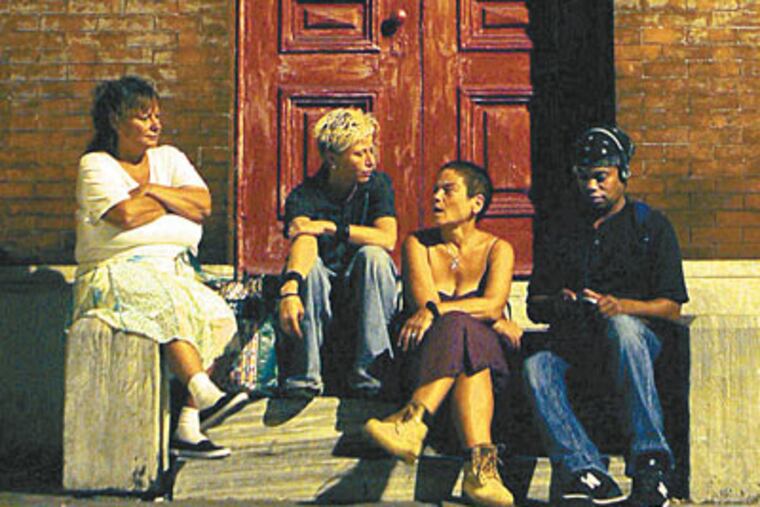
The line starts forming outside the Lutheran Church of the Holy Communion after the sun goes down.
Homeless men and women - lugging knapsacks, shopping bags and suitcases - wait patiently on a ramp, hoping to get one of the 40 slots to stay inside for the night.
It's first come, first served. But tonight's a good night. Everyone gets into the all-night "cafe" near 21st and Sansom Streets.
The cafe is not a shelter but a stopgap measure to help ease the number of people living on Philadelphia streets this summer.
Guests tonight say that if it weren't for the cafe, they would be sleeping on a park bench, in a train station, or in an alley.
And this week, they could.
The cafe needs to relocate by Friday, and while the city is working on a permanent location, it is not ready yet, says Dainette Mintz, head of the city's Office of Supportive Housing.
"We're trying to do all we can," Mintz says. She would not disclose the location, but says that workers are preparing the site and that city officials are reaching out to the surrounding community to prepare it, too.
Inside the cafe, there is a noticeable sense of order, routine and familiarity. Guests get hot soup, coffee, and space to stretch out on the carpet in a big, clean, bright room with butter-yellow walls and white columns.
"She's my best friend," gushes Krystof, throwing his arms around Wendy Gaynor, a worker for the Bethesda Project, a nonprofit provider of homeless services and shelter that runs the cafe.
Krystof is a Polish window installer with a bad back, emphysema, and a thirst for liquor. He's a regular, along with Irwin, who is angry tonight.
Irwin, 47, grew up at 19th and Catharine Streets, not far from Rittenhouse Square, and as a boy shined shoes in the park. A few days ago, a police officer told him to get off the grass there.
"He told me to wait for the sunbathers and then try to fit in with them," says Irwin, who is African American. "If you ask me, there's a certain amount of racism in it."
Irwin has gotten three citations in his years living on the streets: for loitering, disorderly conduct and public urination. "When you're homeless, where's your bathroom?" Irwin asks.
The city runs two overnight cafes in the summer, this one near Rittenhouse Square and the other in West Philadelphia. Both are running at capacity.
Most of the cafe regulars are lost - to mental illness, to alcohol, to drugs, to poverty. All have an intense distrust and fear of city shelters.
Misty Sparks, who runs the cafe, estimates that 10 people would "jump up and go" if offered permanent housing. But on this night, there are only three vacancies in the entire city at addiction-treatment centers or "safe havens," places where people can live while working on recovery.
It frustrates Sparks - and others in homeless services - that the city has first-rate drug- and alcohol-treatment centers, but that "for a person with just a mental-health diagnosis, it's near impossible to find an appropriate placement," she says.
Since December, Sparks has placed 129 people from the cafe in housing or recovery programs. About a third remain, with most of the others returning to the cafe or streets, she says.
By 11 p.m., everyone at the church is ready to sleep. One younger Japanese man named Ken, who lost his apartment in the winter, has an inflatable mattress. Another man is huddled under a grand piano.
Eric Markle, 37, has trouble sleeping. He sits at a long table poring over a grand jury report on the biggest story in the city - the starvation death of 14-year-old Danieal Kelly. He is appalled and quotes a line from Jane Eyre: "Such dread as children only can feel."
Markle, who is short with wiry hair and fair eyes, says his adult life has been a revolving door of going "from the penthouse to the park bench." He says he has "demons who haunt me" - drug addiction, self-mutilation, a personality disorder.
Bethesda caseworkers are trying to get him into a safe haven. In the meantime, he says, he picks up odd jobs and, just this night, cooked dinner for 30 people at the Broad Street Ministry. "It's a way to keep myself civilized because the streets will do some damage," he says.
While a few of the guests are in their 20s, most are middle-aged or older.
Burnis Thomas, 57, was on his way from Prince Georges County in Maryland to Atlantic City in the winter to find work when he got sick in Philadelphia, went to a hospital, and was told he had noncommunicable tuberculosis.
He had been asleep at 30th Street Station when one of the city's homeless outreach teams told him about the cafe. "The shelters are not like this," he says.
Thomas, slight and short with big, clear glasses, is animated. A caseworker for the Bethesda Project thought he had found a spot for him at a safe haven, but it was a false alarm. Thomas is still on a waiting list.
Insistently upbeat, he picks up his canvas bag to head to 30th Street, where he plans to sit for the day. He carries a train ticket for Atlantic City in a sealable plastic bag with his other papers, just in case police ask him what he's doing at the station.
On his way out, he stops to read a poster with a passage from the prophet Isaiah. Pointing to each word, he reads, "Those who hope in the Lord will renew their strength."
He heads down the ramp, certain to return tonight.