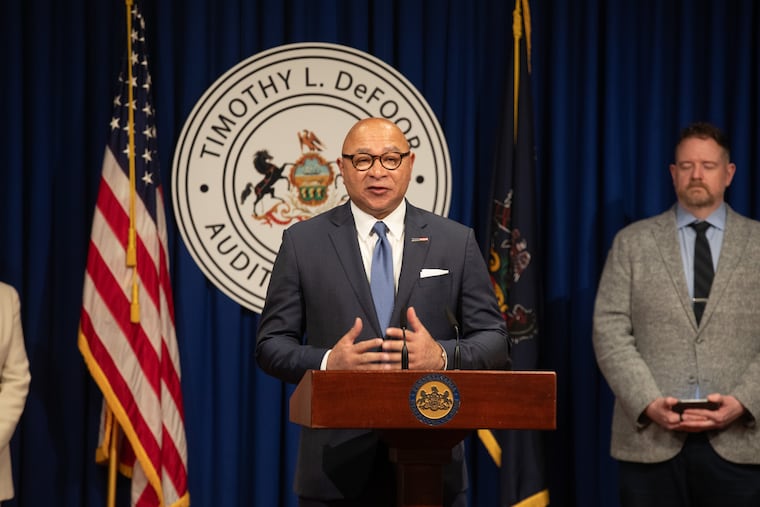
NEW YORK - David Paterson, a Democratic politician little known outside New York, is set to become the state's first African American governor and the nation's first legally blind governor Monday after the resignation of Eliot Spitzer.
Paterson, 53, elected with Spitzer 16 months ago, will serve a term that runs through the end of 2010. He inherits a state in financial turmoil with a $4.4 billion deficit and a looming April 1 deadline for approving a new budget.
"Like all New Yorkers, I am saddened by what we have learned over the past several days," Paterson said in a statement. He said it was now time for the New York government to "get back to work as the people of this state expect from us."
Paterson is from a prominent political family in Harlem. His father is Basil Paterson, the first black person to serve as New York's secretary of state and as vice chair of the national Democratic Party.
"We will be in good hands," former New York City Mayor Ed Koch said. He said Paterson "is highly intelligent, has a first-rate, warm personality, and is an excellent leader."
Widely respected by New York lawmakers of both parties, Paterson has long been known as a trailblazer.
"David is somebody who works hard at getting along with people, works hard at common ground to make things happen," H. Carl McCall, former state comptroller, told Bloomberg News. McCall has known Paterson since he was a teenager.
James Tedisco, the leader of the minority Republicans in the state Assembly, who has clashed with Spitzer, told reporters that Paterson had called him Monday as the crisis unfolded.
"He called me to ask if we would give him the benefit of the doubt, and go forward," Tedisco said. "I told him we would."
Paterson was elected to represent Harlem in the New York Senate in 1985 and became minority leader in 2002 when the GOP controlled the chamber.
In that role, he proposed legislation for a $1 billion voter-approved initiative on stem-cell research. He also pushed for a statewide alternative-energy strategy and a crackdown against domestic violence.
A 2006 profile in the New York Observer newspaper called him a "mystery man" who had "a complicated relationship with the truth and a difficulty in saying no" to opponents.
When his interviewer suggested that Paterson was too quick to agree, he replied: "I think that's right. How do you like that? I think that's a good criticism. I think I'm by nature a conciliator."
As the state's first black lieutenant governor, he has been an advocate for minority- and female-owned businesses in New York.
In 2004, Paterson, who lost most of his sight as an infant after suffering an infection, addressed the Democratic National Convention.
"I have a vision for New York state," he said then. "I can't see it with my eyes, but I feel it in my heart."
The American Foundation for the Blind said Tuesday that Paterson would be the first legally blind governor in U.S. history. The foundation noted that Paterson served on its board of trustees from 1997 through 2006.
A graduate of Columbia University and Hofstra Law School, Paterson is an adjunct professor at Columbia's School for International and Public Affairs.
Paterson and his wife, Michelle, have two children, Ashley and Alex.