Impulse of the public
They have descended on Harrisburg in scrubs, clerical vestments, and even running shoes. They've arrived - hundreds at a time - with placards and signs demanding attention to their causes.
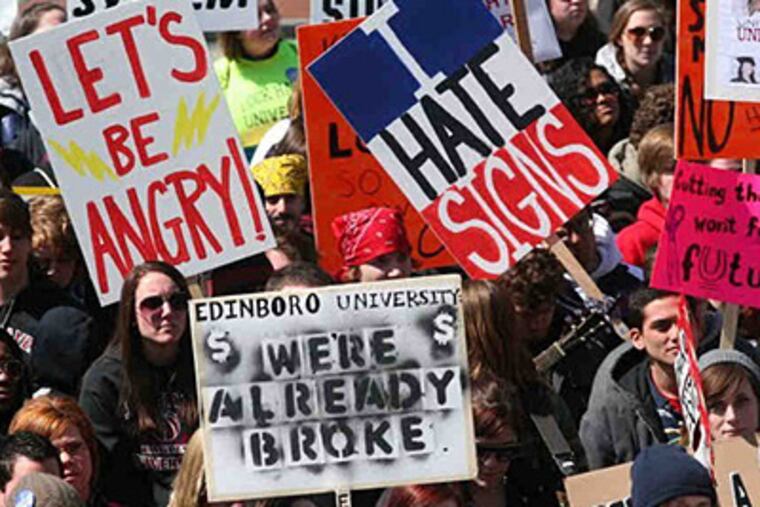
They have descended on Harrisburg in scrubs, clerical vestments, and even running shoes.
They've arrived - hundreds at a time - with placards and signs demanding attention to their causes.
But unlike the rallying pros who typically clog the Capitol steps championing platforms such as workers' rights and environmental regulation, many of those speaking out during this year's state budget negotiations are entering the political fray for the first time.
Whether inspired by the deep education or health-care cuts that Gov. Corbett has proposed or by the protest fever in the air after mass demonstrations in Wisconsin and the Middle East, first-timers say they have felt called - no, compelled - to challenge policies that would directly affect their lives.
"I had to try and make a difference," said Nick Hilton, a Lock Haven University senior who led his cross-country team on a 100-mile trek from the university to Harrisburg late last month for a rally against Corbett's proposed higher-education cuts. "This budget would affect not just our lives now but also our careers in the future."
Last week alone, hundreds of students and faculty members filled Capitol hallways chanting against a budget that would eliminate more than $24 million in community college funding and cut the state's higher-education budget in half.
Rallies organized by political novices have also sprung up in recent weeks around the elimination of the adultBasic health-care program for low-income families and Corbett's refusal to tax natural gas extracted from the Marcellus Shale.
Even some Corbett supporters have felt the need to speak out for the first time in response to such vocal opposition.
Two Temple University students bearing pro-administration signs - Matt Hissey, 22, and Brendan Kissam, 25 - tussled with union protesters during a Monday rally along Broad Street.
"I've been a professor for 40 years, and it's been at least since the early '80s since we've seen anything this extensive here" in Pennsylvania, said G. Terry Madonna, a political-science professor at Franklin and Marshall College. "You'll normally have a one-day rally, and then it's over. I think what's fascinating about this year's rallies is that they've had a life now going on three or four weeks."
Hilton, the Lock Haven cross-country runner, spent three days running from Clinton County to Harrisburg. Two weeks later, he's not sure his mission is over yet.
The 21-year-old history major, who described himself as an average news consumer, recalled being immediately struck by Corbett's budget proposal. But it was a rally on his Clinton County campus, where the crowd suggested taking its message to Harrisburg, that left him with an idea.
During the middle of his speech, Hilton yelled out for those present to run their message to the Capitol. The next thing he knew, he and 37 teammates were on the road, running in shifts, before meeting up with other college runners outside the Capitol's steps on March 28.
"I just kind of jumped into it," Hilton said. "And we got a lot of positive feedback from the university and our lawmakers."
The Rev. David N. Kistler, a retired Lutheran minister from Bethel, Pa., said religion had called him to speak out at another rally in March, protesting the elimination of adultBasic.
Holding a candle and a bullhorn, Kistler stood with a crowd of dozens outside the governor's mansion, calling the decision to let the $163 million fund lapse "unconscionable."
"I saw it as part of my religious duty," he said. "There are so many people in my congregation who relied on this program or were on the waiting list."
Closer to home, the protest bug has even struck some barely old enough to vote.
Tyler Jacobs, an 18-year-old senior at Pottsgrove Senior High School, pushed his campus to host a debate on the education cuts featuring arguments made by groups of students and a speech from their state representative, Republican Tom Quigley.
He's now urging administrators in the nearby Spring-Ford Area School District to host a similar program.
"Look what's happened in the Middle East - in Egypt, Syria, Libya, Jordan," Jacobs said. "I think people are looking at what's working there and thinking they can make a difference."
It's not as if political demonstrations are anything new. This is, after all, Pennsylvania, where labor organizing dates back centuries and a group of Germantown residents became the first group of white men to speak out against slavery in 1688.
What makes these protests different is who is getting involved and for how long, Madonna said.
How much impact Pennsylvania's new political actors will have on budget negotiations remains to be seen, but there is clearly growing support in the legislature for less drastic trims.
Cuts in education spending - perhaps the issue that has drawn the most ire - seem unlikely to make it into the fiscal 2012 budget at the levels that Corbett proposed.
House Republicans spent much of last week trying to soften the blow to the state's schoolhouses by focusing on "waste and abuse" in the state's welfare system instead.
Political analysts give some of the credit for that shift to the protesters even if other factors also came into play.
"The rallies reinforced it," Madonna said. "But you're also dealing with a huge alumni population of voters and a lawmaker population many of whom are alumni of these schools themselves."
That said, don't expect questions over the protests' impact to stop those potentially on the chopping block next.
A group of charities providing social services to those with autism and developmental disabilities is planning a Capitol rally Wednesday should legislators decide to dip into their funding.
Robyn Zippilli, president of the Swarthmore group Community Interactions, is fairly new to demonstrating but said she planned to be there to represent those her organization was created to help.
"We have to get our voices out there," she said. "It's important to keep our faces out there."