Wolf, GOP leaders: Budget deal still on track
HARRISBURG - Gov. Wolf and Republican legislative leaders scrambled Tuesday to fortify their tentative budget deal, hours after signs that the long-sought agreement may have been unraveling.
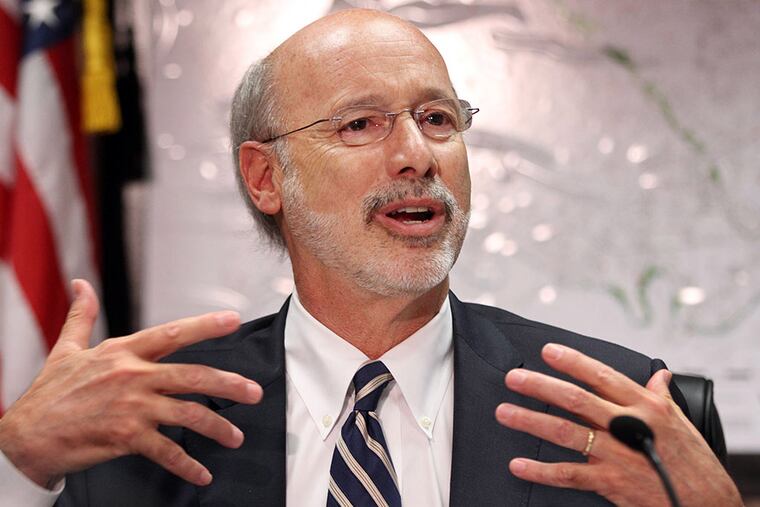
HARRISBURG - Gov. Wolf and Republican legislative leaders scrambled Tuesday to fortify their tentative budget deal, hours after signs that the long-sought agreement may have been unraveling.
Calling reporters to the governor's office for a late-afternoon update, Wolf and the GOP negotiators predicted they would enact a $30 billion spending plan by Thanksgiving that includes significant funding boosts for public schools, a sales-tax hike to enable property-tax reductions, and changes to the state's public pension system.
"This is a really important break," said Wolf, flanked by legislative leaders from both parties, addressing the media for the first time since parts of the pact began trickling out on Monday. "We are working very hard to get this done."
The display of unity came just hours after Republicans had signaled they were considering scuttling the deal because they believe Wolf had overstated - and oversold - the scope of their agreement on education funding.
Republicans said they had given a green light to boosting spending for schools only by an extra $400 million in this fiscal year, not $750 million over the next two years, as Wolf had announced to start the week. In a radio interview with a Pittsburgh station, Senate Majority Leader Jake Corman (R., Centre) had suggested that their negotiations had suffered a setback.
By the end of the day, both sides clarified that they have a deal on education spending for this year, but are still ironing out details for the next.
This year "is where our commitment lies right now," Corman said. "We're agreeing on an historic package."
The roller-coaster day reflected how difficult and tenuous it has been to reach a settlement after a five-month budget stalemate poised to be among the longest the state has seen. Counties, public schools, and nonprofits that deliver critical social services have seen hundreds of millions of dollars in state aid cut off as both sides struggled to bridge philosophical and policy divides on taxes, the privatization of liquor and wine sales, and changes to the state pension system.
"I think at the end of the day, it's a day worth waiting for," House Majority Leader Dave Reed (R., Indiana) said of the tentative accord.
The deal calls for $350 million in new money for basic education and an additional $50 million for special education. It also would increase the state sales tax from 6 percent to 7.25 percent, raising roughly $2 billion in new revenue to cover property-tax reductions statewide.
If it is approved, Pennsylvania would have the second-highest state sales tax in the nation, after California. And Philadelphia, where the sales tax is now 8 percent, would see its rate shoot to 9.25 percent, placing it among the five cities nationwide with the highest sales-tax rates.
On pensions, the deal calls for providing newly hired state government and public school employees with a traditional benefit plan - although one that is less generous - as well as with a 401(k)-style plan that includes a 2 percent employer contribution.
Corman, who has said those changes could save $12.5 billion across decades, described the measure as "one of the most thorough, comprehensive pension reform bills" in the country. He also noted that pension reforms have long been a priority of GOP legislators in Harrisburg. Neither he nor Reed would say whether legislators, upon being reelected, would see their pensions change.
Still unclear are details about how the state's liquor-sales system might be altered. Past proposals have called for selling the state stores, or leasing the wholesale operation to private vendors.
For Wolf, the deal comes with at least one major setback: There will be no new levy on natural-gas drilling, a key platform in his campaign and revenue source for which he had lobbied throughout his first year.
That decision drew one of the first negative reactions to the proposed budget deal - push-back from environmental advocates.
"Rather than listening to their constituents, lawmakers are listening to well-funded industry interests at the expense of our environment," PennFuture president and CEO Larry J. Schweiger said in a statement.
Also uncertain was whether other new revenue sources - from a cigarette tax or expanded gambling options - might end up being part a final budget.
And neither side has explained how the new revenue for schools will be distributed - a key factor that could affect how some legislators vote on a final deal.
Still, both sides said they were pleased to have a finish line in sight.
And Wolf, when asked whether the deal was worth waiting for, answered with one word: Yes.
717-787-5934
@AngelasInk