Six advantages for Democrats in the midterms ... and six advantages for Republicans
Several factors point to a clear Democratic advantage. But Republicans also see reasons for optimism, and it’s not just about gerrymandering.

President Donald Trump’s low approval ratings and widespread economic discontent, along with historical trends, point to a clear Democratic advantage come November and the midterm elections. But Republicans also see reasons for optimism, and it’s not just about gerrymandering.
Six factors working in Democrats’ favor:
Out-of-power parties typically pick up seats in the midterms
The Democrats’ most basic advantage is the fundamental pattern of midterm elections: The party that controls the White House usually loses seats.
In midterms from 1934 to 2018, the president’s party bled an average of 28 seats in the House and four in the Senate, according to the American Presidency Project at the University of California, Santa Barbara.
If Democrats added 28 House and four Senate seats this cycle, they would win majorities in both chambers. The House, in particular, is seen as a promising target for Democrats this cycle, in part because Republicans are clinging to a razor-thin advantage in that chamber.
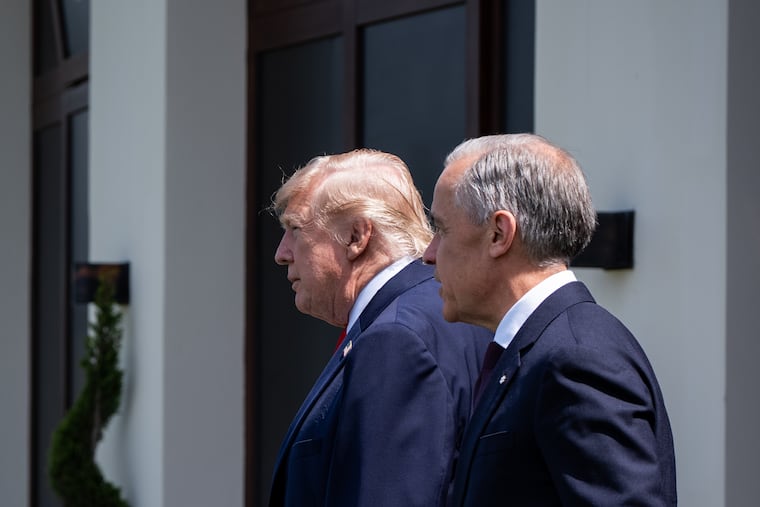
Trump is deeply unpopular
Parties have occasionally defied the historical trend and won seats in the midterms on the strength of popular presidents.
But this year, Trump is widely expected to hurt Republicans’ chances. His approval rating, dampened by voter disenchantment with the war in Iran and stubbornly high inflation, has recently sunk to the lowest level of his second term. The New York Times polling average currently shows that 58% of Americans disapprove of the president’s job performance, while only 38% approve.
Voters are dissatisfied with his handling of immigration and the war with Iran. Trump is also losing ground with white working-class voters on the economy. And he is deeply unpopular with voters of color without college degrees.
House races in particular tend to follow the national mood closely, and analysts see Democrats as favorites to win the House.
The Iran war has driven up prices, and voters are focused on inflation
Polls consistently show that the economy and inflation are the top issues for voters. And voters say they are unhappy with the economy under Trump.
His war with Iran, now in its seventh month, has driven up the price of oil, fertilizer, healthcare and other goods and services, as well as mortgage rates. Gas costs more than $4 a gallon, and the AAA motor club reported that drivers over Labor Day weekend were facing “the highest gas prices ever for this time of year.”
By July, consumer prices were up 3.7% from a year earlier, according to the Federal Reserve’s preferred inflation gauge, far above the Fed’s target rate of 2%. The cost of diesel, which powers the farming economies of key midterm battlegrounds, hit a record high Friday.
Senate Minority Leader Chuck Schumer, D-N.Y., said his party’s candidates were competing in challenging territory by keeping their campaigns focused squarely on costs.
“Americans see what’s happened,” Schumer said in an interview. “They’re paying more, and getting less.”
Democratic candidates are outraising their rivals
In five of the six most closely watched Senate contests, Democrats had outraised Republicans through the first half of the year, according to campaign finance filings. In some races, such as those in Texas, Ohio and Alaska, the gap was vast.
Democrats’ fundraising advantage in two other states, North Carolina and Georgia, has helped to transform races once seen as toss-ups. Analysts with the Cook Political Report, a nonpartisan election forecaster, now say both races lean toward Democrats.
The large hauls suggest enthusiasm for individual Democratic candidates. But Republican groups still have a huge money advantage over Democratic ones.
Several Democrats have shown strength in states Trump carried
Two popular, moderate Democratic Senate candidates in the South, Sen. Jon Ossoff of Georgia and former Gov. Roy Cooper of North Carolina, appear to have maneuvered into particularly strong positions. Both have vast fundraising advantages and clear polling leads.
Democrats are also bullish about the chances of former Rep. Mary Peltola, a Democrat, to flip a Senate seat in Alaska. She is running on “fish, family and freedom.” Her Republican opponent, Sen. Dan Sullivan, must contend with two other Republicans on the ballot, including one with the same name.
Peltola, the lone Democrat on the ballot, led Sullivan by more than eight percentage points in a nonpartisan primary in August.
Democratic primaries have set turnout records
One clear reflection of Democratic energy going into the fall: the huge turnout the party has recorded in primary after primary. Some primaries, including ones in Michigan and Texas, set midterm records for the party.
Strong turnout in primaries is not necessarily predictive of a strong performance in the general election. But Republicans acknowledge that there has been a significant enthusiasm gap between the two parties this primary season and describe it as one of their starkest challenges heading into the fall.
Six factors working in Republicans’ favor:
Republicans won the gerrymandering war
In a burst of rare mid-decade redistricting, Republicans were able to give themselves a structural advantage in House races by redrawing maps to carve out more safe red seats.
Congressional maps are typically drawn just once a decade to reflect population shifts after the census. But after Trump urged lawmakers in Texas to draw new maps favoring Republicans, Democrats and Republicans across the country engaged in an intense, cross-country redistricting tug of war to try to shift the House map in their favor.
Aided by favorable rulings in state and federal courts, Republicans emerged with a national map that tilts in their favor and could help them counter a difficult political environment. Seven Republican-led states had redrawn their maps while only two Democratic-led states did so.
The new maps could position the Republican Party to net roughly five to 10 additional House seats. Still, despite that edge, the House battle is still seen as tilting toward Democrats because of the political climate.
The GOP is sitting on a mountain of cash
The main Republican groups have a large overall financial advantage — totaling hundreds of millions of dollars — over the main Democratic ones, and the Democratic National Committee is in debt.
Republican advertising spending has eclipsed Democrats’ ad spending in all the top six Senate races except for the contest in Texas, according to the ad-tracking firm AdImpact.
Trump’s super political action committee, MAGA Inc., which has raised hundreds of millions of dollars and had long resisted tapping its war chest to help the party in the midterms, recently made its first general-election investment, a $10 million ad buy in Texas.
Still, it is not yet clear how much the group will spend overall and which races it will target. Trump said Friday that he planned to spend “probably” $400 million to $500 million on the midterms, but that he also expected “to have money left over.”
The Democratic brand is weak
Trump may be deeply unpopular. Yet Democrats might eagerly trade their approval ratings for his.
One Quinnipiac poll in July pegged Trump’s approval rating at 32%, worse than usual for him. But it measured congressional Democrats’ approval rating even lower — at 23%.
Still, the same poll suggested that voters were eager for Democrats to win back Congress. It also indicated that Democratic voters were far more motivated than Republican voters to go to the polls. But Republicans have seized on a series of recent Democratic primary victories by left-wing candidates and democratic socialists to try to paint the party as out of step with many voters.
The Senate map tilts to Republicans’ advantage
Republicans hold 53 Senate seats. For Democrats to win back the chamber, they need to flip seats in four states while defending their own most vulnerable ones. Five of the six most competitive Senate races are in states Trump won in 2024. Four are in states he carried by double digits.
And even among three other relatively competitive Senate battlegrounds where Democrats are seen as having an advantage — Georgia, New Hampshire and North Carolina — two are states that Trump captured two years ago.
Democratic divisions could complicate their paths in two key states
In Maine, where Sen. Susan Collins has been seen as one of the most vulnerable Republican incumbents, the Democrats’ initial nominee, Graham Platner, was accused of rape in early July. Platner denied the allegation but eventually dropped out of the race, requiring his party to scramble to find a new nominee outside the usual primary process.
The candidate that the Maine Democratic Party settled on, Troy Jackson, had finished third this year in Maine’s primary for governor. Some Maine Democrats were dissatisfied by the rushed convention process and many are anxious about Jackson’s chances in a short campaign he had not planned for.
In Michigan, where Democrats hope to keep a seat that is being vacated by a retiring senator, Democrats are still trying to heal the wounds after a tense, expensive primary race that centered on disagreements about Israel. Some Jewish Democrats in Michigan have declined to immediately support the candidate who won the nomination, Abdul El-Sayed, a progressive who has been a forceful critic of the Israeli government.
The stock market is strong, and crime is down
Wall Street has been on a remarkable, three-year run of gains. There have been some signs that inflation is cooling, too. And the Labor Department reported that hiring was unexpectedly strong in August, with the unemployment rate steady at 4.1%.
Republicans can also point to positive trends on crime, an issue that has often swayed elections over the years. Today, violent crime rates are extremely low by historical standards.
“Republicans have a real chance at defying history in November because of our candidates, massive war chest, and enthusiasm behind President Trump’s agenda,” Joe Gruters, chair of the Republican National Committee, said in a statement.
Still, voters say that the economy is their No. 1 issue — and polls suggest that they don’t approve of how Trump is handling it.
This article originally appeared in The New York Times.