Missouri voters, officials anxiously await resolution of electoral chaos
Clashing rulings by Justice Kavanaugh and a federal judge have left the fate of the state’s new GOP-friendly map in limbo.
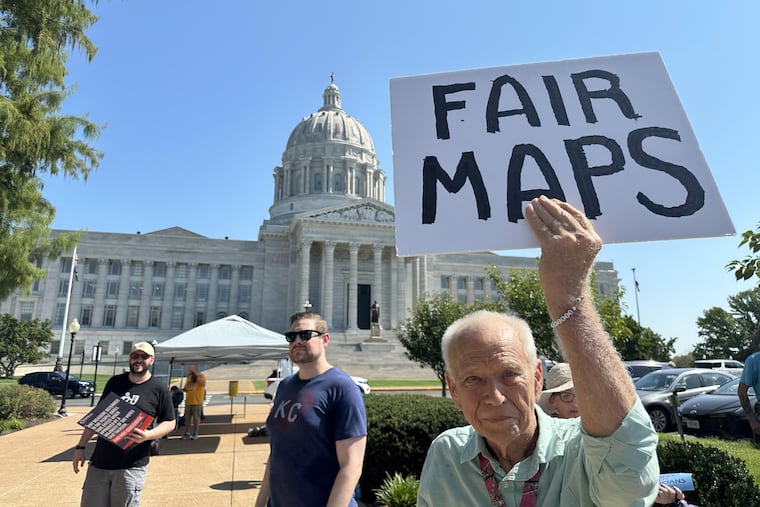
The Missouri Supreme Court threatened to hold the state’s top election official in contempt late Tuesday, the latest twist in an extraordinary legal fight that has plunged the state’s congressional races into chaos.
The state’s high court ordered Republican Secretary of State Denny Hoskins to explain why he approved a new congressional map favoring the GOP for November’s midterm elections despite court orders blocking it.
The legal uncertainty has left voters and election administrators unsure about what map will be in use, as the state passed a deadline to finalize its ballots and is scheduled to send out mail-in versions in days.
Roy Temple, a longtime Democratic strategist in Missouri and former head of the state Democratic Party, said voters “can’t possibly understand who they’re going to be voting for.”
“There is a great deal of chaos,” Temple said. “The sad part is that it’s almost entirely inflicted by people whose responsibility was to ensure the orderly conduct of elections.”
The move to hold Hoskins in contempt capped a furious night of legal developments Tuesday, as U.S. Supreme Court Justice Brett M. Kavanaugh and a federal judge in Missouri issued conflicting rulings less than a half-hour apart about whether the state could use the new map.
Republicans currently hold six of Missouri’s eight congressional seats, and the new map, adopted by the GOP-controlled state legislature, is designed to give the party a good shot at picking up an additional seat.
Kavanaugh denied an appeal by Hoskins to overturn a Missouri Supreme Court ruling last week blocking the new map, without giving his reasoning. The state high court had ordered Missouri to use a 2022 map that gives Democrats a better chance of keeping two seats.
But soon after Kavanaugh denied the appeal, a federal judge, Stephen Clark, a Trump appointee in the in St. Louis area, ordered Hoskins in a separate case to use the new, more GOP-friendly electoral map.
Hoskins and the state’s Republican leadership quickly announced that they would abide by that ruling, but an anti-gerrymandering group challenging the new map appealed Clark’s decision to the U.S. Court of Appeals for the 8th Circuit. It has yet to rule on Clark’s temporary restraining order, or TRO.
“If the TRO remains in effect, elections officials will effectively be in contempt of either the Missouri Supreme Court or the federal district court if they implement either HB 1 or the 2022 map, leaving ballots and voters in flux,” attorneys for People not Politicians wrote in the group’s filing.
HB1 refers to the law that created the new map. It was adopted by the legislature last year at the behest of President Donald Trump, who has urged GOP-controlled states to draw maps more favorable to Republicans to help the party retain control of Congress.
The result has been a nationwide redistricting war in which at least 20 states have redrawn — or are in the process of redrawing — legislative maps to favor one party or the other.
People Not Politicians collected more than 300,000 signatures to force a statewide referendum on the new Missouri map in November’s election.
Hoskins rejected the petitions, saying the state constitution did not permit referendums on congressional redistricting. People Not Politicians sued.
A federal judge upheld Hoskins’s move, and the state held its August primaries for November’s contests using the GOP-friendly map. Afterward, the state Supreme Court issued its ruling blocking the use of the new map.
Missouri Attorney General Catherine Hanaway, a Republican, said in a statement that this would leave state officials in an impossible position: holding a general election using different maps than were used in the primaries.
“We maintain that changing the congressional map in between the primary and general elections is simply not feasible and profoundly unjust to Missouri voters,” Hanaway said.
State Sen. Rick Brattin, the GOP nominee in the district redrawn to favor Republicans, said in a social media post that he was disappointed in the U.S. Supreme Court ruling. He is taking on Democratic Rep. Emanuel Cleaver.
Brattin praised the temporary restraining order from the lower court that preserves the maps used in the primaries, saying it would ensure that “voters will not be disenfranchised by being forced to vote in a different district for November.”
“The stakes are high for our nation in the upcoming election,” Brattin posted on X, “and I look forward to continuing to campaign across the 5th District, where I know many voters feel like it’s time to send eleven-term incumbent Emanuel Cleaver home.”
Former U.S. senator Claire McCaskill, a Democrat, called Hoskins “lawless” and said he had intentionally waited to act until “he thought it was too late for anybody to do anything about it.”
The Missouri Supreme Court has set a Thursday hearing on whether to hold Hoskins in contempt.
It was extraordinary that the conservative state Supreme Court ruled against him, McCaskill said, noting that five of its seven members were appointed by Republicans.
“So it was really a very strong signal that they had gone too far, but according to the new Republican Party, the law is a mere nuisance that can be avoided if there is political gain to be made,” McCaskill said.
Boone County court clerk Brianna L. Lennon said that she has been left “in a holding pattern” while the various courts and officials decide the shape of this fall’s elections.
“I am hoping that they move quickly,” Lennon said, adding that her county and its 125,000 voters are “heavily impacted by which map we’re going to use.”
About 40% of Boone County voters are directly affected, she said, both because the congressional district numbers change depending on which map is in effect and because the boundary shifts across the entire county.
Because the situation has been fluid for much of the year, Boone County has preset its election systems with both maps, Lennon said. That process involves manually linking each street address to a particular precinct based on each of the competing maps, she said, so that every voter has double precinct assignments until the situation is resolved.
“So the question is not, ‘Oh my gosh, what do we do?’ It’s just, ‘Tell us which map to use,’” she said.
But the clock is ticking. Missouri uses paper ballots, and court clerks have been in regular contact with printing vendors to ensure there’s time to get them prepared. Ballots have to go to military and overseas voters by Sept. 18, Lennon said, and early absentee voting begins Sept. 22.
In Boone County, the practice is to test voting equipment three to four weeks before Election Day, which means officials will need paper ballots by then. Election Day — Nov. 3 — is now seven weeks away.
“So it will be a crunch, I think, to get the ballots printed,” Lennon said. “But it’s still doable at this time.”