Union president Tim McDermott discusses signing ‘bigger name players,’ a Philly stadium, and much more after a World Cup reset
McDermott, the club’s president since 2019, sat down with The Inquirer for a wide-ranging discussion about players, fans, and how their place within Philly's sports landscape could change, literally.
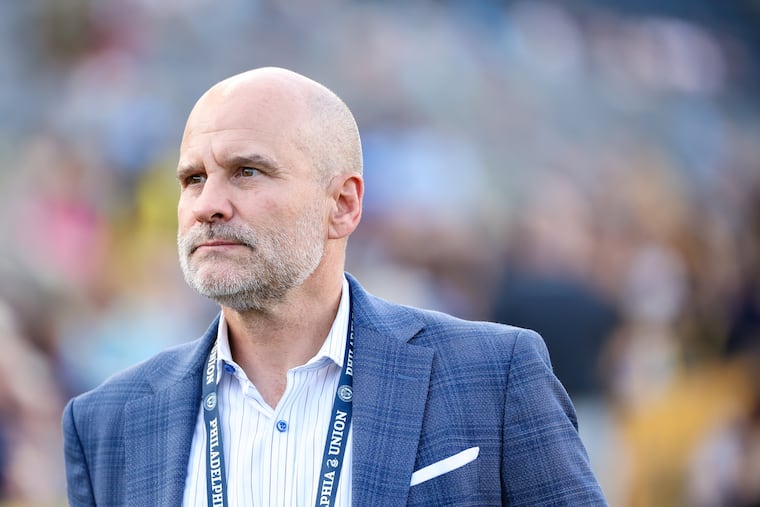
Union president Tim McDermott wants to clear a few things up.
McDermott, 51, who has hit multiple stops along the Philly professional sports highway as a former executive with both the Eagles and Sixers, is in his 11th year with the Union.
He’s been able to do a lot with what some might view as a little by resource standards when it comes to the first team — though he readily contends the money is there from ownership “should the right situation present itself.”
In all of that, McDermott can lay claim to the club being one of Major League Soccer’s success stories, winning a pair of Supporters’ Shield titles, nearly capturing an MLS Cup crown in 2022, in what’s still regarded as one of the best finals in the league’s history, and playoff appearances in eight of the 11 seasons he’s been in charge.
But in a town like Philadelphia, he’s well aware that success, when it comes to sports teams, is a year-over-year proposition. From an optics standpoint, after finishing off another successful season last year, winning their second Supporters’ Shield under a first-year head coach, depending on who you ask, the team has temporarily fallen off the precipice of relevancy — at the worst possible time.
» READ MORE: With the World Cup’s afterglow still on him, Danley Jean Jacques resumes his key role for the Union
With the eyes of the world on soccer courtesy of this summer’s FIFA World Cup, this was supposed to be the Union’s moment, showcasing itself as a powerhouse club in America’s domestic league situated in a city fortunate enough to be one of 16 that hosted FIFA’s grand event.
Instead, the Union limped into MLS’ World Cup break with issues both on and off the field, winning just one game and mired in the drama of its head coach losing a locker room and its sporting director undergoing league-mandated sensitivity training after allegations of misconduct were substantiated.
It forced a reset of almost everything. Ownership let both the coach and sporting director go, ushering in a fresh start in the player personnel department for a team that desperately needed it.
That lack of success has also ushered in reflection, as McDermott explained during a recent interview with The Inquirer. A reset that forced everyone from ownership on down to take a look at the club, not just in its current state, but visualize what the future looks like with the sport getting fresh eyes, courtesy of the World Cup.
It’s a wide-ranging analysis, and it comes in two tiers. On one hand, you have devout ticket-paying supporters of the club, who contend that the Union doesn’t spend enough, that they rely on youth over experienced, world-renowned talent to win games.
Some say that among a hodgepodge of players, where is the one that you can build a team around? They’ll point to teams like defending champions Inter Miami, whose budget and star power dwarfs that of the Union.
Or Los Angeles FC, or Orlando City, or Vancouver, or…
McDermott will stop you right there. While he admits that those teams have readily found success with bringing in European stars to build a roster around, their model is very different. McDermott told The Inquirer that an annual investment of $10 million is spent on developing within the Union’s academy system, fostering the growth in everything from its school, YSC Academy, to coaching staffs, to maintaining the sprawling WSFS SportsPlex, basecamp for the Union’s youth movement.
“If you look at the entirety of how we do things, it does rely heavily on youth development,” said McDermott. “We’ve been very good at that, and we’ve been recognized as being the best at that.
“If you look at our [first team] payroll, we’re toward the bottom, and that’s what I think people get upset about, and it’s a fair statement. But what I would say is there’s lots of ways to bring players in, right? You can go free agency, you can go to transfers, you can transfer in the market, or you can bring people in from the league, outside the league, etc. There’s lots of different ways to do it. And we’ve chosen many of those methods, but we’ve [also] chosen heavily in youth development.”
» READ MORE: Ryan Richter’s journey to Union interim head coach follows a familiar path for the club
But that’s the other issue. Retention of those young players. Over the last few years, the Union has brokered many of those it groomed within its system for substantial transfer fees to and from other clubs.
Perhaps its biggest young star at the moment, midfielder Cavan Sullivan, is set to move to Manchester City upon turning 18, and U.S. men’s national team standouts like Brendan Aaronson, Mark McKenzie, and Matt Freese were all shipped elsewhere. All of this has prompted the Union to be labeled as a “selling club” by many who say that comes first and that the franchise and ownership are content with just getting into the postseason but not doing anything more to lift a trophy.
“I totally agree. I don’t think they’re wrong; I don’t think they’re wrong at all, but I think that’s more of a big picture problem that’s out of our immediate control,” McDermott said. “I want this not just for the Philadelphia Union, but for the MLS to grow. There needs to be a point in time where the players that are coming through our youth academies are starting to say, ‘No, I don’t want to leave. I want to do it here in my hometown.
“I think it has to also be on the players themselves [who] are not always looking overseas. We’re developing players, and we’re transacting in MLS, but keeping them in the lab right here is what’s going to elevate MLS to a higher profile.”
‘Our goal is to win’
As McDermott tells it, new sporting director Jon Scheer has been “working the phones heavily.” He says the club knows it needs to bring in new players, and added that there’s a board with “bigger name players” that they’re “actively working” to bring in. However, he contends it has to be a player that fits the club’s current methodology, a high-pressing team that will attack opponents from the outside, and frustrate defenders with dizzying diagonal runs wherever space allows.
The World Cup has offered a great look into some potential names, but at the time of this report, it seemed like it was only a discussion.
» READ MORE: What’s the secret sauce at the Union’s youth academy? Here’s a taste of it.
“I’ll just tell you right now, we’ve fielded calls for potential players over the last two weeks,” said McDermott. “We have a weekly call with ownership, myself, and Jon Scheer, and these names come up. But the question is always what does that do for our team?
“On the other side, we field calls about our own players and we may or may not transact on a player because we want to make sure that our focus is winning, right? What’s the point of the transaction if it’s going to make us less competitive? Maybe now’s not the time to do it. But you’re always balancing that.
“If somebody makes you an offer, you don’t know if that offer will be there a year from now, right? So you’re always trying to balance that. Our focus is we must win. The goal is not just to develop players to sell them. Our goal is to win.”
A place in Philly
McDermott inherited a hurdle when he joined the Union in 2016. How do you maintain relevancy as Philadelphia’s Major League Soccer representative from 18 miles away in Chester?
He knows that while the team’s marketing efforts aim to keep a grip on the collective consciousness of a city, as it’s stood since its inception, the Union’s success of filling up a stadium each game day heavily relies on people getting in their vehicles and navigating the I-95 corridor. But there begs a question. How many more fans could the club have with a stadium or a facility in Philly proper, situated somewhere fans can access the team by SEPTA, their bike, or even walk?
When asked the question, McDermott noted that the Union isn’t unique in being the only MLS franchise with a stadium outside city limits, and he’s right. Several clubs represent cities with stadiums outside their city limits, but many have begun to realize that there’s a real need to inhabit the city that emblazons your crest.
» READ MORE: The Union’s new sportsplex was Tim McDermott’s dream. Reality could look a few different ways. | From 2025
One of the more recent examples is the Chicago Fire, which last year announced plans for a $750 million, 22,000-seat stadium to be constructed downtown, financed entirely by team ownership.
It’s the type of move that inherently brings interest, and aligns the team more with being a part of the city. McDermott recognizes that too, and didn’t disagree that there is a connection lost by way of the Union’s footprint in Chester. However, in the same breath, he acknowledges just how good Chester has been for the growth of the club.
But, according to McDermott, that doesn’t mean that the Union isn’t “actively studying” how to replicate what Chicago did.
“We have a great relationship with Delaware County and with Chester; that’s been phenomenal, and they’re incredible supporters of ours,” McDermott said. “But I would say at a more macro level, if you look at all of the teams that have come into the MLS in the last decade, where are they located? A lot of them, not all, but a lot of them are in a downtown location. That fact is not lost on us. I think it’s fair to say we’re proactively studying is that something we need to look at in the future? And is our future in an environment that looks like that?”
As it stands, the Union sits on infrastructure, to the tune of over $300 million, when you consider the cost to build the stadium in 2010 for a reported $122 million, the newly designed WSFS SportsPlex, which came in at a $100 million price tag just last year, in addition to its annex for the first team, offices, and school in the adjacent Wharf Building.
“We are very comfortable where we are right now,” McDermott said. “It’s been a fantastic relationship. I think we’ve done a lot in terms of the development that we’ve done in Chester. But thinking about what a move downtown or some other place [within the city] would look like, I think it’s fair to say we have to be aware of it, studying it and being thoughtful to see if our future would be brighter if we were in a situation like that. So, I can say that yes, we’re actively studying that process and what that would look like.”
‘Still have our homework to do’
Perhaps the portion of the sitdown with McDermott where his eyes lit up was the notion that growth and expansion of the club comes from getting people out to matches. It’s a fair point, considering the Union’s gameday experience has been repeatedly lauded as one of the best in MLS, winning a J.D. Power Award for best fan experience just a year after McDermott joined the club in 2017.
Amanda Young Curtis, the club’s vice president of communications, told the Inquirer that fans who attend just three matches are significantly more likely to lock in as season ticket holders.
She said that it comes down to a few facets beyond just increasing brand awareness, but it’s everything from capturing new fan data to wooing potential first-time attendees with discounted tickets to, and perhaps most importantly, “converting attendees into repeat visitors.”
McDermott agreed, and added:
“We need to make sure that not only do they come and have a good time, but we’re actively always thinking about how do we get them back two more times. The likelihood of locking them in jumps pretty significantly. It’s why we’ve initiated this whole concept around trial and retention, and I believe that the momentum from the World Cup offers a major strategic opportunity for us to do that.”
But an area where McDermott says the Union still has their work cut out for them is cultivating stronger partnerships with youth clubs from an awareness standpoint so young players and their parents gravitate to the Union as supporters.
And for the youth coaches clutching pearls thinking that the Union is trying to woo a player away from their club, McDermott says it’s not about that. In fact, this notion transcends recruiting. Kind of…
» READ MORE: This summer created World Cup fans, but that's not the same as soccer fans. MLS must bridge the gap.
“I think there’s two parts,” McDermott said. “There is the fan development part, and there’s the kind of talent identification part, and they somewhat link together. I’ll go back again to when my kids were 6, 7, 8 years old, and I was on the sideline of my daughter’s games. I looked down the sideline, and I saw all these parents wearing Eagles green.
“I know we’ll be successful when I look down the sideline at a kid’s game and they are wearing blue and gold. I had many different instances like that where I felt like parents and the kids that were in the youth soccer ecosystem weren’t necessarily matriculating to being a Philadelphia Union fan, and we still have our homework to do to change that.”
McDermott knows the Union has work to do across the board from a grassroots perspective on up. In the immediate, righting the ship in an forgiving league like MLS is the goal, and the club is off to a strong start coming out of the World Cup break, winning two consecutive matches for the first time this season following wins against Red Bull New York and an impressive Saturday win over Seattle, two teams that if the season ended today would be playoff-bound.
It’s a great start in the eyes of a guy like McDermott, who contends his approach has always been to win. And listening to him speak now, it appears that talks are happening between ownership and team leadership about doing so — at all costs.
“As president, my job is solely focused on how can we win, across the board,” McDermott said. “I want to win; everyone in this organization wants that, but the culture is always and has to be first and foremost. You gotta have guys that want to play for each other, that believe in the system, that care for each other, that love one another and that are good quality character people.
“I think on the whole, we’ve really been doing a great job with that over the years. I’m not just talking about where we’re at today, but I’m talking about the last six, seven, eight years; we’ve been building towards having success, and we’ve had success. We’ve won a lot over the last five, six years, so our design works. I think [this reset] provides a real look at what we need to do to get back to that, and in the conversations we’re collectively having daily, I have no doubt that we’ll get there. None.”
» READ MORE: Follow The Inquirer's complete coverage of the Union here!
Purchase the front page reprint of The Philadelphia Inquirer from Saturday, July 25, 2026, featuring LeBron James following the news that he was joining the 76ers.