Audubon has opened its new history museum. Here’s what you’ll find there, from a New Century Theater seat to ‘Mudubon’ photos.
Audubon Historical Society members are inviting residents to discover their borough's 121-year history on the second Saturday of every month.
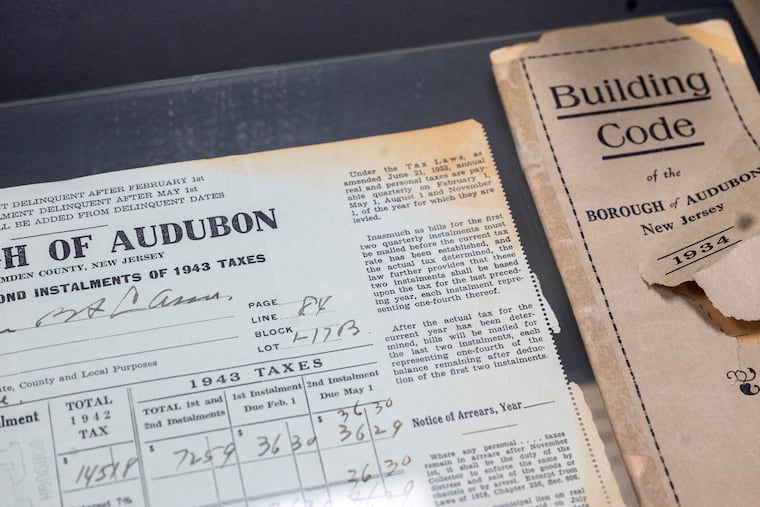
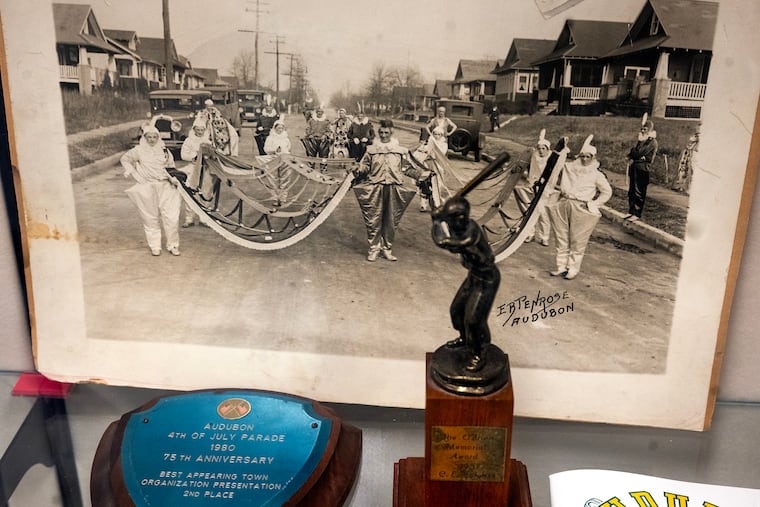
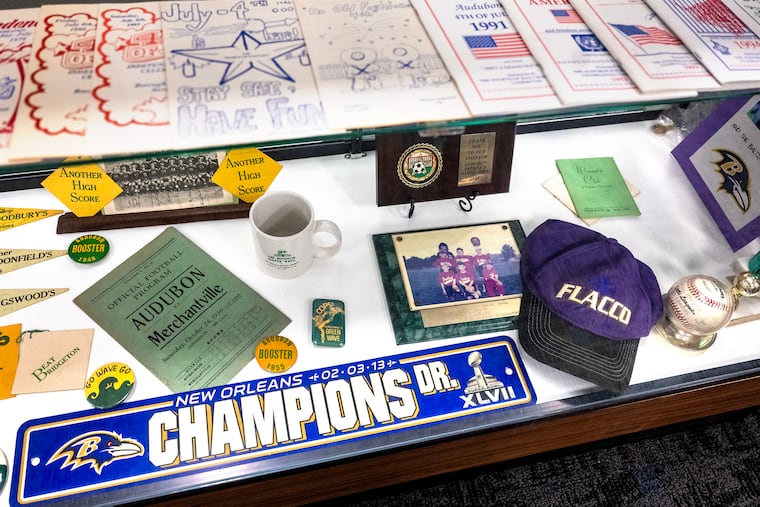
More than a century’s worth of varsity jackets, trophies, civic documents, photos, and more memorabilia from Audubon Borough have made their way into Camden County’s newest museum.
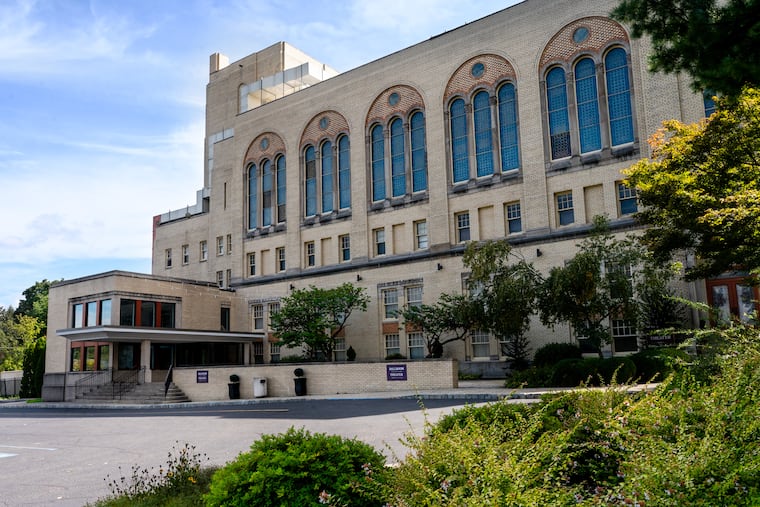
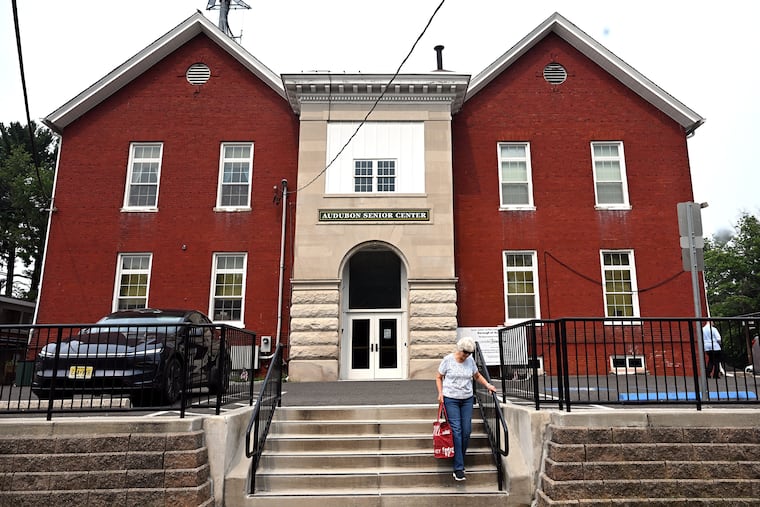
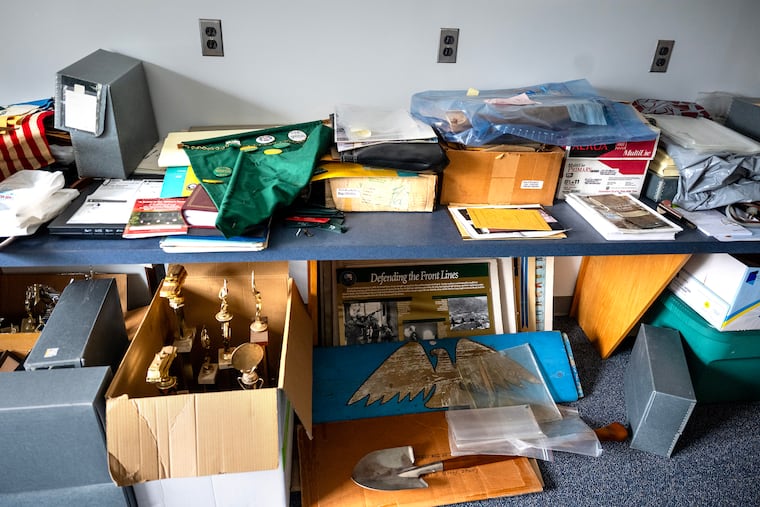
The Audubon Historical Society Museum takes up much of Audubon Senior Center’s second floor, a red brick building that once served as Audubon School No. 1. The collection includes donated items from Audubon residents, including from the historical society’s own members, found in basements.
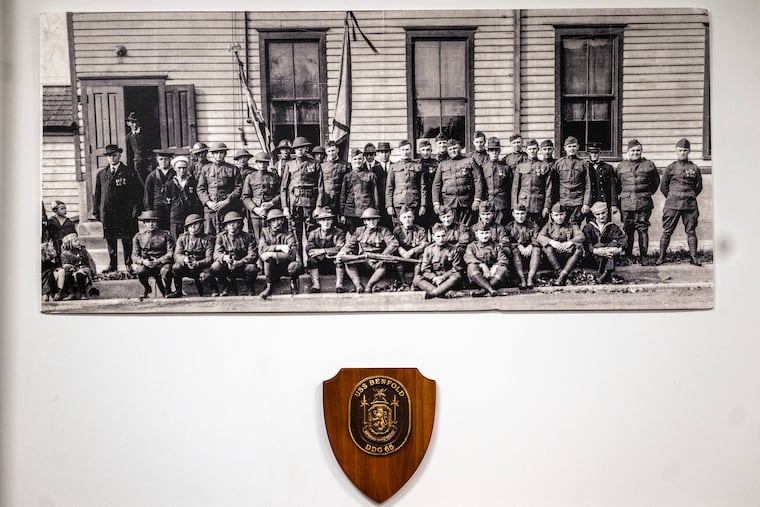
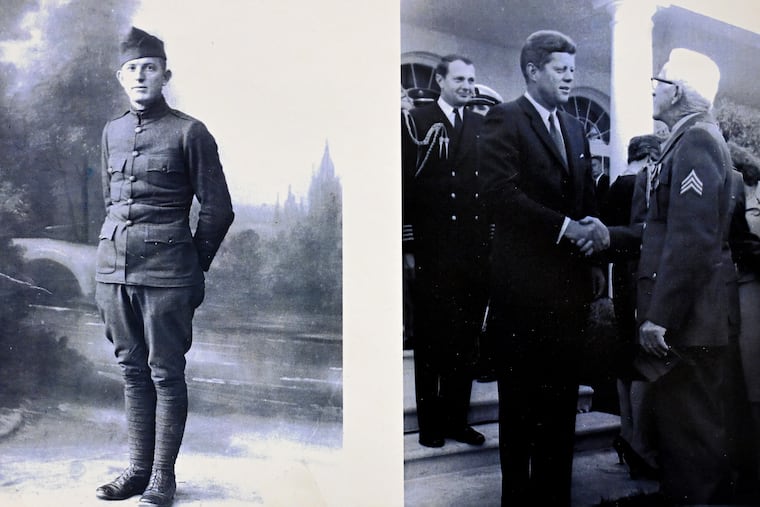
Even though there are still more artifacts to put on display, from a 45-star American flag to thousands of pictures, Audubon’s rich history is already well represented. There’s memorabilia repping Joe Flacco, an NFL player and Audubon High School grad; an Audubon-themed Monopoly board created for a fundraiser; outdated land use maps; and an old police radio. A large section of the museum covers Audubon’s military history, including information about the borough’s three medal of honor recipients and two naval vessels named in their memory.
The museum hosted its first public open house on July 4, and about 60 people came despite the heat, said Rob Jakubowski, Audubon’s mayor. Starting Aug. 8, the historical society will open the museum from 2 to 4 p.m. on the second Saturday of every month.
Jakubowski worked to develop the museum with a small group of Audubon Historical Society members, kept on task by corresponding secretary and longtime Audubon resident Nancy Whalen, 80. The museum, the brainchild of the late Walter Casebeer, a founding member of the society, came together 18 years after his death. Members sorted through four full closets of donated relics to establish the museum’s initial displays.
“We were able to set up what is a really beautiful museum with a lot more work to do,” Jakubowski said.
Though the senior center isn’t a schoolhouse anymore, the museum, funded by $40,000 in Camden County grants, was clearly once two classrooms, divided through the middle by chalkboard panels that pull out from the wall. The seniors running the museum hope to rotate the items on display as time passes, but for now, the group is proud to show off their hard work.
Here are a few of the standouts.
New Century Theater
New Century Theater, founded in 1921, is no longer standing. The theater, renamed the Coronet in the ‘60s, was demolished in 2003. The space is currently being developed by a car wash company.
But the historical society managed to acquire many keepsakes to remember the theater’s past. They have a seat someone rescued before the building got knocked down, a part of the wall, bricks, faint blueprints, and a movie reel Jakubowski said he found on eBay. A 1931 vaudeville contract is propped against the seat.
Craig E. Burgess, 81, remembers when he could see a movie, a newsreel, a serial, and get candy, all for 10 cents at New Century Theater. When he found out the Audubon staple was going to be torn down, Burgess, who lived in the same house in Audubon for 73 years before moving to Collingswood, didn’t let the theater die without a last trip.
“I stood in front of the door and said, ‘You don’t get in here until I get in to get some photos and get some video. If you won’t do that for me, then I will stay here, and you’ll have to push me over into the rubble,’” Burgess said. “And they believed me. I got in.”
‘Mudubon’
Audubon, a part of Haddon Township until residents voted to become a borough, was incorporated in 1905. That was a couple of decades before paved roads boomed in the U.S., which made for a lot of wet dirt streets in the early 20th century in Camden County. Some photos at the new museum show those mucky roadways.
Thus, the nickname Mudubon. It came from the mouths of delivery drivers trekking Audubon after bad weather, Jakubowski said.
Enjoyed this story?
Get more South Jersey news on your homepage with one click.
Burgess said ice trucks and milk trucks, along with the horses pulling them, used to get bogged down in the mud when it rained. He likes to tell a story about a boy who spent the summer away with his grandparents in the early 20th century, and returned home to paved roads — and confusion.
“Mom took him out to visit his grandparents, came back on the bus to get off at Merchant Street. And he refused to get off the bus,” Burgess said. “He said, ‘This is not Audubon. I know my hometown.’”
Nancy Ryan, 79, moved back to her native Audubon nine years ago to retire. She recalls stories from her father about the pavers coming in when he was 4 years old, watching the steam shovels digging up Cedar Croft in 1917 or 1918.
Now, Ryan said, the only people who call the borough Mudubon are non-natives who like to make fun, like her husband. But Audubon residents know the borough has grown far beyond its muddy origins, Burgess said.
“We’ve come a long way in the last 110 years, more or less,” Burgess said.
100 years at Audubon High School
Nearly a century ago, about 500 students took the first classes offered at Audubon High School on Edgewood Avenue in September 1926.
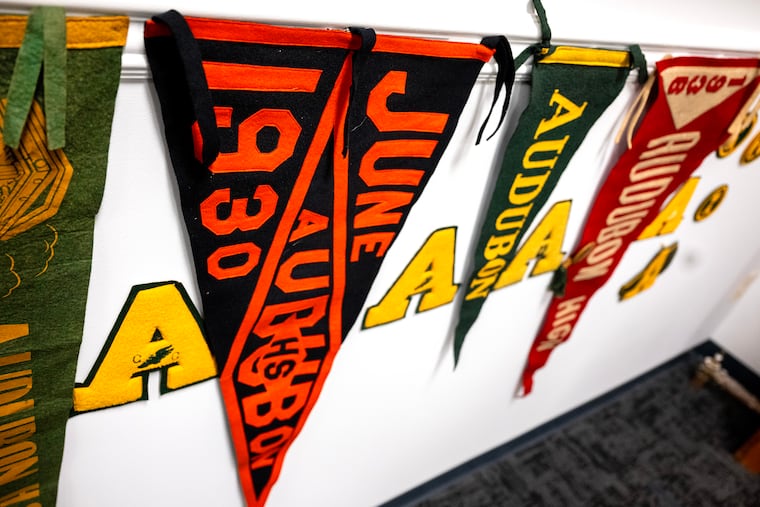
Today, items spanning the high school’s history are on display: a booklet teaching children the 20th-century Palmer Method to learn cursive, pennants, a rack of letterman jackets, school handbooks, admission cards, and a cream varsity cardigan from 1966. A candlestick telephone used by the school’s first principal, Grace Kramer, sits at the bottom of a display case.
Three replica oil paintings recreated by the late Michael J. Miceli, a Mount Ephraim local, hang on the walls, too. They picture military drummers, fictionalized American Revolutionary War heroine Molly Pitcher, and French American artist and ornithologist John J. Audubon, the borough’s namesake. Their previous home was the Audubon High School auditorium, but when they were removed during recent renovations, a history teacher saved them, Jakubowski said.
Plus, every high school yearbook available since the school’s founding line a bookshelf in a back room, in case anyone comes looking to do archival research.
The group is still open to taking donated artifacts, though with their large existing collection, they’re not afraid to decline duplicates. In the meantime, the historical society will continue sorting their archives. It’s a lot of work, all volunteer.
“But that’s what makes it fun,” Burgess said.