A look inside Camden County’s $25 million investment to end homelessness by 2030
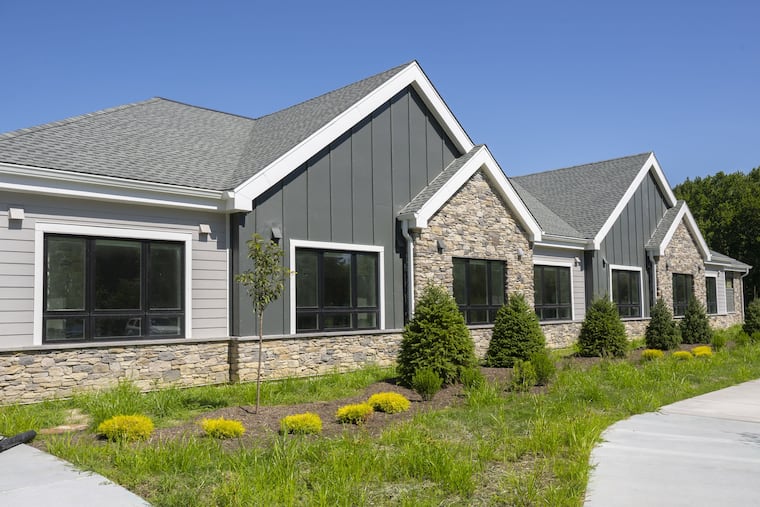
Built on a former off-road racing track at 15 County House Rd. in Camden County, the new Martin McKernan Supportive Housing Center has 60 transitional housing units.
On a quiet, wooded road in Blackwood, a long-awaited respite for homeless people is opening its doors Friday, a $25 million investment in the county’s efforts to eradicate homelessness by the end of the decade.
Built on a former off-road racing track at 15 County House Rd. in Camden County, the new Martin McKernan Supportive Housing Center has 60 transitional housing units and a bright and airy community room with tall ceilings and natural light pouring in.
The project is a core feature of the county’s plan to reach “functional zero” homelessness by 2030 — achieved when the number of homeless people is not greater than the monthly housing placement rate.
The deadline is not a state mandate, but instead, it’s a goal the county set for itself, driven by the desire to help amid the pullback of federal funding for social safety net programs, according to Camden County Commissioner Director Louis Cappelli Jr.
“It’s all about compassion,” Cappelli said. “Our mission has always been to help those most in need, and I think this is a huge leap forward towards meeting that objective.”
The 45,000-square-foot building includes ADA-accessible units alongside communal laundry, computer and mail rooms, a gym, and lounges for residents. Each room comes equipped with a small kitchen and bathroom and was constructed with trauma-informed design in mind, county officials said, with large windows and ligature-resistant furniture.
Staffed 24/7 by the Volunteers of America Delaware Valley, the shelter will also include temporary offices for traveling service providers, county officials said, connecting residents with workforce development, physical and mental healthcare, substance use recovery resources, and more, in partnership with Cooper Norcross University Hospital and Jefferson University Hospital.
“There’s not a service, really, that we’re not providing that these folks need,” Cappelli said.
The shelter, its programs, and services were designed utilizing insights the county gleaned from what has worked well at the Regan Center, a 23-bed emergency shelter also in Gloucester Township, Cappelli said.
Since opening in 2021, 80% of the nearly 300 people who have turned to the Regan Center for assistance have gone on to secure permanent housing, he said.
“That’s a pretty extraordinary success rate and we’re very confident we could duplicate that here,” Cappelli said.
Unlike many state-funded shelters, the McKernan Center will not have a hard-and-fast deadline for when residents need to leave their transitional unit, said Rob Jakubowski, director of the Camden County Division of Community Development.
Instead, the length of stay will be determined by social workers and healthcare professionals on a case-by-case basis, he said, prioritizing the needs of the individual as opposed to an “arbitrary deadline.”
Jakubowski said residents will need to fulfill some requirements during their stay — mainly just taking an active role in their own wellness.
“You always have to be working towards your next step. You’re not just coming for a free sandwich, you have to be meeting with your case manager,” he said. “And for everyone it’s different but the ultimate goal is housing. Today it’s your ID, tomorrow it’s your social security card, but you always have to be meeting and participating in your own help.”
The McKernan Center also does not require a traditional referral.
“If you walked into a shelter right now they’d say ‘who’s your referral?’ meaning who’s paying for it,” Jakubowski said. “That’s not an obstacle anymore when it comes to the Camden County Commissioners.”
The majority of the $25 million construction was paid for by the county’s remaining federal COVID relief funding that was set to expire at the end of the year, Cappelli said, with county bonds used to cover the rest of the construction budget.
Cappelli said the county is prepared to shoulder most, if not all, of the financial burden for operation — estimated to cost over $2 million per year.
They’ll apply for grants to help offset costs, Cappelli said, “but we’re not real optimistic.”
“We’re presuming we’re going to pay for all of these operations and that’s the way it’s going to be,” he said. “But it’s an investment in people who need the investment.”
In Camden County, like elsewhere in the state and country, homelessness rates have been increasing since the pandemic, Cappelli said.
During the point-in-time count in January 2025, 759 people in Camden County were experiencing homelessness — 140 of whom were determined to be chronically homeless. In comparison, Burlington County counted 1,550 homeless residents on the same night while Gloucester County recorded just 162.
The yearly count is a federally-mandated effort used to provide a snapshot of sheltered and unsheltered people experiencing homelessness across the nation on a single night.
“There’s been significant cuts in federal aid, plus the economy is really difficult for a lot of folks right now,” Cappelli said. “And we need to stem the tide here and reverse what has been a trend in homelessness over the past few years.”
The McKernan Center is just the latest addition to the range of programs and services the county has in place to address homelessness, including the Regan Center and a planned Multi-Agency Center in Camden that will help connect people with the services they need.
In partnership with the Volunteers of America, the county also operates the Work Now program, which offers homeless people a day of paid work for the county while giving them the opportunity to engage in other services while they’re at it, the end goal being to ultimately secure permanent housing.
“The philosophy of this board is that we need to help those most in need,” Cappelli said, whether the issue be homelessness, mental health, substance use, or something else entirely. “We’re going through the communities, finding those who really need help, and we’re trying to help them.”

Inquirer South Jersey