N.J. schools are wrestling with how teachers and students should use AI in the classroom
Rather than an outright ban, many districts are deciding how and when AI may be used, at what age, and what tools should be permitted.
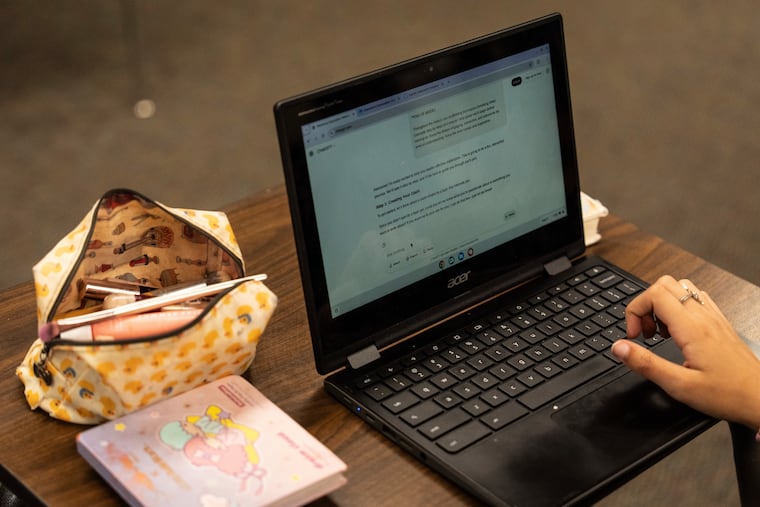
New Jersey public schools are weighing policies on how generative AI is making its way into classrooms and whether students and teachers should be allowed to use the technology.
Some require schools to get parental consent at the beginning of the school year for students to use AI for assignments, while others like Cherry Hill considered but backed away from a proposal that would have let parents opt out for their children.
It comes amid a growing debate about the use of digital devices in the classroom and concerns that evolving artificial intelligence compromises learning.
Schools across the country are tackling policies to address the rapidly changing technology. Rather than an outright ban, many districts are deciding how and when AI may be used, at what age, and what tools should be permitted.
“Everybody is wrestling with this challenge,” said Sarah Schneider Kavanagh, an associate professor in the Graduate School of Education at the University of Pennsylvania. “This is an enormous paradigm shift for education.”
» READ MORE: How some schools are embracing AI to help students learn French, edit papers, and more
Haddonfield teaches AI to all students — but bans use for elementary schoolers
In Camden County, Haddonfield adopted a sweeping AI policy in August that established three tiers of AI use based on grade level. It bans AI in elementary schools, while allowing supervised access for middle school and high school students.
This is the first AI policy for Haddonfield, which enrolls about 2,700 students, said Gino Priolo, an assistant superintendent. Initially, the district only had a provision in its academic integrity guidelines that required students to cite AI as a source when using it.
Priolo said surveys found that students and teachers were already using AI on at least nine platforms. Policymakers spent months developing guidelines that focused on education, safeguards, and limiting students to using approved platforms, he said.
“We needed a policy that protected privacy and provided guidance about safe and appropriate use,” Priolo said in an interview. “We’d be putting our heads in the sand if we simply tried to avoid AI.”
The policy bans younger students from using AI to ensure that they learn foundational and critical learning skills, he said. All students will get AI literacy education, beginning in first grade, he said.
“We want students to understand what AI is even before they are permitted to use it,” Priolo said.
Beginning in sixth grade, students can use a Google AI platform, where teachers are able to closely monitor their interactions in real time with Gemini Notebook, the district’s only approved generative AI platform.
Considered a closed system, the platform generates responses based on documents loaded by the user, Priolo said. Students cannot access the internet, and chatbots like ChatGPT are blocked by district software, he said.
For example, a student could upload handwritten chemistry class notes into AI to develop flash cards as a test study aide, Priolo said.
Haddonfield has also adopted generative AI policies for teachers. High school teachers must get teacher permission prior to using AI for an assignment.
Meanwhile, some of the country’s largest districts are also enacting AI bans.
Last month, New York City, the nation’s largest public school system, placed strict limits on digital devices and AI tools for younger students. The policy bars individual screens until third grade and prohibits teachers from using AI to grade assignments.
The Los Angeles public school system imposed a moratorium restricting most AI use at all grade levels for this school year. The district said it would determine how the technology would be incorporated in the future.
“I see it as a positive step, though not necessarily the best solution,” said Subodha Kumar, a professor of statistics, operations, and data science at Temple University’s Fox School of Business. “Bans may not stop students from using it and we do not have conclusive evidence that they produce better outcomes. It may take years to determine the best approach.”
Across South Jersey, some other districts are also taking unique approaches to teaching kids about AI. Deptford, for example, has added an AI course for high school students.
Cherry Hill considered allowing families to opt out of AI use
Cherry Hill considered a provision that would have allowed parents to opt their children out of using AI in school. There was some backlash that it would create inequity for so-called “analog” students prohibited from the technology.
District officials believe the opt-out option was not needed because Cherry Hill selected School AI as its generative AI program, a closed system that allows teachers to monitor students’ interactions, said Superintendent Kwame Morton. The board approved the revised policy on Oct. 13.
“It has been a deliberate process. We’ve tried to roll it out slowly and responsibly,” Morton said. “What we want more than anything is for our students to be safe and understand how to responsibly use the tools.”
The policy has guidelines for when AI is appropriate by grade level, said Allison Staffin, director of curriculum and instruction. Using a scale of 0 to 4, teachers must inform students in writing when generative AI is acceptable for an assignment. It ranges from 0 where no AI use is allowed, to 4, where AI can be used to draft content.
Staffin said there is no AI allowed for pre-K and kindergarten. By second grade, it may be used for an entire class, but closely monitored, she said.
Fourth and fifth grade is when most students will begin more fully using AI with specific instructions from a teacher, but not to generate original work, Staffin said.
“The teacher determines which tool they use and what prompts or answers they can generate,” Staffin said.
Cherry Hill parent Carolina Bevad said she was disappointed in the policy and called it “half-baked.” The mother of two district students believes elementary schoolers should be excluded from using AI.
“It’s a slap in the face to all students and parents,” Bevad said. She wants more guardrails to address privacy concerns.
Kavanaugh, from Penn, said parents have legitimate concerns, and researchers have unanswered questions about the impact of generative AI on learning. Opting out, however, can become complicated for students and teachers.
“The technology is changing so quickly that none of us really knows what we’re opting into or opting out of,” Kavanaugh said. “Education has to decide what are we unwilling to give up about what human beings can do on their own.”
» READ MORE: AI and the illusions of college teaching
Glassboro doesn’t restrict use by age
Glassboro Superintendent Alfred Lewis is a big proponent of students and teachers using AI — ethically. The districted adopted MagicSchool as its generative AI platform, he said.
Lewis said the district’s policy doesn’t restrict AI use by grade level, but it has mostly been used in middle and high school.
“We’re not even seeking to use it at the elementary level,” Lewis said. “Quite frankly, there’s just so much that needs to be taught and taught directly by teachers that it’s not even a natural fit for us.”
In some classes, students are using AI to score their assignments before submitting to the teacher, Lewis said. Teachers are also using AI to develop instructional materials and look for patterns to improve learning, he said.
Lewis believes AI can be used to enhance learning, but cannot replace a quality teacher in the classroom.
Assemblywoman Heather Simmons (D., Gloucester) recently introduced “The Educators Before AI Act,” which would prohibit the state’s nearly 600 public schools from replacing teachers with AI. Lewis supports the bill.
The bill, if adopted, would require a human presence in the classroom, Simmons said. There has been no indication thus far that any teacher has lost a job due to the technology, but she said safeguards are needed.
“There’s an art to teaching and a science to teaching,” Lewis said. “AI might be able to replace some of the science, but it will never replace the art.”

Inquirer South Jersey