N.J. students will have to put down their cell phones this fall under new state law
The law requires the state’s nearly 600 public school districts to adopt a policy banning the use of cell phones and other personal devices for the entire school day.
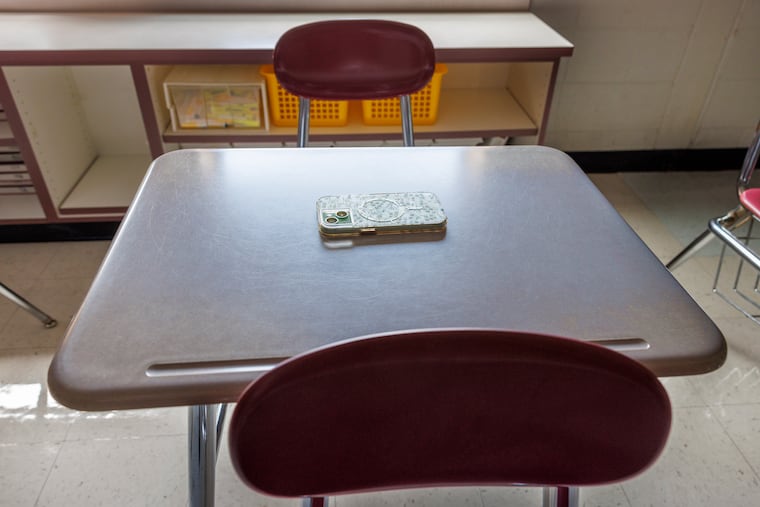
New Jersey students are going back to school with a new phone-free routine in September.
Starting on the first day of classes, all K-12 students in public schools must power off and put away phones and most internet-enabled devices before the bell rings, with only a few exceptions.
The new policy — signed into law in January by former Gov. Phil Murphy — puts New Jersey among a growing number of states including New York and Maryland that have passed measures to crack down on students using cell phones during the school day. (Pennsylvania has not passed a state law, though Gov. Josh Shapiro has signaled his support for such a policy and some districts have independently banned the devices in their schools.)
Heartily endorsed by educators who believe it will ease classroom distractions, promote academic performance, and improve student mental health, New Jersey’s new rule marks a big change for students accustomed to having their cellphones and other devices nearby and checking them regularly — even during class.
Some districts, such as Cherry Hill and Woodbury, have voluntarily implemented cell phone bans. Woodbury Superintendent Andrew Bell said most students embraced the restrictions and spend more time interacting with each other during breaks.
“At this point, it’s simply part of our culture and daily routine,” Bell said of the cell-free policy, passed two years ago.
The state left it to local school boards to determine how to implement the law at a district level, while complying with the guidelines. Because policies may vary, parents and students should check with their local district.
» READ MORE: Lockable pouches keep kids off phones during class, but don’t improve test scores, study finds
Here’s what you need to know.
How are districts implementing the policy?
The law requires the state’s nearly 600 public school districts to adopt a policy banning the use of cell phones and other personal devices for the entire school day. The law allows some flexibility on enforcement and how the devices are stored.
The state Department of Education issued guidelines this summer to help district set local policies. Some districts including Cherry Hill in Camden County and Washington Township in Gloucester County this month are voting on amending existing policies.
Districts had to decide whether students would be required to store their phones in their lockers or bins, in locked pouches, or in their backpacks with their personal belongings. The devices must be powered off.
The guidelines apply to all internet-enabled devices, typically smartphones, smartwatches, smart glasses, and ear buds, or any device that can access online content.
Some districts have also included other communication devices like flip phones, two-way radios, and walkie-talkies. Some rules may vary, for age appropriateness, depending on grade level, too.
What is bell-to-bell?
Cherry Hill school board member Bridget Palmer explained the restriction this way at a recent board meeting: “The minute you walk in to the meeting, you leave.”
The law restricts students from using their phones during lunch and study hall periods.
Districts get to decide whether phones can be used before and after school on school grounds, on school buses, and during school-sponsored events, such as athletic events and extracurricular activities.
“We’re not going to tell kids they can’t use their phones when they’re at Disney,” Washington Township Superintendent Eric Hibbs said at a board meeting. “We couldn’t enforce it anyway.”
Districts must also provide parameters for how and when parents can contact their children during an emergency. Hibbs said Washington Township will have phones available in every office that a student can use, and is developing a way for parents to contact their child on a district-issued device.
“A true emergency — all of this goes away,” Hibbs said. “No child will ever get in trouble for calling 911 for reporting an emergency.”
Where will the phones be stored?
The law lets the districts decide where the phones will be stored during the school day. The state provided some funding for districts to purchase locked Yondr pouches. Others are designating lockers or bins.
Cherry Hill’s amended policy would allow students to keep their phone in their personal belongings. It must be turned off, not just on vibrate or silent.
“We prefer that you don’t bring it to school, but if you bring it to school, it has to be off and in your backpack or your locker for the duration of the day,” Palmer said.
In Camden, the district’s new “off and away” policy says phones should be off and out of sight. They are permitted at a teacher’s discretion for instructional purposes. After a first offense, the phone will be confiscated and returned to the student at the end of the day; for subsequent offenses, the phone will be returned to a parent or guardian.
In Washington Township, pre-K to fifth graders must store their phones in their backpacks, sixth to eighth graders must store theirs in their lockers, while high schoolers will be allowed to keep theirs in their backpacks.
Hibbs said few high school students use their lockers so it was decided to allow them to keep their phones in their personal property. With about 2,100 students, the high school is among the largest in South Jersey.
Are there any exceptions to the law?
The law mandates exemptions for students with a disability or an Individual Education Plan (IEP) or 504 plan that stipulates the need for an internet-enabled device.
The exemptions include students with a health plan, such as students with diabetes who need their phone to check glucose levels.
There are also exemptions for students who use the cell phone for translation, or are the primary caregiver responsible for the well-being of a family member.
School policies must also outline procedures for mobile devices that will be implemented in the event of an emergency, such as a lockdown.
In the event of a family emergency, parents should contact the school office, and not the student directly, according to the guidelines.
How will violations be handled?
Districts are posting the new policy on district and school websites, in newsletters, and on social media sites to inform parents and students about the changes. They may also review it at back-to-school-nights, orientations, and training sessions for staff.
The disciplinary action may vary, depending on the district, and typically begins with a warning that could escalate with additional violations. Districts must specify how a phone may be confiscated.
Washington Township’s policy calls for progressive discipline, based on grade level. Administrators, not teachers, will be responsible for confiscating a phone if warranted.
There are 10 possible “consequences” for high school students beginning with an administrative warning for the first two violations, Hibbs said.
For additional violations, students will get a lunch detention and have their phone confiscated for three to four infractions, Hibbs said. Sanctions for additional violations include requiring a student to store the phone in a locker or main office, a two-day internal suspension, and a mandatory parental meeting.
“It’s going to be a very big change, but we’re going to navigate it,” Hibbs told the board.