Loss of Control
A man from Amish country bet on the U.S. Open, then sent the U.S. Tennis Association a bomb threat. Things will only get worse.
When he was told of the bomb threat, Brian Maguire was where he was supposed to be and doing what he was supposed to do: on the grounds of the USTA Billie Jean King National Tennis Center in Queens, just 100 feet from the complex’s security command center, watching, noting, sizing up.
It was Monday, Sept. 2, 2024, the U.S. Open in full swing, clouds dimming the early afternoon sun. Inside Louis Armstrong Stadium, a surprise was brewing. Jasmine Paolini, the No. 5 seed in the women’s singles tournament, was losing her quarterfinal match to an unseeded opponent, Karolina Muchova. Maguire, the USTA’s director of security, wouldn’t learn the full significance of the match’s outcome until later.
He answered a call from one of his staff members. At 12:12 p.m. — less than seven minutes before Muchova polished off Paolini, 6-3, 6-3 — someone had sent a direct message to the USTA’s Twitter/X account:
“I’m inside Louis Armstrong with a bomb that will go off at 1 pm est”
Louis Armstrong Stadium has a seating capacity of 14,000, and Maguire estimated that, among spectators, staff, and athletes, there were at least an additional 4,000 people on the 46.5-acre campus. All of them had been screened or searched — metal detectors, explosive-detection K-9 teams — so he was confident that the threat was empty. Still, for a man in his position, there was no such thing as being too careful, and if, somehow, there actually was a bomb out there somewhere …
He called his bosses at the USTA to inform them of the threat, then walked back to the command center. Once he arrived, he glanced at a computer screen to see the message for himself, and he conferred with his staff and with on-hand representatives from both the New York Police Department and the Federal Bureau of Investigation.
The likelihood of a device getting on our campus is pretty slim. But I’m still taking resources away from other places. We have to take every threat as if it’s real.
Built like a solid barrel, Maguire had been an NYPD detective for 27 years, 15 of them on the department’s joint-terrorism task force. Madison Square Garden, Yankee Stadium, Citi Field, the Barclays Center, the United Nations General Assembly, countless Midtown parades, even several previous U.S. Opens: Before the USTA hired him in June 2024, he had worked every major event at every major venue in New York. This kind of situation was not new to him, and he brought an investigator’s calm and logic to bear in evaluating and handling it.
“The Open is a great event,” he said. “Not a lot of bad things happen here, so this was like a one-off when we had this threat. I also knew that bomb threats, since online gambling has become a thing, have just skyrocketed.”

People engaging in online gambling, or their loved ones, can look for signs that they might be struggling and seek help, says Ellen DiDomenico, the deputy secretary of the state Department of Drug and Alcohol Programs. Those signs include:
- spending more time or money on gambling
- missing payments or having money problems
- hiding or lying about their gambling
- using gambling as an escape
- experiencing problems with relationships
The state runs a number of programs for people experiencing problems with gambling; a hotline, 1-800-GAMBLER, can help people navigate options for treatment and recovery support.
Maguire requested that the FBI open a guardian — that is, begin gathering evidence for a federal case — against the person who had made the threat. The NYPD’s bomb squad and the FBI’s special-agent technicians, accompanied by bomb-sniffing dogs, canvassed the campus. Within 20 minutes, the officers and agents were radioing back from their search to tell Maguire, We’re clear. Louis Armstrong Stadium was never evacuated.
“The likelihood of a device getting on our campus is pretty slim,” Maguire said. “But I’m still taking resources away from other places. We have to take every threat as if it’s real. I know in my mind, ‘Is there going to be a device? Probably not.’ But I still have to go through the motions.
“He’s not thinking that far ahead, this poor sap.”
A young man’s future on the line
Aidan Getchius trudged into a courtroom with his lawyer and his mother. Twenty-one years old, with small features and a few dark whiskers drooping around his pursed mouth, wearing a black plaid shirt, he gave the impression of a student who always took a seat near the back of the classroom, to try to go unnoticed. If he was anxious, he did not show it. His nerves already had done their work. Flecks of his dark hair had gone gray.
He was there, inside the Edward N. Cahn Federal Building in Allentown on a rainy morning in May, because he had admitted to doing a stupid and reckless thing. He had used a gambling app to place a $100 wager on the Muchova-Paolini match, betting on Paolini to win. But as Muchova won point after point on her first serve and it became clear that Paolini would lose, Getchius panicked. He wanted to keep his money, and the only way to do it, he thought, was to disrupt or stop the match. From 160 miles away, from the Lancaster County house where he lived with his mother, Trisha Sullivan, he had thumb-typed and sent the bomb threat.
Authorities had an easy time tracing the message back to Getchius and his Twitter/X account. He was charged with conveying false information and hoaxes, a count to which he had pleaded guilty in November 2025. Now he was in court for his sentencing hearing, facing up to five years in prison and a $250,000 fine.
He took a seat at the defendant’s table, its mahogany top gleaming. Sullivan, in a black blazer and a librarian’s glasses, slid into a row just behind him. The lawyers whispered and fiddled with their folders and papers. There was no other sound in the courtroom.
In less than an hour, U.S. District Judge John M. Gallagher would determine Getchius’ punishment and, in turn, his future, but that revelation was just one angle in a story with several worth accenting and examining. The case of Aidan Getchius had come in contact with so many disturbing trends and developments in the relationship between sports and American society that Gallagher’s decision would be the least compelling aspect of it.
‘He doesn’t talk at all’
Getchius had a factor — one rare set of circumstances for someone charged with a federal crime — working in his favor. Neither the attorney defending him nor the attorney prosecuting him believed or argued that he deserved jail time.
He was 19 when he sent the direct message to the USTA, and Jeremy Isard, the federal public defender representing him, framed Getchius as a good kid from a decent home who, while not a dangerous loner or incel, had temporarily lost any sense of social norms and boundaries.
“This is the only time that Mr. Getchius has done such a thing,” Isard said in court. “We live in a world where even the momentary frustration of a teenager can have real-world consequences. That is the reality that all of us are living in for the first time.”
Someone with Getchius’ background and upbringing, though, might feel more removed from those consequences than the average teen who stares at a screen all day. From the east, a car ride out to Strasburg, a town of fewer than 3,200 residents, will likely take someone past the Railroad Museum of Pennsylvania. There isn’t a big-brand supermarket or retailer to be found. And as drivers zoom past eggshell white barns and endless acres of verdant cornfields, they have to mind the shoulder of the road for any Amish and Mennonite farmers and children, dressed plainly, who might be walking, riding modest bicycles, or coaxing horses to keep on clip-clopping as the animals tug them along in wooden buggies.
Throughout middle school, Getchius was bullied “on a near-daily basis,” Isard wrote in a sentencing memorandum. So Sullivan, who raised him by herself and works full time at an insurance company, enrolled him in Pennsylvania Leadership Charter School, an online high school headquartered in West Chester. His four years there “overlapped almost perfectly with the COVID-19 pandemic,” Isard wrote, and allowed him to “focus on academics while saving him what had developed into not insignificant social anxiety.” Multiple messages to the school’s communications office, seeking a comment on or insight into Getchius’ tenure there, went unreturned.
“There are reasons related to Mr. Getchius and his own vulnerabilities,” Isard said in court, “that the sting of losing a bet hits harder for this gentleman than it would for many of the rest of us. … This was someone who [was] living an isolated and digital life.”
After graduating, Getchius took a job at Don’s Collectibles, a sports and pop-culture memorabilia store owned by his grandfather, Don Dorwart. The store is a fixture in Strasburg, open at its location on Main Street since 1984. For the two years he worked there, Getchius waited on customers and wrote and designed listings for items that Dorwart sold on eBay.
“He’s very quiet,” Dorwart said one morning at the store last month. “He doesn’t talk at all.”
Among the sports cards and trinkets and classic toys that he sells, Dorwart had recently ordered 300 pounds of foreign coins to offer to his customers. Several bags of them were stacked near his cash register, as if the store were a bank vault. Hundreds of coins from Brazil, Canada, and Italy rested in a wide, shallow cardboard box on the front counter. Dorwart was asked about sports gambling, and he was quiet as he considered how and why his grandson had come to place bets and to write and send that threatening message.
“It’s all this,” he said as he ran his left hand through the coins in the box. “He’s not that kind of kid.”
The hold on him
The implication of Dorwart’s gesture — that Getchius and others like him had given in to the addictive allure of legalized sports betting, the rush it delivered, and especially the winnings it promised — would have resonated with Josh Davison, the assistant U.S. Attorney prosecuting the case.
Davison agreed that Getchius didn’t need to be sentenced to federal prison for the bomb threat. Getchius knew he had screwed up, had owned up to his awful mistake, and hadn’t denied it or dodged it or fought the charges; he had pleaded guilty as fast as he could. But there were two aspects of the crime, Davison asserted at the hearing, that Gallagher ought to consider when imposing the sentence. Distilled, they were danger and fear.
Getchius began betting in 2022, when he was 18, after getting back in touch with a few friends from middle school. They formed a group text chain, and Getchius, according to court documents, found comfort in the rekindled friendships and the daily, sometimes minute-by-minute routine of betting. His user name on his Twitter/X account was “GetchiSoto” — a combination of his last name and that of one of his favorite baseball players, star outfielder Juan Soto — and he used that name or a derivative of it on several other accounts, some of which were vessels for his betting: Instagram, Facebook, Reddit, Kik, PlayStation, Xbox, and TikTok.
His mother didn’t know he was gambling. And even after his arrest and plea, even after attending at least 10 sessions of counseling, Getchius continued to bet small sums of money on sports.
“It’s certainly legal to place those bets,” Davison said during the hearing. “It’s just disappointing that someone with a pending sentence, who is still facing the threat of incarceration, is placing those bets. That tells the government, ‘Wow, that’s a strong hold.’ That confirms to the government that bringing this case was entirely the right thing.”
The group chat became a forum for banter among the boys and for hyperbolic reactions to lost bets. “As Mr. Getchius understands it,” Isard wrote, “this is how the rough script for his threat to the U.S. Open entered his mind.” He did not pause to consider what might happen if he shared that script.
The scope of the problem
When it comes to the potential damage of his actions, Getchius was no different from others who have tried to intimidate or menace athletes or have engaged in “swatting” — falsely reporting an emergency with the intent of victimizing an individual or institution. The goal is the same. The chaos and upheaval are the point.
In August 2025, for example, a report of an active shooter at Villanova University caused “panic and terror,” the Rev. Peter M. Donohue, the school’s president, said in a statement. The report was false, and in April federal prosecutors charged a juvenile suspect who was allegedly part of an online group claiming responsibility for similar calls to several colleges and universities.
“This hearing would look a lot different,” Davison said, “if we had Villanova students here.”
Two months before the Villanova hoax, during a Grand Slam Track meet at Penn’s Franklin Field, a bettor who identified himself on Twitter/X as “@mr100kaday” screamed at sprinter Gabby Thomas as she stood at the starting line for one of her races, calling her “Trash Spice.” After Thomas — a three-time Olympic gold medalist — lost her events, the man followed her around the track, insulting her, before posting screenshots of betting slips that showed he had won money by wagering against her.
“I made Gabby lose by heckling her,” he wrote on Twitter/X. “And it made my parlay win.”
The accumulation of such incidents can create a boy-who-cried-wolf effect that numbs people to a harsh truth: It takes just one of these threats to be genuine, just one bona fide villain who follows through, for an atrocity to occur. And the ubiquity and casual acceptance of betting don’t help.
Matthew Wein, an expert in cybersecurity and a former policy adviser at the Department of Homeland Security, keeps a database of incidents in which athletes have been harassed or threatened. A quarter of those incidents, he said in a phone interview, have been connected to gambling, and his database doesn’t paint a full picture of the problem, given how many threats go unreported.
A lot of it comes back to, are teams and leagues and sportsbooks and players unions and social-media platforms and other stakeholders willing to invest in sports-integrity measures?
Wein recommended that sports leagues and franchises start sharing information on problematic or malevolent bettors. The Phillies, for instance, were playing at Citizens Bank Park, less than six miles south of Franklin Field, on the same day that the anonymous gambler hounded Thomas.
“If you’re the Phillies’ owners, wouldn’t you like to know if this man had a ticket to your game?” Wein said. “I’ve described it as a pre-9/11 mindset. In the aftermath of the 9/11 commission hearings, we said that one of the big problems was that people weren’t working well enough together to make the puzzle pieces fit.
“A lot of it comes back to, are teams and leagues and sportsbooks and players unions and social-media platforms and other stakeholders willing to invest in sports-integrity measures? When sports gambling is marketed to young men, some who have mental-health issues, it’s a potent mixture that can really create an on ramp to criminal activity and violence.”
Neither Getchius nor Sullivan responded to requests for an interview, so certain questions about why he did what he did remain unanswered. How much money had he lost? How far in the hole was he? Why did a modest hundred-dollar bet inspire such a dumb and desperate reaction? And why was he betting on tennis?
In today’s gambling culture, there’s no sport or competition too obscure, no over/under or opening tap or coin toss too insignificant, that a wager can’t and won’t be placed on it. Yet even by that standard, the women’s singles bracket of the U.S. Open seemed a strange and random event for a bet from a young man from Amish country. Getchius was not a fan of the sport. He didn’t follow it. Why the Paolini-Muchova match? Why that tournament?
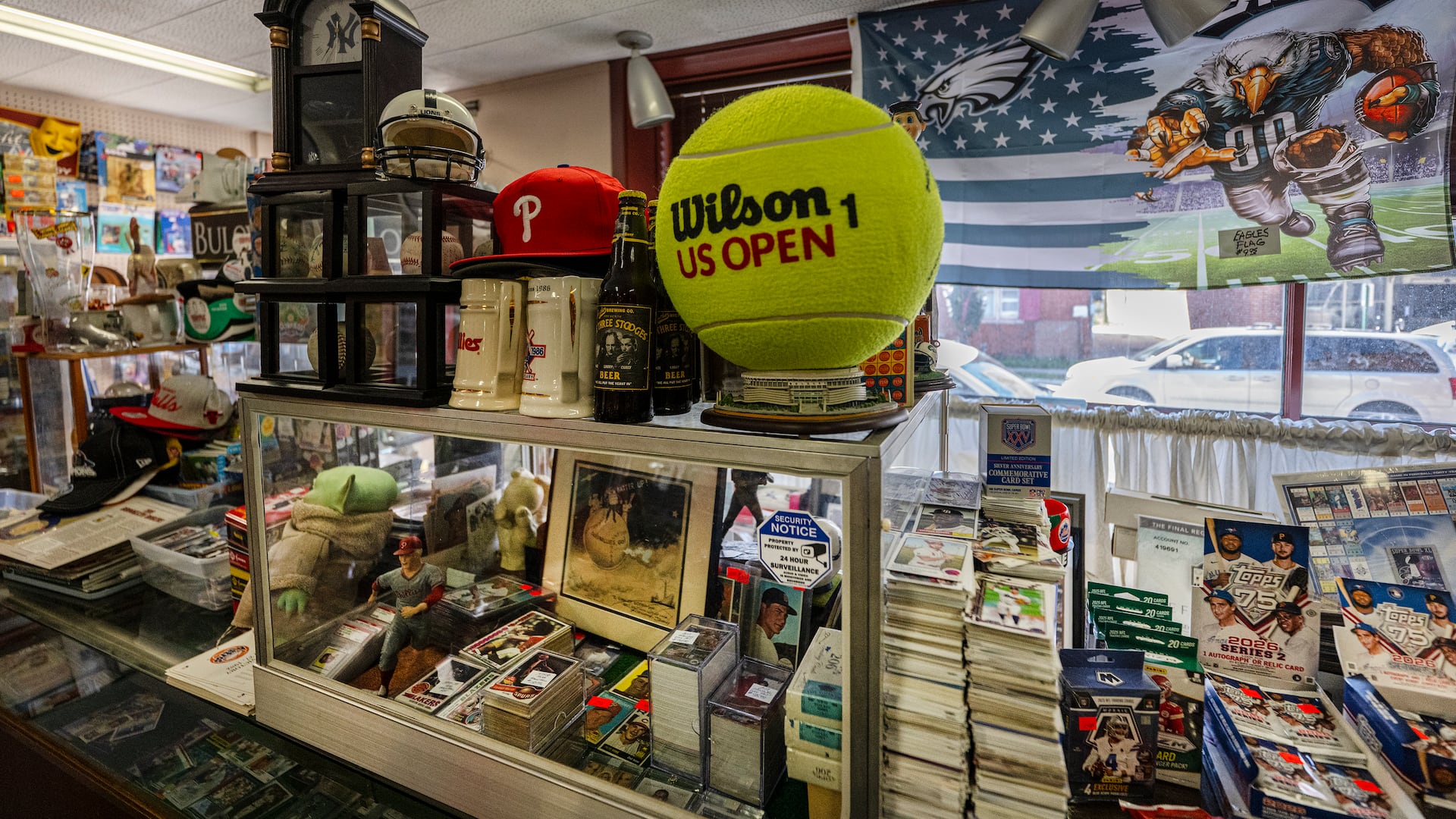
A clue might come from one of his favorite and most familiar places. Near the front window of his grandfather’s collectibles shop, atop a large glass case displaying stacks of baseball cards and a Richie Ashburn figurine, rested the largest item in the store. There was no telling how long it had been there. It was a jumbo lime green Wilson tennis ball. Across the ball, in red lettering, were the words “US OPEN.”
The life and threats to come
As Gallagher prepared to hand down Getchius’ sentence, he told him, “You have the right to be heard, to say anything you want to me or nothing at all.”
Getchius remained seated at the defendant’s table and spoke in a low monotone.
“I apologize for my actions,” he said. “I understand the severity, and I take full responsibility. I’ve learned a lot over the past two years, and I can promise that nothing like this will ever happen again.”
He showed no reaction when Gallagher imposed the sentence: three years’ probation; a $1,000 fine; and the imposition of certain conditions — that Getchius had to attend Gamblers Anonymous or another treatment program and that he was forbidden from engaging in any gambling activity of any kind. Getchius nodded to Isard, consenting to the terms. His mother kept her hands folded on her lap.
“Instead of losing a bet, you lost a lot more,” Gallagher said. “None of this is to excuse what you did, Mr. Getchius, but I do have to consider who you are. … You have a full and lawful and productive life ahead of you. You have people who care about you. You have everything you need. We all want you to put this bad decision behind you and go on living that happy and productive life.”
The 2026 U.S. Open is underway. It has been less than two weeks since the first day of Aidan Getchius’ sophomore year at Millersville University. He carried a 3.24 GPA in his first semester there, makes deliveries for DoorDash to earn some money, and is for now a useful cautionary tale. What he said in court is probably true: He won’t do anything like this again. But if we aren’t careful, someone else will. Someone else will do something worse. And someone will die.