Port Richmond’s 48-foot-tall pile of industrial waste is finally getting cleaned up
The four-acre Franklin Slag Pile Superfund site contains a pile containing 68,000 cubic yards of covered slag.
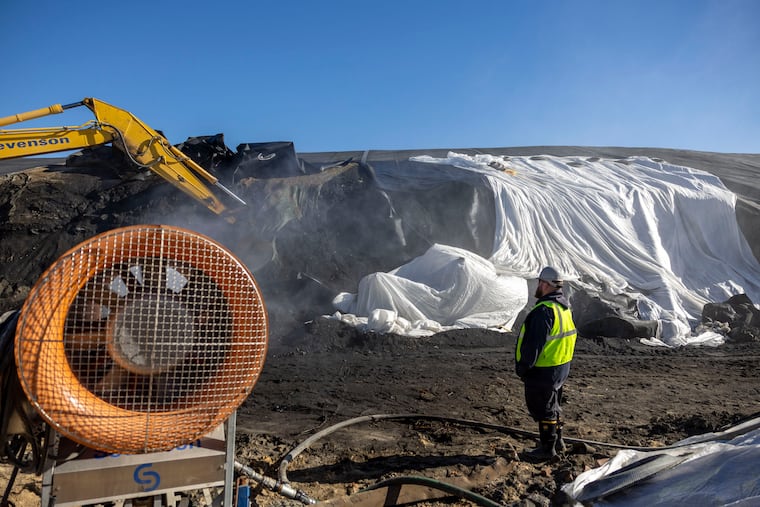
The 48-foot high, 350-foot long Franklin Slag pile has dominated the corner of Castor and Delaware avenues in Port Richmond.
Now, crews have begun a painstaking $26 million process of removing the equivalent of 20 Olympic-size swimming pools full of contaminated industrial byproduct from a defunct copper smelting operation just off the Delaware River.
“This is a 68,000-cubic-yard pile of hazardous waste that’s been in people’s backyards,” Andrew Haneiko, project manager for the U.S. Environmental Protection Agency’s Region 3, said during a tour of the site on Thursday. “It’s part of the EPA mission to get the stuff treated and get it out of here and turn the site back into productive use.”
The EPA, along with the U.S. Army Corps of Engineers, began remediation and associated construction in August. But crews from New York-based contractor Sevenson Environmental Services have just begun digging up the pile.
Though the contract is through May 2031, Haneiko believes most of the pile could be gone by next fall. Castor Avenue, parallel to the site, is closed. Cars and bikes are being detoured through Balfour and Venango streets.
Cleaned slag will be transported north on I-95 to WM’s Fairless Landfill in Bucks County.
“No trucks will be going through the community,” Haneiko said. “That’s a really important part of this project.”
Though the area is mostly industrial, state Rep. Joe Hohenstein, a Democrat who represents the area, noted that over 20,000 people live within a mile of the site and people work nearby.
He said he is sure the cleanup is safe for residents and workers from the nearby Port of Philadelphia, and from industrial facilities who could be exposed to any drifting pollution.
“We need to make sure that we’re taking care of our environmental quality for our neighborhoods,” Hohenstein said.
A history of contamination
Franklin Smelting and Refining Corp. began smelting copper at the site in the 1930s, producing slag as a byproduct.
MDC, the operator of the site from the 1950s to 1999, sold the slag as sandblasting grit. But the slag migrated off site. It once covered the nearby rail line and area sidewalks. It caked the inside of storm drains, and could be seen blowing away.
The EPA, the City of Philadelphia, and the Pennsylvania Department of Environmental Protection (DEP) sampled the site in the 1980s and 1990s and determined the slag contained leachable concentrations of lead. Additional sampling revealed high concentrations of beryllium, copper, and lead in the air near the pile. In high quantities, all can be harmful to humans.
The four-acre site was added to the EPA’s National Priorities List of contaminated sites and entered into the Superfund program, making it eligible for cleanup funding.
In 2000, the EPA piled the slag and capped it with a membrane so it could be controlled. Slag that had spilled off-site was removed, along with slag and contaminated soil at a nearby wetland.
Officials began studying how to approach the site’s full cleanup in 2007. In 2020, the EPA issued a formal plan.
Sevenson, the contractor, was hired in March.
Franklin Slag is one of two Superfund sites in Philadelphia. The other is Metal Bank in Northeast.
Haneiko, the EPA project manager, said insurance carriers from the site’s previous owners are paying $18 million toward cleanup costs.
The Franklin Slag site is currently owned by the city as the result of a sheriff’s sale. EPA officials said there are no immediate plans for its use.
The land is zoned for heavy industry. It is bordered by a Conrail rail line, closed lagoons owned by Philadelphia Water Department’s Northeast Water Pollution Control Plant, and Philadelphia Gas Works.
The Delaware River is less than one-quarter mile southeast. The closest residents are about one-half mile away.
How the cleanup works
Army Corps Lieutenant Colonel Ryan Baum said his organization served as an overall project manager for the Franklin Slag site. The Army Corps provided engineering, construction oversight, and contract management, including hiring Sevenson.
Each day, crews from Sevenson peel back part of the slag’s cap. They wet the slag to keep it from blowing away. Dust suppression equipment known as a DustBoss emits a fine mist that collides with dust particles to bring them to the ground.
As the slag is excavated, a proprietary liquid chemical reagent called Make-Tight is applied at a pace of roughly 50 cubic yards every 30 minutes. The solution permanently binds the lead so it can’t leach into groundwater while at the landfill.
Each batch is tested to ensure it is nonhazardous. The slag is then loaded into haulers equipped with the liners known as “burrito bags” to prevent dust from escaping into the neighborhood.
The trucks travel Castor Avenue to I-95, bypassing residential areas.
Solar-power stations encircle the perimeter and monitor the air continuously. If dust reaches 150 parts per million, real-time mobile alerts will prompt workers to halt.
Additional air monitors are installed at neighboring industrial sites and nearby homes based on community input.
Angela Unoarumhi, a spokesperson for the EPA, said the agency began meeting with neighborhood groups in March to listen to concerns.
It met with Port of Philadelphia officials, union stevedores, and port workers concerned about dust.
As a result, air monitors were installed at the port as well as in a lot adjacent to I-95, near where a 30-year resident of the neighborhood lives. The EPA also learned of the nearby bike path that wasn’t on initial project maps.
“It allowed us to be better positioned to address community concerns,” Unoarumhi said of the meetings.