The not-so-secret weapon that helped the Philly Open draw an unusually strong field of players
Hosting a tournament not far from New York the week before the U.S. Open helped attract players who've made deep runs in recent majors. The timing could help the Philly Open expand in the future.
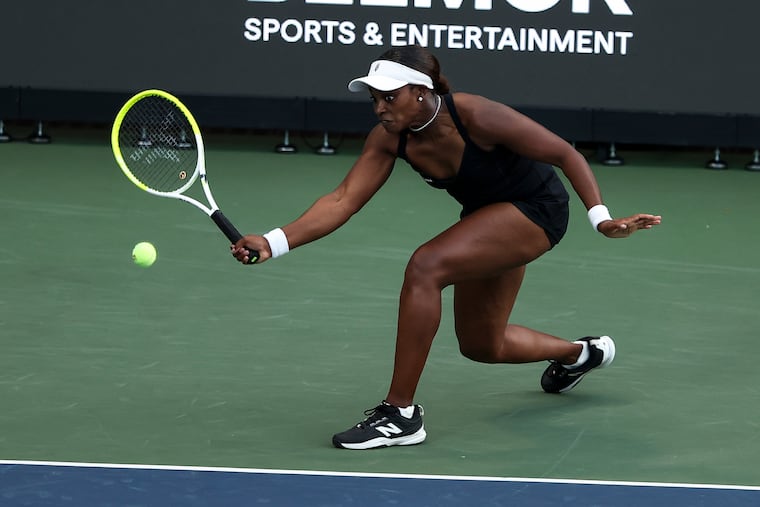
Last year, Loïs Boisson captured the hearts of her native France and tennis world with a stunning run to the French Open semifinals at Roland Garros.
Though she hasn’t reached those heights since, she’s still well-known around the sport. So when her name showed up as a late entry into the Ennoble Care Philly Open tennis tournament this week at Penn, it created some buzz.
It isn’t just another week for tennis players. The U.S. Open starts Monday, so it’s an important time to get ready for the big stage. There are a few events out there to play in, from a women’s tournament in Monterrey, Mexico to the U.S. Open’s flashy mixed doubles showcase. The latter has some of the sport’s biggest stars: Serena Williams and Carlos Alcaraz are playing together, as are Aryna Sabalenka and Novak Djokovic.
The Philly Open is a lower-level event than any of those, at the WTA’s 125 tier compared to the Monterrey event’s 500. Traditionally the players in a 125 tournament aren’t so well-known.
But this one has had an unusually strong field. Spain’s Jessica Bouzas Maneiro made the round of 16 at Wimbledon last year, and has reached the third rounds of the French and U.S. opens in the last two years. Ashlyn Krueger made the Wimbledon round of 16 this year, the 22-year-old’s best finish yet at a major.
Then there was the headline attraction, 2017 U.S. Open champion Sloane Stephens. She has fallen to No. 240 in the world rankings since suffering a long-term foot injury last year, and arrived in town after making the third round at the high-profile Cincinnati Open.
Unfortunately for local fans, Stephens lost her first-round match, Boisson took a medical retirement after losing the first set of her opener, and Bouzas Maneiro and Krueger lost in the second round.
» READ MORE: Last week, Esha Velaga took the MCAT. This week, the Penn senior made her pro tennis debut — right on campus.
They still chose to come to town, though, which means they chose to drop down — because that’s what it is for players like these — to a 125. Why do it?
Making the rounds of the tournament over the first few days, one thing came up repeatedly: Philadelphia’s proximity to New York. Spare the “sixth borough” jokes this time, because it’s an asset. Players can spend the week here, then get in a car or train and make a short trip to Manhattan.
Those in Monterrey, meanwhile, are looking at a four-hour, nonstop flight if they can get it, or a connection through Mexico City or somewhere else.
“Honestly, leading up to the U.S. Open, it was important for me to play in a tournament closer to New York than some others,” Bouzas Maneiro said, “so I decided to play here in Philadelphia to get into a bit of a rhythm.”
The geography angle was an intentional play by the tournament’s organizers, including the Philly Sisters group that helped bring the Unrivaled basketball showcase to town in January.
When the WTA 250 event in Cleveland that had this week for the last five years stopped, the Philly Sisters jumped at the chance to bring something here at the same time. But they already had the attention of Cleveland’s tournament director, Alex Guthrie, who is now the director of the Philly Open.
“We had a lot of discussions going on behind the scenes last year, and we were looking to get into a new market,” he said. “And Philadelphia, obviously being such a big market, but also so close in proximity to New York for the U.S. Open, and then pair that with the amazing facilities here at Penn, it made a lot of sense to explore this even further.”
The sense that Philadelphia could work was also helped by some history on the circuit. There was a WTA stop in New Haven, Conn., from 1998-2018, and a men’s ATP event with it from 2005-10. When the Connecticut operation folded, there was a one-year stop in the Bronx in 2019, then Cleveland took over in 2021 after the world came out of the pandemic.
» READ MORE: What Philly got out of the World Cup, the nation’s 250th, and the MLB All-Star Game
The Philly Open now has a three-year contract. That gives some runway to potentially scale it up to a 250-level event, which the local organizers would like. But there is a lot of work to do.
“We definitely have to raise a lot more money: The cash prize, the infrastructure requirements,” Guthrie said. “We would have to build an even bigger stadium court, and then add a lot more things like a bigger television production, more stands on the secondary court, etc. So there’s even more requirements at an elevated standard.”
The stadium court this week seats around 1,200 spectators, with one big side of temporary stands across from fixed seats at Penn’s Hamlin Outdoor Tennis Center. The second “show court” has another 100 or so fixed seats on one side, but just a few portable bleachers and chairs on the other.
There’s definitely room to expand, since the Hamlin Center has 12 outdoor courts. Just three have been used for competition this week, with seating over three others and the rest serving as practice courts. The nearby indoor facility could be used for practice if more stands are built.
» READ MORE: Was the World Cup good for Philly’s economy? The early signs are in
How to raise the prize pot? A boost in corporate sponsorship would help, of course, and the big-city backdrop means officials shouldn’t have to look far.
“It’ll cost more, but I think that’s the goal,” Philly Sisters vice president Ashley Lunkenheimer said. “Then we’ll have more people coming, and we’ll have a more mature opportunity, so people will know about it and say, ‘That’s the tournament I don’t want to miss — this is my chance to see these women up close,’ and in a way [that is] more affordable, and yet still some of them will be at the U.S. Open the following week.”
Guthrie added “The infrastructure here would allow us to one day run a 250 here, if the opportunity became available.”
The decision will be up to the WTA, and it only grants so many sanctions for 250 tournaments each year. Topnotch already owns one for a 250 event in Memphis in late July, so at least it’s familiar to the tour. WTA officials have been in town this week to see the setup in person.
» READ MORE: Our photographers' best shots from the first few days of the Philly Open
The tour’s top official isn’t one of them, but she needs no introduction to Philadelphia. Valerie Camillo spent five years as one of the highest-ranking figures at Comcast Spectacor, including as president and CEO of Spectacor Sports and Entertainment, and head of business operations for the Flyers and Xfinity Mobile Arena. She became chair of the WTA last November.
The players’ experience matters a lot too, and that seems to have been going well. Bouzas Maneiro said “the facilities here are very good,” praising the gym and practice court facilities in particular. She also has taken some time to enjoy the vibrancy of summer in Center City.
“I like having lots of coffee shops nearby and places where I can spend some time,” she said. “The hotel’s location is excellent, and it’s close to the venue, too … I think the tournament is very well organized, and I’m getting a really good vibe so far.”
Guthrie called this first edition “an exploratory year for us and for the WTA in many ways,” and said he believes it might be a few years before a 250-level sanction opens up. But he didn’t rule it out either.
“I would venture to bet this will be a 125 next year, but you just never know in tennis,” he said.