The very Philly story of how the modern day pencil got the eraser on its end
Pencil-like objects have been used through history but it was Philadelphia stationer Hymen L. Lipman who filed for a patent for the pencil attached to an eraser in 1858.
During the Roman empire, scribes recorded notes with styluses, early pencil-like gadgets that left faint strokes on papyrus.
Miners discovered large deposits of graphite in Borrowdale, England in 1564 and wrote with the soft, mineral because it was dark and easy to read.
“Shepherds even used graphite to mark their sheep,” explained Andrew Westburg, president of the American Pencil Collectors Society from his home in Mankato, Minn. “It was how they kept track of them.”
But graphite was soft and hard to get a grip on, often melting in the users’ hands. Early writers wrapped sticks of graphite in string. In the 17th century, scribes began inserting graphite into hollow wooden sticks, inventing the first pencils.
German carvers began mass producing pencils in 1662 with a graphite point on both ends. Businessman Kasper Faber founded Faber-Castell in 1762 turning Germany into the pencil capital of the world.
In 1770, English chemist Joseph Priestly figured out rubber erased graphite marks. (Priestly immigrated to Pennsylvania in 1794 after his home was burned down by a mob.) That same year, London instrument maker Edward Nairne started selling rubber cubes as erasers.
Faber-Castell expanded its pencil empire to the United States in 1849, setting up shop in New York. But the pencil, as we know it, wouldn’t be complete until nine years later in Philadelphia.
On March 30, 1858, an Old City stationery merchant Hymen L. Lipman filed a patent for the pencil with an eraser.
“He figured out you could drill a hole at the end of the pencil and stick a little piece of rubber in there,” Westburg said. “The eraser on the end was sharpened just into a point, like a pencil.”
The pencil with the attached rubber eraser will be celebrated Saturday from 11 a.m. to 1 p.m. at the National Liberty Museum in the Philadelphia Historic District’s Thanksgiving weekend firstival.
Firstivals are held each Saturday this year to honor global milestones with Philly roots.
Lipman was born in 1817 to a family of Jewish merchants in Kingston, Jamaica. The Lipman family moved to Philadelphia in 1830 when he was between 12 and 13 years old.
“Long before and after the [American] Revolution, Jewish families moved between islands like Jamaica and St. Eustatius to Europe, and the emerging United States,” explained Claire Pingel, chief registrar and associate curator at Weitzman National Museum of American Jewish History. “Hymen Lipman’s early life in Jamaica is an example of that broader story of movement within the Jewish diaspora.”
Lipman succeeded the city’s top stationer, Samuel Stewart, in 1841, moving into his store at 139 Chestnut Street. He launched an envelope manufacturing company in 1844 and is widely credited for adding adhesive to envelope flaps to seal them. (Historians can’t agree if the first U.S. envelope manufacturing firm was Lipman in Philadelphia or Berlin & Jones in New York who started making envelopes in the early 1860s.)
Two decades before Philadelphia inventor Henry Heyl filed a patent for the precursor to the stapler, Lipman applied for a patent for an eyelet binding machine in 1854 that punched holes and fastened stacks of paper with small metal eyelets.
Lipman sold the patent for the pencil and its attached eraser to Joseph Reckendorfer in 1862 for $100,000, about $3.3 million today. Reckendorfer sued Faber-Castell in 1875 for patent infringement, but the U.S. Supreme Court declared Lipman’s original patent invalid. The “invention,” the court said, was a combination of two things with no new known use.
Lipman enjoyed a long career as a Philadelphia stationer, moving to 411 Walnut Street before permanently settling on South Fourth Street.
In 1872, he became the first American manufacturer to produce blank post cards, primarily used by private businessman to mail ads. Lipman sold them in an assortment of colors, advertising them in The Philadelphia Inquirer along with his selection of notebooks, pencils, and greeting cards.
Lipman died of apoplexy in his home in 1893. according to an article in The Philadelphia Inquirer.
But the story of the pencil and the attached eraser did not end with his death.
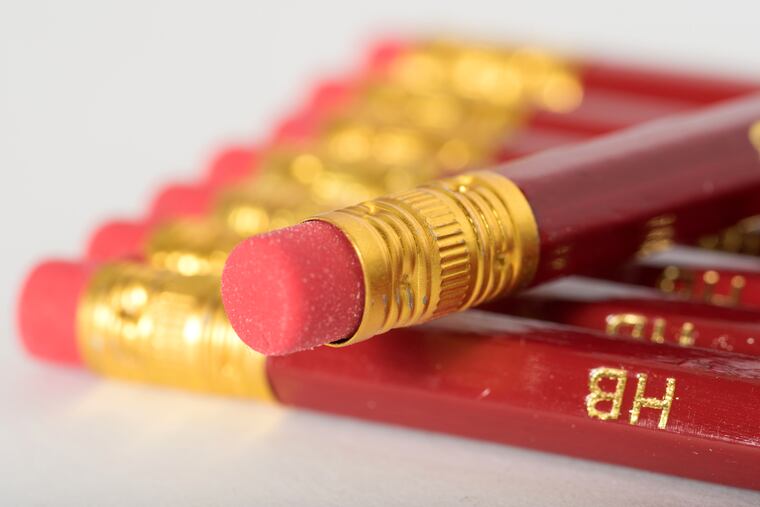
Ferrules — the grooved metal tubes that attaches today’s erasers to pencils — became fancy writing accessories in the first decades of the 20th century, Westburg said.
In 1934, Eberhard Faber’s Blackwing 602 pencils were the first to use flat, decorative ferrules. (Eberhard Faber is the New York-based branch of the German Faber-Castell stationery empire.)
“That pencil retailed for $35,” Westburg said. “It was top of the line. It’s motto was ‘twice the speed, half the pressure’.”
Illinois inventor J.B. Ostrowski filed a patent for an aluminum ferrule with horizontal bands and ridges in 1964, the foundation for today’s beloved pencil and eraser combo.
March 30, however, remains National Pencil Day in honor of the Old City stationer who first put the combination together.
This week’s Firstival is Saturday, Nov. 28, from 11 a.m.-1 p.m., National Liberty Museum, 321 Chestnut Street, Philadelphia, PA
Each week, The Inquirer is highlighting a “first” from the Philadelphia Historic District’s 52 Weeks of Firsts. A “52 Weeks of Firsts” podcast, produced by All That’s Good Productions, drops every Tuesday.