Mural Arts says it’s keeping a banner critics have labeled AI
Mural Arts doesn't yet have a policy about the use of AI in their works. The organizaiton will host a town hall on the topic on November 5.
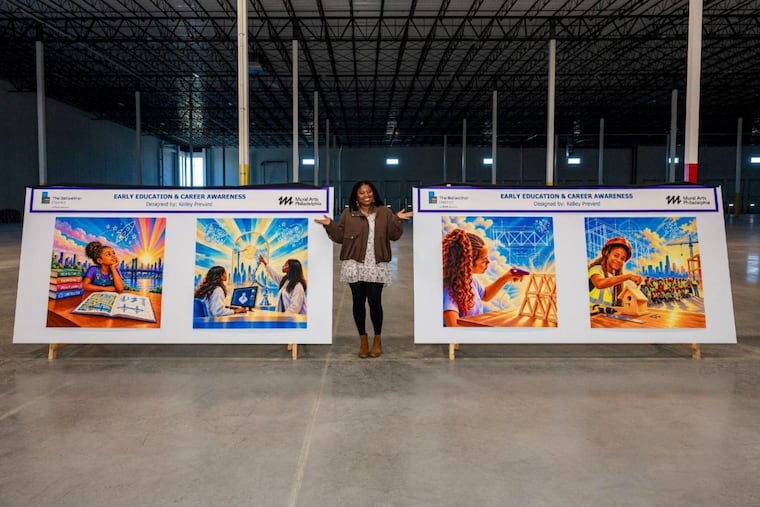
Last month, Mural Arts unveiled designs for banners to decorate a fence along the Bellwether District development in South Philly and, in doing so, jump-started a conversation about the role of AI in Philly’s public art.
The public art project, part of Mural Arts’ “Throughlines” exhibit displayed around the city, is meant to beautify the 26th Street fence on the Bellwether District campus during its ongoing construction.
In partnership with the real estate investment firm HRP Group, Mural Arts hired five artists to create 20 vinyl mesh banners illustrating Philadelphians who live near the former oil refinery site.
Four colorful designs from muralist Kelley Prevard aimed to portray early education and career awareness with images of young girls working in science, construction, and engineering.
But users on social media pointed out that in three of Prevard’s design, the skyline featured a building that looked more like Chicago’s Willis Tower than Philadelphia’s Liberty Place. They spottedother details that bore similarities to AI-generated illustrations, like the lettering and the style of the girls’ portraits.
Prevard, who did not respond to requests for comment, is a painter based in South Jersey who has had a long career in Philly’s art scene.
She received the Mural Arts Fellowship for Black Artists in 2022 and her murals appear throughout the region, from Southwest Philadelphia’s Threads of Joy: Celebrating the Golden Years to Atlantic City’s Aquarium.
The aesthetic styles of those works look distinctly different from the Bellwether District banner designs that Prevard presented: They all look more photo-realistic with a cohesive painting style, while the banner portraits evoke cartoon illustrations.
“My four designs focus on early education and inspiring the next generation of young girls to see themselves in STEM, engineering, and construction,” wrote Prevard in an now-deleted Oct. 9 Instagram post featuring her Bellwether District designs.
AI scholar Tuhin Chakrabarty, who teaches computer science at Stony Brook University in New York, said it was “very obvious” that Prevard’s designs looked like AI.
“The color, texture, and synthetic nature of the image is very indicative of AI slop,” said Chakrabarty in an email. He ran images of Prevard’s designs through Pangram, an AI detection software with 99% accuracy, which concluded that AI was detected in each of the four illustrations, meaning that the images were either AI-generated or edited with AI tools. “Pangram also confirms it,” he added.
(When passed through Pangram’s detection software, the works by the other artists involved — Priscilla Bell Lamberty, Jamee Grigsby, Ernel Martinez, and Cesar E. Viveros-Herrera — did not indicate AI use.)
While critics of the Bellwether banners called them out as AI slop, Mural Arts currently doesn’t have a policy about the use of AI in their artwork.
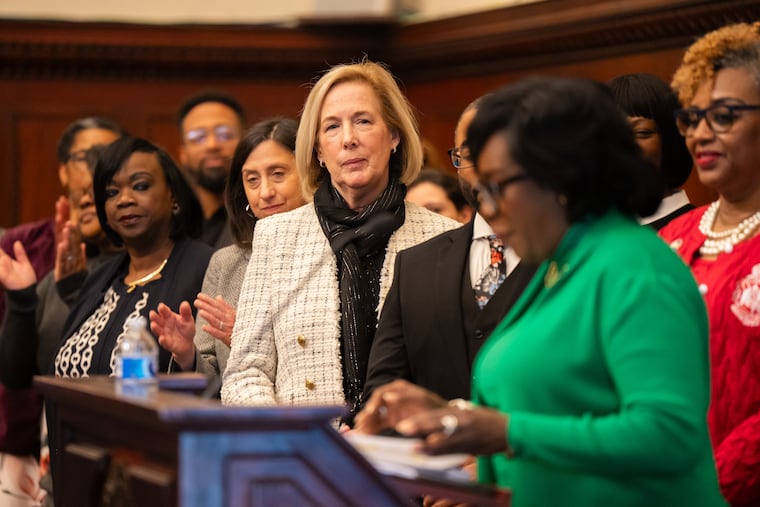
Mural Arts executive director Emily Mello, who took over from founder and longtime arts leader Jane Golden in September, declined to comment on whether the banners in question used AI-generated imagery or whether Mural Arts staff was aware of potential AI use in this project when they approved the designs, which typically go through several review processes during creative development.
Mello said she recognizes that the role of AI tools and imagery in the arts is a divisive issue.
“People have really strong feelings about it, which I think they should, with any rapidly changing technology and how it enters the creative field,” said Mello.
“I really would love to bring the discussion away from this individual and her artwork, and doing forensics on the [designs]. I think it’s a much larger question than one individual’s work. There are questions to be asked about a whole range of ways artists are using AI and what is acceptable and what is not, and people have a huge range of opinions about that,” she said.
According to Mello, there are no plans for these mesh banners to become permanent painted murals. The banners are in the final stages of design edits and Mural Arts is moving forward with printing and installing them, including Prevard’s, in late November.
Amelia Chasse Alcivar, executive vice president of corporate affairs at HRP Group, said the banners for the Bellwether District pictured real Philadelphians. Prevard, she said, including a local high schooler studying engineering, who participated in the Bellwether District’s Career-Connected Learning program.
“This public art project was inspired by real community members in South and Southwest Philly living and working at or around the Bellwether District,” she said in a statement. “We are proud to center their faces and their stories along one of the gateways to the city.”
Frank Luzi, a Mural Arts spokesperson, declined to disclose how much the artists were paid for the Bellwether District work. He said in an email that the compensation was “in line” with other Mural Arts projects “of this scale.”
Mello said that Mural Arts, which receives some funding from the City of Philadelphia, among other sources, has been developing an AI policy in recent months. The arts organization was already scheduled to host a town hall on Nov. 5 for artists to provide feedback on their AI policy draft.
Following public concerns over Prevard’s work, Mello said they added a second session on Nov. 12 in response, given the high interest in these conversations. The events are aimed at an artist audience but open to the public, with RSVPs required.
“Mural Arts will always center humans — human artists, communities. That is central to our mission,” said Mello. “We hire artists throughout the year to work with communities and to change the visual landscape of our city, and that will always center human-made art.”
She added: “One work of art isn’t going to set a precedent for us, either.”