The Academy of Natural Sciences museum armadillos, tortoises, and roaches head for new homes as staff loses jobs
More than 30 vertebrate animals and at least six bug colonies moved to new homes last month. “I think that they’ve all ended up where they needed to be,” said a former staffer.
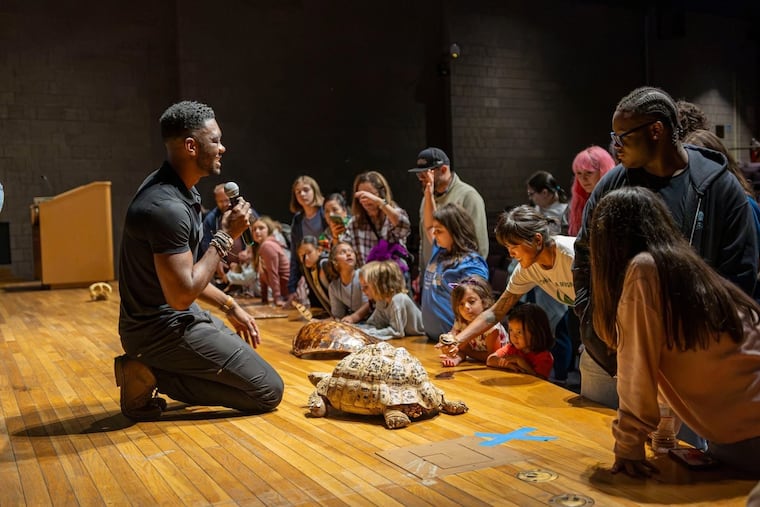
Since the Academy of Natural Sciences of Drexel University museum closed its doors to the public on Sept. 27, a fiery city council meeting, a significant financial offer from a local foundation, and packed public protests have aimed to save the nearly 200-year-old institution. But, inside the museum’s brick walls, a quieter act of care and compassion was taking place.
In their final weeks of employment, a small group of museum staffers secured new homes for the museum’s animals from its live animal shows and “Outside In” center. Every tortoise, snake, and cockroach got settled in its new home by the start of November, said Anwar Abdul-Qawi, former manager of animal programs at the Academy of Natural Sciences museum. His last day of employment, like the rest of his team at the museum, was Nov. 1
Planning for the relocation of the animals started soon after the museum’s closure was announced on Sept. 1, Abdul-Qawi said.
“Me and my team were preemptive with everything,” he said. “We got that ball rolling immediately.”
Industry peers who work at other live animal facilities were more than willing to help, said Stephenie Koniers, previously an animal programs coordinator on Abdul-Qawi’s team.
“All of these people that have reached out, and we have been sending our animals to, are all very entrusted,” Koniers said.
Some of the most well-known animals at the museum, including the African bullfrog “Morbo the destroyer,” and Ollie the leopard tortoise went to nearby zoos last week.
Cohanzick Zoo in Bridgeton, N.J., took Ollie and Kobe, a fellow leopard tortoise (museum staff consider them girlfriend-boyfriend), as well as their beloved third wheel Francis, who is a red-footed tortoise. Armadillo sisters, Blue and Violet, moved there too and “are having a blast” already, Koniers said, running on a giant wheel and tearing up their quarantine enclosure within hours.
The Philadelphia Zoo, meanwhile, took Morbo, as well as a yellow-margined box turtle, a wood turtle, five red-eye tree frogs, and two American green tree frogs.
All the animals from the museum at both zoos will become visible to the public once their quarantines end, representatives from the zoos said. The armadillos at the Cohanzick Zoo are quarantining in a place where the public can view them now.
Many of the decisions around which animals went where centered around what animals area zoos were looking for, and what resources and space were available at each, said Rachel Brown, formerly lead animal keeper on Abdul-Qawi’s team.
Some of the animals that are older and heading toward retirement went to private homes, others moved to animal sanctuaries and other museums and zoos, Brown said.
All of them are staying within a two-hour drive of the museum.
“There’s not one of them I would have placed differently,” Brown said. “I think that they’ve all ended up where they needed to be.”
Moving more than 30 vertebrate animals and at least six invertebrate colonies in the museum’s collection wasn’t simply a matter of driving them from one location to another. It involved checkups from vets, legal paperwork, and permits.
Former staffer Karen Verderamereturned to the museum, where she worked for nearly 20 years and previously held Abdul-Qawi’s position, to help orchestrate the rehoming as a consultant. She now works at Penn Vet doing outreach and teaching about animal welfare.
“Any change on any living organism can be a little stress,” she said. “Every one of these animals, including the cockroaches, the welfare is the priority.”
Verderame herself took some of the hissing cockroaches, vinegarroons, and spiders mostly to be used in educational programming through Penn Vet.
The Academy museum team moved animals primarily during the last week of October. Koniers and Brown took five animals to the Cohanzick Zoo and the Philadelphia Zoo picked up 10 last week.
Knowing some of the animals are at the Philadelphia Zoo, particularly, is a comfort to the staffers; that’s where Stefan Gallini works. He’s been a contract veterinarian for the museum’s animals for three years and now works as an associate vet at the zoo.
Since the museum’s closure, Gallini’s role shifted from doing monthly assessments of all the animals to doing health checks on them all before they relocated. That primarily involved looking for infectious diseases and illnesses that can flare in times of stress.
He said he didn’t find any big issues with the animals’ health as he did his final assessments. He credits much of that to the museum’s animal care team including Abdul-Qawi, Koniers, and Brown.
“As resources were kind of minimal, especially these few years that we’ve been working with them, they’ve done an excellent job working with what they’ve had and keeping these animals in great shape,” Gallini said.
Visitorship at the museum had slipped in recent years, according to the museum closure statement signed by Drexel president Antonio Merlo and Academy board chair Suzanne Biemiller. The Academy worked to rebuild attendance after the pandemic, but “patterns of visitation and audience behavior changed in lasting ways, while the costs of operating the museum continued to rise,” the Sept. 1 statement said.
Drexel University, which became affiliated with the Academy in 2011, estimates the closure-causing deficit to be $4.4 million. But recent financial documents show that the budget deficit, according to Biemiller, could be as low as $960,000.
As far as the animals go, moving to these new homes may be a little jarring for them, but they probably don’t really know what’s happening, Verderame said. The real emotional toll primarily rests on the caretaking team.
“We don’t consider these guys as pets, they’re co-workers,” Koniers said. “We work with them, we take care of them, but they also take care of us.”
It’s bittersweet. She’s confident the animals are going to suitable homes, but it’s hard not to grow attached.
“When you’re having a rough day, they can sense it and feel it. They come up and they’re like, ‘Oh OK I’m going to sniff your shoes’ or ‘OK we will cuddle’,” she said. “I’ve had tortoises climb up on my lap.”
The museum has had live animals for 100 years, Koniers said. The “Outside In” center is now covered in hundreds of love letters to the animals written by museum visitors in its last month open, but all its living creatures are gone.
Though many prominent Philadelphians are fighting hard to find a solution to reopen the museum, watching life vacate the museum halls makes the closure feel more final.
“Seeing all of the tanks getting emptied out and the empty shelves, it’s been hard,” Koniers said. “It feels very, very permanent.”