In Opera Philadelphia’s ‘Mitridate’ you can catch a 14-year-old Mozart in the act of becoming great
The shows runs through Sunday at the Academy of Music.
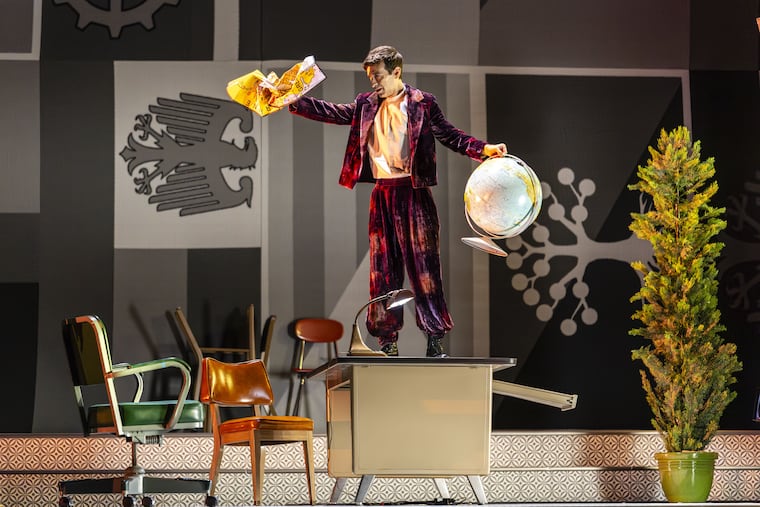
Among the many risks taken by Opera Philadelphia over the past two years, none has been greater than the current production of Mitridate, re di Ponto — the quirk of it all being that such a risk is attached to the name “Mozart.”
Yes, the ever-beloved composer is his ingratiating self in the rarely-heard, remarkably-evolved opera composed at age 14. Age is not an issue so much as the genre that prevailed in 1770 Milan, well before Mozart left behind stock plots about antique royalty that were once standard procedure.
Arias go on for as much as 10 minutes with false endings and expansive postscripts, requiring extraordinary virtuosity and stamina in an age where opera was as much about Olympic-style recreation as artistic communion.
Thanks partly to often electrifying singing in the cast led by star tenor Lawrence Brownlee, the audience seemed fully engaged Wednesday at the Academy of Music, even laughing with the recitatives that focused the characters and made the opera seem far less distant. In his customary pre-curtain speech, general director and president Anthony Roth Costanzo (who was also in the cast) suggested that Mozart was working out his father issues. Opera as psychotherapy? I won’t argue.
What emerged, for me, were parallels with King Lear in this story of the rage-prone monarch Mitridate, ca. 63 BC in the Crimea, whose one son is loyal and the other is plotting an overthrow with aggressive support from Rome. Romantic complications abound — in vocal writing that expects every voice to do everything — in arias that unfold with the dramaturgical formality of a chess game.
Without a lot of direct character interaction, soprano Brenda Rae was able to replace the previously scheduled Lauren Snouffer in the leading role of Aspasia with less-than-usual strain: Mostly, she needed to just show up for her arias, which exist like islands of characterization.
Lengthwise, the opera ranges from two-and-a-half to three-and-a half hours, this version coming in under three. With such flexibility, singers, in theory, can use the opera as a quarry, selecting what best suits them.
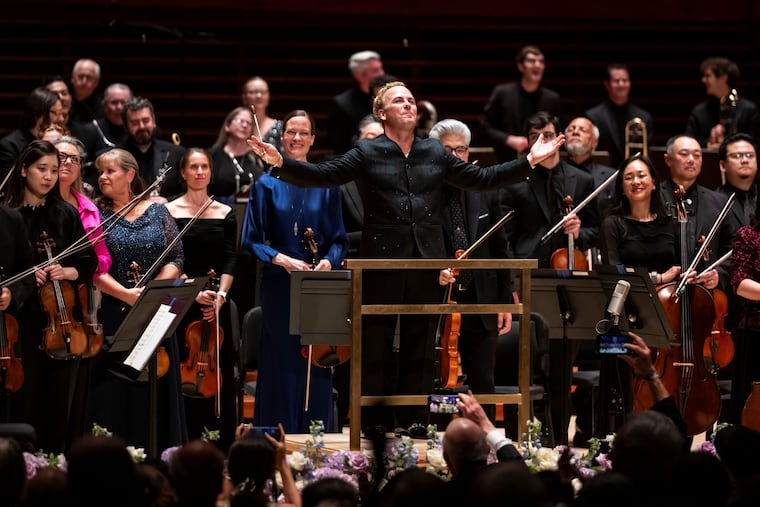
With the convincingly brisk tempos of conductor Corrado Rovaris, the score felt a bit like Philip Glass — with Mozart inhabiting an infectious groove that suddenly changes complexion with the addition and subtraction of a well-targeted note. Long harpsichord-accompanied recitatives can sap the overall momentum, though Leon Schelhase revealed all manner of harmonic richness, creating a space where singers could give their characters greater specificity.
To her credit, stage director Emma Griffin basically left the singers alone — giving their characters a visual context but little physical stage business that would distract them from what they were there to do — sing.
It’s true that countertenor Costanzo (in the role of Farnace, the bad son) was able to sing with astounding accuracy and expressivity while being taken down and tied up. But that can’t be expected of any one else. It’s also true that Griffin had Brownlee’s angry king breaking various objects onstage, but always between phrases, and never stealing focus from his trademark high notes that take off like a skyrocket.
Among all cast members — including Meredith Wohlgemuth as Sifare, Nola Richardson as Ismene, and Sarah Coit as Arbate — the singing was effective but not always tidy, the heat of performance being much more important.
Two special mentions: The emerging tenor Minghao Liu, as the Roman invader Marzio, is singing lots of Rossini in regional opera but is clearly headed for the top with the remarkable ease of his coloratura technique. In a somewhat different way, Rae is perhaps doing her best work in her middle years with a voice that’s showing some wear but is ever more interesting with the kind of shading she brings to what she sings.
She is able to encompass her entire character in a single cadenza. The depth of meaning she brought to her great Act II aria “Pallid’ombre, che scorgete” (roughly translated “Ghosts who look down from heaven” in which she contemplates the end of her life) was the opera’s most entrancing moment.
That and a number of other Act II arias for other characters (such as “Lungi da te, mio bene” with its horn obbligato) showed Mozart periodically leaping ahead in his maturity, creating music at a level of sophistication that would become customary a decade later. One can hear one of Western civilization’s great artists emerging before your very ears.
“Mitridate, re di Ponto” is performed Thursday at 7 p.m. and Sunday at 2 p.m. at the Academy of Music, Broad and Locust Sts. Tickets are $11-$250. The company’s next opera, “Suddenly Last Summer by Courtney Bryan,” opens Oct. 22 at the Forrest Theatre. operaphila.org, 215-732-8400.