Philadelphia Orchestra musicians’ pay will reach $200,000 if new pact is approved
“The musicians’ voices and our collective knowledge of the orchestra and our industry were taken seriously,” said the negotiating committee chair. Opening night of the new season is set for Sept. 24.
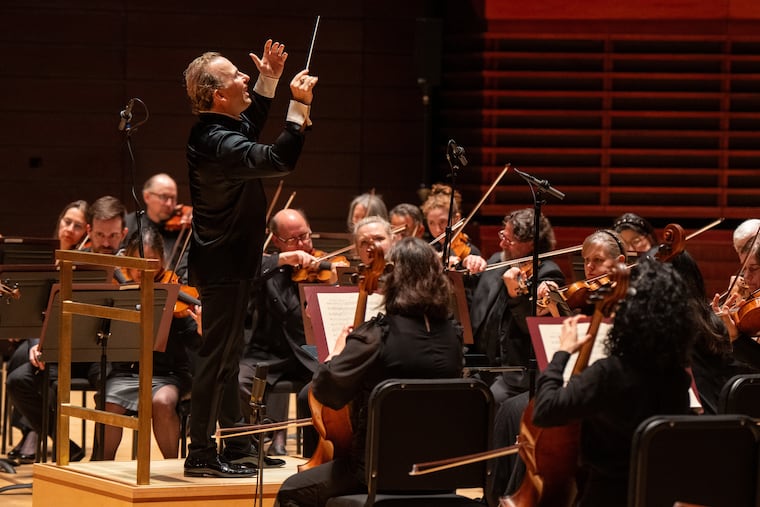
Musicians and management of the Philadelphia Orchestra have struck a tentative agreement on a new three-year labor deal. The pact, whose terms were finalized in the past few days after more than six months of talks, would, if ratified, put the base minimum salary of orchestra members at $200,008 annually by the end of the contract.
Players were presented with the deal Monday and, after a mandatory 48-hour period to mull it, are slated to hold a ratification vote starting Wednesday.
The old contract expired Monday at 12:01 a.m., but no interruption of performances is expected. Opening night of the 2026-27 season is Sept. 24 — a benefit concert for the musicians’ retirement fund featuring Joe Hisaishi’s Orbis and Beethoven’s Symphony No. 9.
The musicians’ negotiating committee recommended the contract — which keeps the Philadelphia Orchestra’s players among a group of the best paid in the U.S. — to the full membership.
“It’s a step in the right direction,” Ellen Trainer, president of local 77-274 of the American Federation of Musicians, said of the tentative deal. “I think the association [management] understood our narrative and worked with us to achieve something we can all be proud of.”
“This is a deal that commits to the artistry of the orchestra,” said Philadelphia Orchestra and Ensemble Arts president and CEO Ryan Fleur. “We’re trying to assure short- and long-term economic stability. It does make an investment in our artists and it is a competitive deal that will keep them among their highest-paid peers.”
The new contract follows one whose negotiations in 2023 were publicly acrimonious and left some orchestra board members feeling bruised. Players authorized a strike, though a strike never happened, and they filed unfair labor practice complaints with the National Labor Relations Board.
Talks this time did not bubble over in public, though musicians did make labor-solidarity statements over the summer such as wearing union T-shirts to rehearsals.
The new contract calls for an increase in base salary from the current $176,280 to $200,008 over the contract’s three-year span. Many players earn more, and some, like principals, make much more.
The contract does not call for changes in healthcare coverage. It provides work-rule changes such as opening up more rehearsals to students and spells out protocols for hearing loss protections during performances using amplified sound. The third year of the contract grants supplemental payments to substitute and extra musicians for their retirement accounts.
The new contract increases the size of the “complement” — that is, the number of full-time members — from the current 103 to 104 by the third year.
The deal also enshrines for the first time a limit on the number of live-to-screen movie presentations that can be programmed to two per subscription season, with no more than three performances per movie. The contract does not restrict the number of film concerts in summer.
Fleur said it’s not the film music itself that concerns the orchestra’s musicians. But film scores are typically recorded in multiple sessions, and when an orchestra performs the entire score all at once, “it’s a very intense process and requires skills that are not consistent with the skills when responding to [music and artistic director] Yannick [Nézet-Séguin] in a Mahler symphony.”
The new contract also provides for a process at the end of the season to review “the quality of all programs featuring a nonsymphonic work, including, but not limited to, programs featuring pops music,” to discuss the income generated as well as the “impact of the programming on the artistic health of the Philadelphia Orchestra.”
Musician dissatisfaction has been around certain concerts at which “the orchestra is playing with stand-lights and they’re not really a partner on the stage but more in the background,” said Trainer. “They want to be mutually featured.”
A number of other major U.S. orchestras have been in negotiations recently. This month the National Symphony Orchestra settled a new contract, as did the Boston Symphony Orchestra last month. Players of the Cleveland Orchestra recently voted to authorize a strike. The San Francisco Opera canceled opening night of its 104th season on Sept. 12 after musicians of the orchestra went on strike.
Philadelphia Orchestra has also had its share of strikes, though the most serious work stoppage in past years was three decades ago — a 64-day strike in 1996.
Fleur said that recent talks featured a “collaborative process,” and while there were times when each side got frustrated, “that’s what happens when there’s an open dialogue, and we worked through it.”
Orchestra negotiating committee chairperson and violinist Dara Morales said that this time in talks she felt that “the musicians’ voices and our collective knowledge of the orchestra and our industry were taken seriously.”
The new contract runs though Sept. 9, 2029.