A Fishtown studio is bringing Hollywood to Philly
In a city that bills itself as a movie making mecca, Ashlee Hollis' studio the Story Factory with its designation as a Pa. qualified production facility is a major come-up.
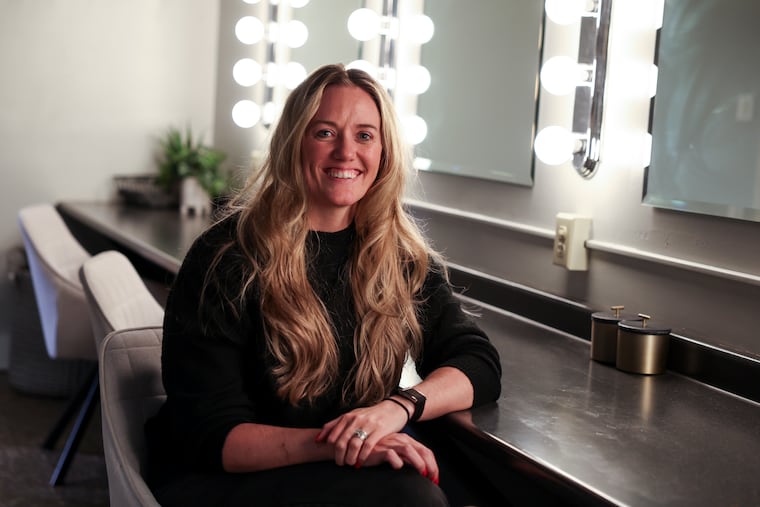
When Ashlee Hollis leased a cavernous Fishtown warehouse in 2022 and named it the Story Factory, the founder of Helm Creative Studio dreamed of turning it into a state-of-the-art- space for her firm’s clients to create content.
And she did.
She built a soundstage for speakers to give Ted Talk-style talks in front of live audiences, and she built two soundproof podcast studios. She installed Instagram-friendly backdrops dripping with faux ivy and neon lights. There’s an island across from the soundstage where folks can give cooking demonstrations, perfect in a town full of food content creators.
For nearly four years, Hollis worked with 296 nonprofit and small business clients — which include the Philadelphia Orchestra, the Philadelphia Ballet, Live Nation, and the Eagles — filming video, producing podcasts, and staging photo shoots.
Hollis was content with the content.
“We were happy and thriving,” she said one recent autumn afternoon dressed in head-to-toe black. She glided through the Story Factory in ballet flats like a modern day princess.
Today, the Story Factory is on the verge of going Hollywood.
The Pennsylvania Film Office designated it as a qualified production facility in March, meaning any independent or major motion picture studio that uses the Story Factory for a project could be eligible for a tax credit from the state. With that credit, the state pay up to 30% of the production’s total cost, saving hundreds of thousands of dollars.
In early November, the state film office also approved the Story Factory as a qualified post-production facility. So now, studios that use the Story Factory for post-production that includes recording sound, editing visual effects, and mixing soundtracks can be reimbursed for up to 30% of their costs, too.
“It’s a huge deal for us,” Hollis beamed.
As of now, the Story Factory is the only qualified production facility in Philadelphia. There are five qualified post-production facilities in the city, but the Story Factory is the only Philadelphia production house the state has approved to be used as both production and post-production.
“We are a place where a film can be shot from start to finish,” Hollis gushed. “That amazes me.”
‘Massive for Philly’s creative economy’
In a city billing itself as a movie making mecca, the Story Factory’s come-up is major, explained Nicole Shiner, co-executive director of the Greater Philadelphia Film Office.
During the fiscal year ending June 2026, Philadelphia hosted 272 film and TV productions ranging from episodes of Abbott Elementary to commercials, documentaries, and feature films. These projects generated $106.8 million in direct local spend with an economic impact of $223.3 million, according to Shiner.
Pennsylvania’s tax credit program — that allots $100 million each fiscal year to incentivize production companies to bring their film projects to the Key Stone state — is the driving force behind those numbers.
Of those 272 projects, 29 received tax credits meaning at least 60% of their total qualified expenses were spent in Pennsylvania. Qualified expenses include everything from set design, hair and makeup, and food for the crew. If the production used a qualified production facility, or a post-qualified production facility, the state raised the ante and paid 30% of the projects total cost.
Tax credit eligible projects were just 10% of the Philadelphia region’s total film projects, Shiner said, “but they drove 90% of the direct spend, accounting for $93.3 million spent in our region and generating $202.4 million in economic impact to Southeastern PA.”
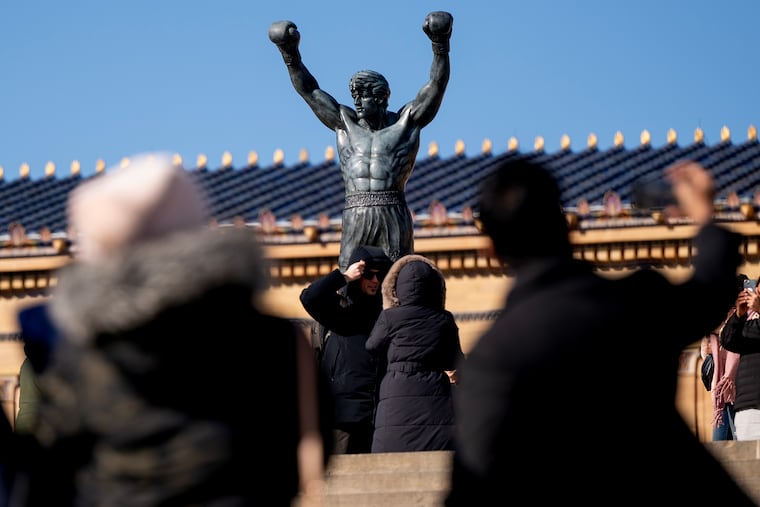
The Story Factory can mean even more money for the city’s bottom line, Shiner said. While recent projects like the Sylvester Stallone biopic I Play Rocky utilized Philadelphia strictly for on-location shoots, having a dedicated local facility allows future productions to also book in-town stage space for interiors, costume changes, and hair and makeup.
“The Story Factory is a massive win to the Philly creative economy,” Shiner said. “We love hosting big productions for location days, and our goal is to bring as much of their full schedule to the region as possible.”
A growing trend
In order to be a qualified production facility, a movie house must meet certain qualifications by the state including a soundstage with an unobstructed floor space, a sliding roll-up access door a minimum of 14-tall (think a loading dock); an HVAC with 50 tons of cooling capacity, and 24-hour security with badge access.
There are 12 qualified production facilities in Pennsylvania including QVC’s Studio Park in West Chester (The home shopping network received its QPF status in 2013.) Two more QPFs will open by the end of 2026, bringing the state’s total to 14, Pennsylvania Film Commissioner Gino Pesi wrote in an email.
Most of these facilities are tens of thousands of square feet and are situated on acres of wooded land like Sun Center in Aston where HBO’s Task and Apple TV’s Dope Thief were filmed.
However, Pesi wrote, smaller facilities are popping up across the state like Triode Studios in Lancaster that is just 10,000 square-feet and the Story Factory which is just over 12,000 square feet.
Shiner said smaller facilities like the Story Factory are becoming common as both streaming outlets and network television experiment with more series with fewer episodes. Shooting is quicker and budgets are tighter.
And many, like Story Factory, are growing hubs for independent creators, Pesi wrote.
We can thank the pervasiveness of social media reels for that.
“My small business and nonprofit clients need the same quality of equipment and studio time titans in the movie industry need,” Hollis said. “Short documentaries, web series, even film festival entrants.”
Church videos to creative hub
Hollis, 39, moved from Kansas City to Kennett Square in 2008 with husband Elijah Hollis, who was then a youth pastor at the Power Place Church in Kennett Square.
Around 2012, the couple made a video promoting the mission of the non-denominational Christian church and soon after, members began asking them to make videos for their secular businesses.
In 2015, Hollis — now a mom of a boy and a girl — formed Helm. Her vision was to help small businesses tell stories with compassion, empathy, and zest. She landed the Robert Irvine Foundation as her first major client in 2016 and Helm grew one inspirational video at a time.
Hollis watched as social media continued to impact how her clients reached their audiences.
In 2021, she started looking for a one-stop-shop where she could help clients make reel-ready videos and record podcasts in addition to designing and printing clients’ merch, posters, and brochures.
“We were becoming a niche creative studio,” Hollis said.
In 2022, Hollis stumbled upon the block-long studio on along the border of Kensington, Fishtown, and Northern Liberties on Fifth Street. The building was the former home of Thomas Ashley’s Invincible Pictures’ Philadelphia Sound Stage. For a time, it operated as a QPF. A bit of the production for the 2012 Oscar-winning film Silver Linings Playbook was completed there. Philadelphia Sound Stage’s QPF status expired in 2016.
Hollis started leasing the building from Oxford Properties. In 2025, she had a chance meeting with Shiner who suggested she apply for QPF status.
“I knew it would be the cherry on top of what they already created,” Shiner said.
The minimum investment of a QPF is $10,000. Hollis invested a total of $500,000 in the Story Factory. She redid the floors, installed a new kitchen, added rolling walls, upgraded the lighting, and made the podcast rooms soundproof, among other things.
A technicolor mural popping with bold graffiti and inspirational quotes by artist Alloyius McIlwaine wraps around the colossal corner stone building.
On weekends, the Story Factory is the virtual home for Elijah Hollis’ Change Church. (Ashlee Hollis isn’t just a storytelling princess, she’s a first lady of a church.)
The rest of the time, the Story Factory is churning out, well, stories.
On a recent Wednesday afternoon, Blocs CEO Robert Delany and former Republican State Rep. George T. Kenney chopped it up during a recording of the inaugural episode of Blocs’ Mission Moments podcast.
“Helm has helped us evolve into a new place of modern day storytelling,” Delany said. “They are helping us keep pace.”
Blocs, the nonprofit scholarship organization, has worked with Helm for nearly eight years.
Only now, there’s a bigger chance that one day as Delany is walking out of the Story Factory, Stallone, Tina Fey or perhaps even Will Smith will be walking in.
The Story Factory is located 1600 N Fifth Street.