This Trump policy has Asian ships hauling U.S. cargoes for Philly refineries despite a century-old ban
U.S. shipyards and sailors want protection from cheap foreign shipping. Oil companies benefit from waivers.
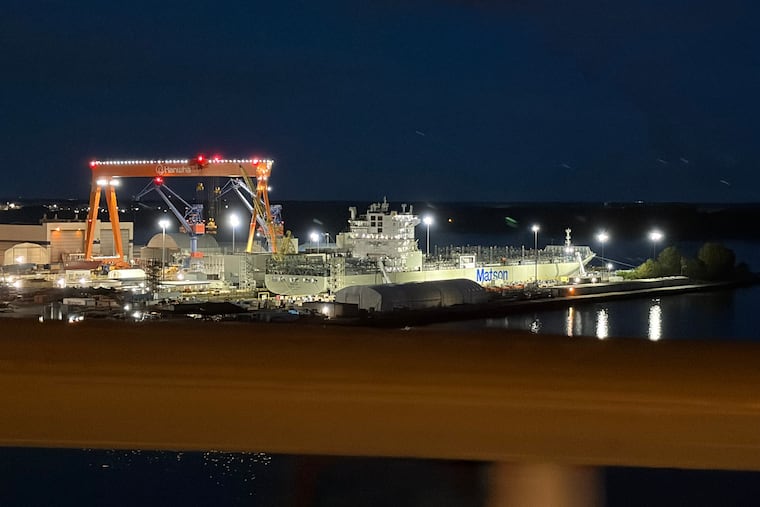
Except in wars or great storms, the federal Jones Act of 1920 requires that U.S. cargoes shipped between U.S. ports on the Delaware River and other waterways must travel in U.S.-built ships worked by U.S. crews.
But since March, amid the war with Iran that stalled Middle East energy shipments, the U.S. has been in one of those exception periods, with President Donald Trump authorizing waivers allowing ships built in Korea, China, and other shipbuilding nations to haul cargoes between American ports.
Trump on Friday extended the waivers, which had been due to expire Sunday Nov. 15, for another 90 days, the longest exception since the law was passed, Reuters first reported.
The waivers have been cheered by energy lobbies representing refineries such as Delta Air Lines’ Monroe Energy in Trainer, Delaware County, and PBF Energy’s in Paulsboro, Gloucester County, and Delaware City, Del. And they’ve been lamented by reps for U.S. shipbuilders such as Hanwha Philly Shipyard in Philadelphia and American tugboat and barge owners, merchant marine officers, and the Seafarers union.
Energy companies say waiving Jones Act restrictions is “giving shippers access to additional vessels and potentially lower transportation costs,” said Michael F. Merlie, business and maritime lawyer at Gawthrop Greenwood in West Chester.
By contrast, Jones Act supporters warn the waivers risk shifting cargoes to foreign carriers and eroding support for U.S. flag vessels, American mariners, and domestic shipbuilding, as well as the Jones Act goal of preserving a U.S. shipping fleet, Merlie said.
Most cargo and energy ships are now made in China, Korea, or Japan, where costs are a fraction of those in U.S. yards, thanks in part to mass production.
An Inquirer review of federal cargo reports and other records showed more than 30 tanker loads of U.S. crude oil and locally refined fuels worth over $1 billion have traveled between Delaware River ports and other U.S. ports on waivers since March, in ships built mostly in Korea, China and Japan.
That level of trade “suggests the waivers have been commercially meaningful in this market,” Merlie said.
A total of 25 tankers, container ships, automotive carriers and other commercial ships visit ports on the river each month, according to data posted by the Maritime Exchange for the Delaware River and Bay, an industry group.
The rush of foreign ships to carry U.S. cargoes between U.S. ports has changed trading patterns.
Crude oil from the Bakken fields in North Dakota and Eagle Ford fields in Texas, moved by pipeline to Gulf Coast ports, have been shipped north to the Philadelphia area in European-owned, Asian-built tankers. It’s used to make jet fuel at Delta’s Delco refinery and gasoline at PBF.
The waivers make it easier to ship crude between U.S. ports instead of exporting it and leaving U.S. refineries to use imported crude.
Propane from Energy Transfer’s Marcus Hook Industrial Complex, collected from the Marcellus and Utica gas fields in western Pennsylvania, has similarly traveled on foreign tankers to Puerto Rico. The island relied more on gas from West Africa and Latin America before the waivers.
A smaller stream of oil products from area refineries has been sent on foreign ships to specialized chemical facilities in Louisiana and Mississippi. A shipload of asphalt made in Paulsboro was carried by a Chinese government-affiliated tanker to Baltimore in July.
The foreign ships are “displacing imports, not U.S. ships,” because there aren’t enough U.S.-built ships to meet demand, said Colin Grabow, a trade scholar at the pro free trade Cato Institute in Washington. That means more U.S. demand for energy produced in Pennsylvania, Texas, and other gas and oil states, and less pressure to export it, he said. That should lead to cheaper energy.
But the increased use of foreign ships “is counterproductive to the [Trump] administration’s own goal of revitalizing American shipbuilding,” said Jennifer Carpenter, president of the American Maritime Partnership of U.S. shipbuilders and workers, and American Waterways Operators, which represents tugboat and barge firms.
Without Jones Act protections, investors won’t buy and update U.S. commercial ships, leaving America farther behind China, the world’s leading shipbuilder, she said.
» READ MORE: Hanwha details plan to speed Philly shipbuilding with more piers, dry docks, cranes, and robots
“Without the Jones Act, there is no U.S. maritime industry” or future jobs for U.S. seafarers, ship officers and shipbuilders, Rear Adm. Michael Fossum, superintendent of Texas A&M University Merchant Marine Academy, told a crowd of senior U.S. officials in July, who gathered at the christening of the Philadelphia-built TS Lone Star State.
Plus, Jones Act advocate Carpenter noted, fuel prices haven’t been dropping, as waiver advocates hoped.
Despite improved domestic oil sourcing and fuel delivery under the waivers, last month jet fuel prices reached a record high of nearly $5 a gallon, boosting revenues for Delta, thanks to its Delaware County refinery.
Much of the cost of more expensive jet fuel has been passed along to consumers, with U.S. airfares up 25% over last year.
Ship brokers on the Delaware River and in other East Coast ports say there has lately been little cost difference between shipping on U.S. and foreign ships with the ships now available, but also noted prices are volatile.
Permanent waive?
The South Philadelphia shipyard, now operated by Hanwha Defense USA, built a majority of the “Jones Act ships” to carry cargoes between U.S. ports that have been constructed since 2000.
But U.S. ships now comprise less than 1% of the world fleet and new ship production. That shows the Jones Act has been ineffective for shipbuilders while boosting costs for U.S. manufacturers, refiners and other shippers, Grabow said.
Hanwha Philly Shipyard is building three Jones Act ships for Matson, the dominant West Coast operator of U.S. cargo ships. Each is to cost over $300 million, compared to under $100 million for similar-sized ships from Chinese yards.
Last month, with the Jones Act waivers still in force, Hanwha said its civilian shipbuilding arm was transferring control of the Philly yard to Hanwha Defense USA, which builds warships. Hanwha also named a new president to head the Philly yard, Hyuk Kim, a veteran naval and commercial shipbuilder from the company’s much-larger Korean shipyards, succeeding David Kim.
The two contracts Hanwha announced this year are for U.S. government missile-tracking and Navy landing craft, The company is seeking other Navy contracts.
“We are continuing to pursue commercial work,” said Hanwha spokesman James Hewitt.