Reading Terminal Market reports nearly 6 million annual visitors, who spend $1.2 billion
The market contributed about $126 million worth of economic activity to the city of Philadelphia, according to an inaugural report on its economic impact.
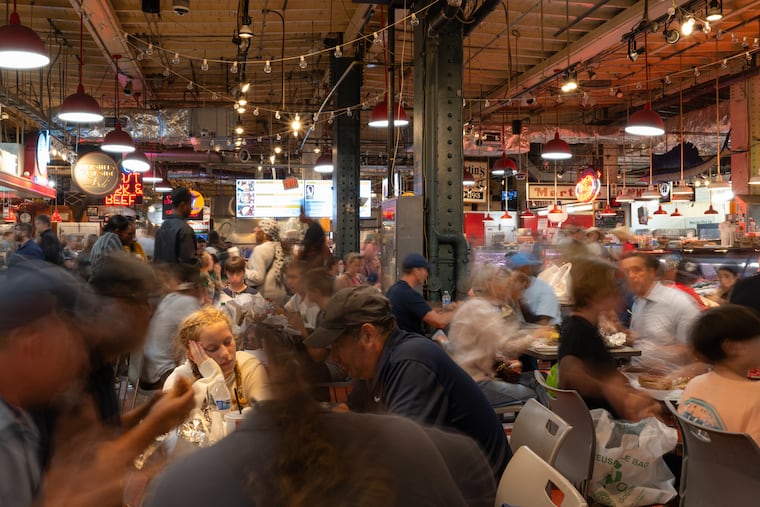
Nearly 6 million visitors, a mix of locals and tourists, spent $1.2 billion at Reading Terminal Market last year, according to a new study on the economic impact of the historic Center City market. That sales figure is more than double what more traditional supermarkets typically record in a year.
It’s the first time the nonprofit Reading Terminal Market Corp. has commissioned such a report, and the stats solidify the market’s status as “a beloved civic institution, and a powerful and vital economic engine for Philadelphia and Pennsylvania,” said Annie Allman, CEO and general manager. With the report, Allman said she is encouraging “continued investment in the market, its merchants, and its infrastructure.”
It highlighted the market’s importance to lower-income residents, with 18 Reading Terminal merchants accepting SNAP and EBT benefits. This accounts for about 55% of the Center City merchants who accept food-assistance programs, according to the report. Reading Terminal Market is considered the largest EBT- and SNAP- redemption location in Pennsylvania.
“Every dollar spent here is a dollar invested in Philadelphia — in our merchants, our hospitality industry, our neighbors, and our future,” Allman said in a statement.
The “Feeding the City, Fueling the Economy” report — released Tuesday and conducted by the Philadelphia firm Econsult Solutions at Reading Terminal Market Corporation’s request — found that the market has contributed about $126 million worth of annual economic activity to the city of Philadelphia and $146 million to the Commonwealth of Pennsylvania. These figures include direct spending at the market’s more than 75 vendors, as well as the subsequent spending by those vendors and the employees they pay.
The study also cited national accolades, noting that Reading Terminal was recently named the No. 1 public market in America by USA Today travel experts.
The new report found just over half of the market’s visitors last year, 3.1 million customers, were visitors staying overnight in the region, while the rest were Philly-area residents.
Some Reading Terminal customers may have first heard of the market online, on a podcast, or on TV and streaming programs: The report found that Reading Terminal reached 10.8 billion people through these kinds of media mentions, equaling $81 million in “publicity value.”
Between the market’s merchants and the corporation that runs it, Reading Terminal pays nearly 700 full-time-equivalent employees a combined $39 million a year, according to the report.
And market partners spend about $10.5 million a year on capital improvements, which include mechanical, plumbing and electrical upgrades, as well as larger undertakings like the 2022 Filbert Street Project that added 15,000 square feet of pedestrian-friendly outdoor space.
Founded in 1893, Reading Terminal is one of the country’s oldest continuously operating markets. Spanning nearly 80,000 square feet along 12th Street, between Arch and Filbert Streets, the market sells everything from fresh produce and seafood to homemade meats and baked goods.
At its quick-service restaurants, customers can find Caribbean cuisine, Asian street food, Filipino-fusion eats, Thai food, falafel, cheesesteaks, and vegan bites.
Allman, CEO and general manager, said 2026 “brought unprecedented global attention” to Philadelphia. This summer, the city hosted the World Cup, America’s 250th birthday celebrations, and the MLB All-Star Game. Any economic impact those events had on Reading Terminal Market, however, would be reflected in next year’s report.