More cars, containers, and cranes: What to know about ‘the largest expansion’ in Philly port’s history
Gov. Josh Shapiro said $371 million in state funding would help create thousands of jobs. That projection was based in part on a study officials declined to share.
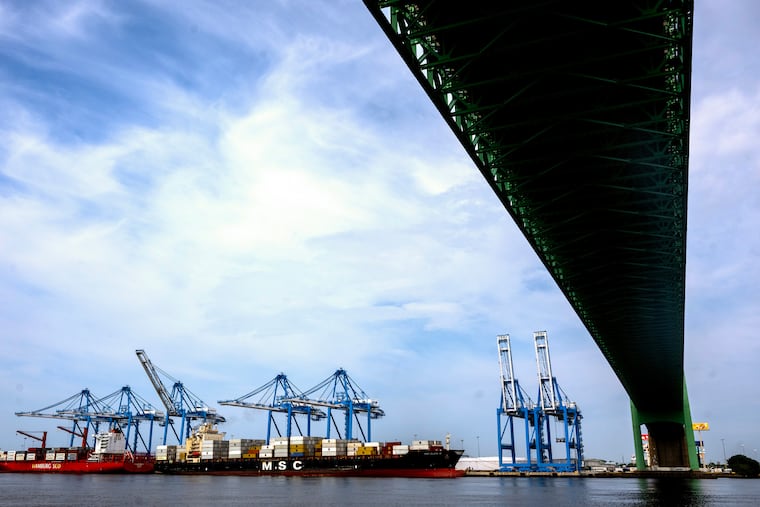
With the planned expansion of Philadelphia’s port on the Delaware River, it could grow to accommodate twice as much container cargo and over 100,000 more automobiles.
Pennsylvania Gov. Josh Shapiro earlier this month pledged $371 million in state funding to help attract more goods to the Port of Philadelphia. He said the state investment, combined with hundreds of millions of dollars more in federal funds and corporate investments, would create thousands of jobs.
The Democratic governor framed the investments as a vote of confidence in Philly as a hub of global trade even as President Donald Trump’s tariffs have inflated the costs of foreign goods. Trump has cast the import taxes as part of an effort to bring manufacturing jobs back to the U.S.
Shapiro says investing in the port will boost the local economy.
Here’s what to know about what the governor called “the largest expansion” in the port’s history.
Where is the money coming from?
$371 million from the state, financed through borrowing. That includes $90 million Shapiro’s administration authorized last year for the purchase of a 152-acre rail yard from Norfolk Southern Corp.
$266 million from the federal government, via two grants that were announced during former President Joe Biden’s administration. Shapiro’s office says that money couldn’t be tapped until the state came up with matching funds.
At least $200 million from the private sector: $100 million apiece from Holt Logistics Corp. and Glovis America, both of which lease property from the Philadelphia Regional Port Authority (PhilaPort), a state agency that owns seaport facilities along the Delaware.
How many jobs will be created?
PhilaPort says it currently supports 8,000 direct jobs, such as dockworkers, as well as about 4,000 jobs in port-related industries. Shapiro says the new investments will help create 6,000 more direct jobs — and generate $45 million in annual state and local tax revenues.
Those projections were based in part on a study performed by consulting firm Hatch that PhilaPort declined to share, calling it “commercially sensitive” because it is being used to support ongoing lease discussions with tenants.
Shapiro’s office referred questions about the matter to PhilaPort.
The Teamsters and longshoremen’s unions spoke in favor of the plan. Teamsters work the auto yard at the port’s Southport facility, while longshoremen unload cargo from ships.
“This is going to create hundreds of new Teamster jobs, thousands of jobs across the area,” said Bill Hamilton, eastern region vice president of the International Brotherhood of Teamsters.
In addition to Philadelphia-based jobs, “you’ll have, besides the Teamster jobs that are here, you’re going to have trucking jobs coming and going,” he said at the announcement Oct. 13. “… It’s a dream come true for some people without a college degree.”
The port will be able to handle more shipping containers and automobiles, creating greater economic impact, according to the port authority.
What cargo is the state trying to attract?
The port handles cargo such as automobiles, paper, petroleum products, steel, and cocoa beans, as well as containers that carry goods such as produce and pharmaceuticals.
The new investments are aimed at bringing in more containers and vehicles, officials said. The port handled a record 889,000 container units last year, as well as about 250,000 automobiles.
A key driver of the port’s container growth has been an increase in perishable imports such as fruit and meat, according to PhilaPort.
The volume of container cargo moving through the port was up 39% last year compared to 2020, Shapiro said. “The demand is quite real.”
Based on its current land allocation plan, PhilaPort projects the new capital will more than double the port’s container capacity to 2 million units and increase capacity for autos by 18%, from 588,000 to 694,000.
“We have the assets, we have the workforce, we have the land, and we’re ready to take this port to a whole new level,” PhilaPort CEO Rich Lazer said.
Why is this happening now?
Shapiro’s announcement comes two years after PhilaPort unveiled a strategic plan, Destination 2040, intended to guide its growth over the next decade and a half.
The plan cited increased investment by rival ports such as New York and New Jersey, Baltimore, and Wilmington, Del.
PhilaPort’s board “worked together to develop an ambitious vision for growth that not only plays to the strengths where this port is leading but also doubles down on the areas where we have the greatest potential to be able to grow,” Shapiro said.
What projects are being funded?
Much of the expansion is planned for Philadelphia’s southern port district, including at the Southport Auto Terminal on the eastern end of the Navy Yard.
Southport was created in 2010 when Gov. Ed Rendell set aside more than 200 acres of vacant land and water at the old Philadelphia Naval Base for port development. With $93 million in state funds invested under Gov. Tom Wolf, Southport opened in 2019 as a 155-acre auto terminal, where Hyundai and Kia vehicles are stored and processed before they go to dealer showrooms.
That expanded the port’s vehicle-import business, which started in 2010 at Pier 98 annex, a parking lot at Columbus Boulevard and Oregon Avenue.
Now Southport is poised to bring in more cargo. The port authority wants to build two berths that would allow ships to dock directly at Southport, relieving congestion for ships at the nearby Packer Avenue Marine Terminal.
The funding will also allow PhilaPort to fill in part of the river to expand the Southport terminal by 10 acres, creating more space for cargo, officials said.
Biden’s administration previously authorized two grants — one in 2021 and another in 2024 — totaling $266 million to support the Southport berth project. Shapiro’s office said those funds couldn’t be used until the state came up with matching funds, which the governor announced this month.
Once the berths are built, PhilaPort anticipates both containers and autos being handled at Southport, said spokesperson Marty O’Rourke.
The port authority’s acquisition last year of the nearby Mustin rail yard from Norfolk Southern is expected to create more space for that cargo.
Beyond South Philly, Shapiro’s plan also invests in the Tioga Marine Terminal in Port Richmond. The state is providing $58.1 million for two electric ship-to-shore container cranes and berth improvements.
The Environmental Protection Agency in 2024, under Biden, awarded PhilaPort tens of millions of dollars for the two cranes. But the type of crane needed isn’t made in the U.S., according to the port authority and industry groups. So to use them, PhilaPort has asked the Trump administration for a waiver from a U.S. law that requires federally funded infrastructure projects to use American-made products.
What’s the timeline for these projects?
“We have this project on an aggressive timeline with cranes being bid this year and the berth project being bid in 2027,” PhilaPort said.
Which companies will be involved in the port’s expansion?
The big players are family-owned Holt Logistics, operator of the Packer Avenue Marine Terminal south of the Walt Whitman Bridge, and Glovis America, an affiliate of South Korea-based Hyundai Glovis Co. Ltd. Glovis operates the Southport Auto Terminal.
PhilaPort appears unlikely to open the projects to other competitors.
In January, PhilaPort authorized up to $33,705 for consulting firm Hatch to “evaluate strategic development options” for Southport and Mustin, according to documents obtained by The Inquirer through a public records request.
In its project proposal, Hatch wrote that it would determine whether the port authority should negotiate development plans directly with existing tenants — such as Holt, Glovis, and DVR Philly — or initiate a competitive process by issuing requests for proposals, the records show.
The Inquirer obtained a copy of the study through a records request, but it was almost entirely redacted. PhilaPort cited exemptions in the state’s Right to Know law for documents that reflect “internal, predecisional deliberations.”
Asked whether PhilaPort considered issuing a public RFP, spokesperson O’Rourke said the authority’s board “reviewed alternatives to move forward to identify the best path forward to effectuate port growth and expansion.”
“Based upon lease agreements and current partnerships with our existing tenants (Holt and DVR/Glovis), it is our intention to move forward in expanding these agreements and relationships currently in place,” O’Rourke said in an email.
“Our partners clearly add value to our efforts to maximize port growth,” he said. “PhilaPort is working with DVR/Glovis and Holt on a parallel path to identify a land allocation and phasing plan to accommodate the increased capacity.”