2026 Volvo EX30: The little EV that could go fast, but beyond that …
It’s small and feels every bit of it. That helps with the acceleration and handling, but not with fitting in people or feeling like you’ve gotten your money’s worth.
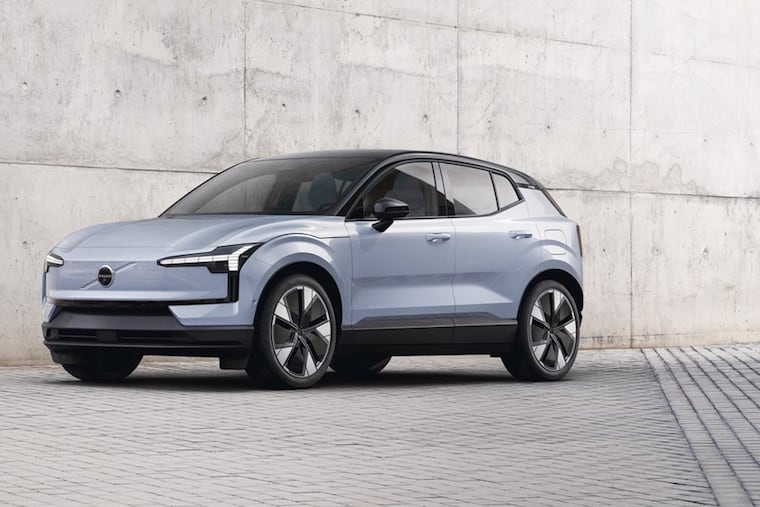
2026 Toyota bZ XLE FWD Plus vs. 2026 Volvo EX30 Twin Motor Performance Electric Ultra: A little EV battle.
This week: 2026 Volvo EX30
Price: $48,445 as tested
What others are saying: “Highs: Blistering acceleration, short stopping distances. Lows: Unintuitive controls, overly light steering, cramped rear seat, some driving position quirks,” notes Consumer Reports.
What Volvo is saying: “The range and quick charging you want in a small SUV that’s big on style, storage and safety.”
Reality: You’re really leading with range and recharge rate, Volvo?
What’s new: The EX30 is Volvo’s answer to the small car, but in EV form.
Competition: I kinda cheated pitting the Toyota and the Volvo against each other, at least following Consumer Reports’ competition report, but they do run about the same price when outfitted comparably. And it’ll make even more sense later. Others are Audi Q4 E-Tron and Q6 E-Tron; BMW iX; Cadillac Lyriq, Optiq, and Vistiq; Genesis Electrified GV70 and GV60; Lexus RZ; Lucid Gravity; Mercedes-Benz EQE and EQS; Rivian R1S; and Tesla Model X.
Driver’s Seat: The EX30 requires a great deal of get-acquainted time. Like a Tesla, the Volvo puts all the information you need into the spacious touchscreen in the center of the dashboard — there are no standalone gauges.
The key card waved in front of a spot marked with a Wi-Fi symbol in the driver’s door gives you access; place that card in the exact spot in the console to fire the motors up. Waving the card in front of the door at shutdown locks everything up and shuts it off.
An app can do all that as well.
Driving position is almost like a city bus in its verticality, completely opposite the bZ’s stance, but the seat is comfortable. An array of seating controls happen in just one button; watch the screen to see which one you’re on and then adjust accordingly.
Play some tunes (perhaps better renamed “Controlling the vehicle”): Like the seat adjustment options, everything happens in the touchscreen. Lights? Also in the touchscreen.
As for the music, I never found much in the way of tone adjustments, but the standard setting seemed to play just fine, about an A-.
Keeping warm and cool: This also pretty much happens in the touchscreen. A small temperature icon lets you change that in a larger window, and a little fan icon lets you make more detailed adjustments, which is a real pain. Either should offer the whole array.
Manual adjustments were quite fussy, but automatic settings left me uncomfortable most of the time. Most vehicles figured this out a long time ago.
Up to speed: Like almost every electric-powered vehicle, the EX30 zips from a start so freely, it’s almost like you barely have to look before pulling into traffic. I said almost, people. I heard those tires squealing.
For small-car lovers like Mr. Driver’s Seat, the EX30 really brings the best of peppy little rides. The two motors produce 422 horses, and that rushes the little car to 60 mph in 3.4 seconds, according to Volvo. That’s half a second slower than a Corvette (2.8 seconds).
A front-drive version gets 268 horses and reaches 60 mph in 5.1 seconds. Advantage Volvo, on both models.
Shiftless: Tap the right steering column lever downward for Drive or up for Reverse. A button on the end parks the vehicle.
On the road: Unlike the bZ, the all-wheel drive and battery weight don’t do much for the handling, though. The EX30 handles like a golf cart at its best. But it’s small and maneuverable, and the punchy performance makes up for the sedate slithering.
Friends and stuff: Legroom is quite snug. Head and foot room are nice, though. The seat is seriously short; the accommodations are just not that nice back here.
Volvo claims the cargo space is 12.5 or 27.8 cubic feet, which is a super low number. Some manufacturers measure the dimensions differently; this seems on par with similar-size vehicles, although probably not as generous behind the rear row as the bZ. Still, I can confidently say advantage Toyota.
In and out: Entering the rear doors is the tightest I’ve felt this side of a two-door. Advantage Toyota.
Sunny days: I still haven’t figured out how to close the shade for the sunroof.
In the rain: When it’s raining, a driver wants easy access to the wipers, defroster, and rear defroster. As in, why aren’t these grouped together?
The wipers are on the steering wheel stalk, and the defrosters require two-plus clicks into the touchscreen. Sure, there’s a standalone defroster button for making the thing blow so hard it feels like the windshield has been removed. (Business idea: This setting could be sponsored by Refresh Tears or some similar eye drop manufacturer.) Advantage Toyota.
Range and recharge: The EX30 has a maximum range of 253 miles, a little on the short side.
Volvo says the charging from 10-80% capacity is 28 minutes. The EX30’s recharge rate on a simple 110-volt charger is one of the quickest I’ve seen in the last several years, gaining 4 miles per hour of charge. Advantage Toyota.
Where it’s built: Ghent, Belgium. Parts are 80% Chinese and 10% Belgian.
How it’s built: The EX30 rates a 2 out of 5 for reliability from Consumer Reports. I’d have guessed lower. I’ve had Volvo EVs that repeatedly failed to show up for test weeks because of rainy weather. I’m hoping they’ve worked out those kinds of issues.
In the end: The EX30 would be great competition for the CX-30 Turbo, a $35,000 ride, because this is also an awesome $35,000 ride. Unfortunately, it costs $48,000.
So the bZ really wins the day here. But even its $40,000 price tag is also not going to help move vehicles.
And the EX30 is no competition for most of the Consumer Reports offerings; some of those are running over $100,000 and have far different space configurations.
Coming in September I expect to review the new Chevrolet Bolt. Here’s hoping.