2026 Chevrolet Colorado Trail Boss: Some give and take
The most expensive small truck of the three tested includes a $13,000 option package but lacks at least one basic amenity almost every other vehicle has.
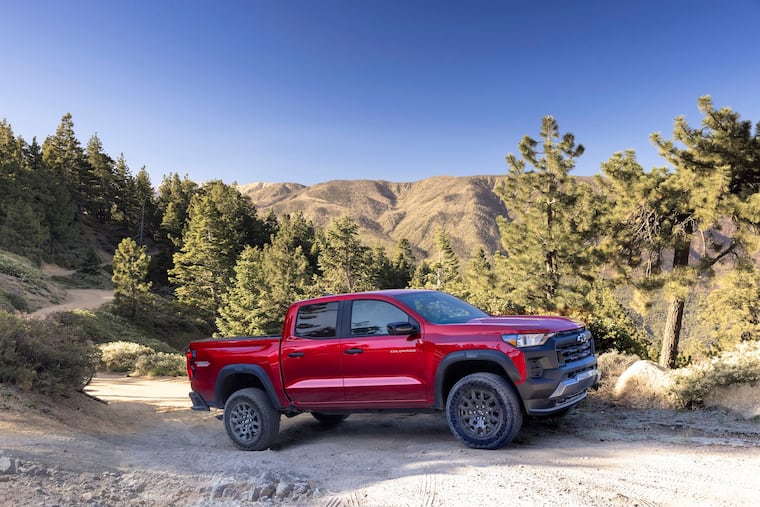
2026 Nissan Frontier Crew Cab Pro-X V-6 vs. 2026 Hyundai Santa Cruz XRT AWD vs. 2026 Chevrolet Colorado Trail Boss Stars and Steel: Smallish truck smackdown.
This week: 2026 Chevrolet Colorado Trail Boss Crew Cab
Price: $57,240 as tested. Almost $10,000 more than the Frontier, and almost $15,000 more than the Santa Cruz.
What others are saying: “Pros: Powerful turbo I-4 engine, great off-road capability, light bar useful on trails. Cons: Somewhat sluggish transmission, slowish steering response, minor wheel hop during hard braking,” notes Motor Trend.
What Chevrolet is saying: “Take the American landscape by storm.”
Reality: Yes, a very bouncy storm.
What’s new: The model has very little updates since the 2023 redesign. This year adds the Stars and Steel Edition tested, which presents $13,555 worth of options. Granted, that includes heated seats and steering wheel, adaptive cruise, technology package, and power adjustable seat, but that still seems like about $7,000 for cool graphics and stuff.
Competition: In addition to the Frontier and Santa Cruz, there are the Ford Maverick and Honda Ridgeline, Ford Ranger, GMC Canyon, Jeep Gladiator, and Toyota Tacoma.
Up to speed: The Colorado as tested is powered by a 2.7-liter Turbomax four-cylinder engine. It creates 310 horsepower and gets to 60 mph in 7 seconds, according to Motor Trend. Despite all those horses it’s still the middle of the pack among our three test vehicles. The Santa Cruz wins this segment.
Shifty: The eight-speed automatic transmission is controlled by a vintage shift lever with just PRNDL options.
On the road: The Colorado Trail Boss followed the usual template of small off-roady trucks — hard to get used to and then suddenly quite fun. Once I found my position on the road, I was able to roll around country lanes with a lot of momentum, probably worrying passing motorists along the way.
The large balloony tires transmit a good bit of bounce, though, and the Trail Boss really loses its cool over rutted roads. I think Motor Trend was a little too subtle in its comment about “minor wheel hop” on hard braking; it’s a lot. The Santa Cruz wins here, too. Although the Frontier and the Colorado were quite fun, I noted the Frontier’s bouncy ride and the Colorado’s hoppiness make both also-rans.
In and out: The Colorado featured rocker protectors, and these resemble running boards sitting there teasing me. I thought they’d lower to ease my climb into this very tall truck, but they were not interested. Gonna have to stretch those IT bands. Obviously the Santa Cruz is the easiest here.
Driver’s Seat: After you pass that little entry test, the seats have nice ergonomics, and the fabric is nicer than trucks have a right to. I set dirty gloves down on them and the dust did not just brush off.
The steering wheel does not telescope, at least not in the test version. (The internet contends some trim levels have it. I’m not going to argue with the internet, but I’m also going to scrunch one eyebrow a bit.) But does Chevrolet really gain by two setups for the steering wheel? Can it be worth the extra manufacturing needs? It’s just another in a long line of cheapskate moves.
I’m surprised that I wasn’t more annoyed, especially since “annoyed” is my default setting, but I seemed to match up with the steering wheel nicely. Still, I cannot see myself ever dropping close to $60k on a truck missing such a basic feature as a telescopic wheel. I like the Nissan for its no-frills approach but still including that “frill.” Finally, the Frontier is king.
Friends and stuff: The rear seat offers scant room for feet and tight quarters for legs. Only headroom is roomy. It sits upright squeezed in between the first row and the bed, with no adjustments at all.
The seat bottom folds up for cargo space but a tool box under the seat remains and makes the cargo space less than ideal.
The Trail Boss pulls up to 7,700 pounds, the highest among the contenders, but passengers win in the Frontier.
A word of caution — if you get the fun Trail Boss roll bar coupled with the roll-up bed cover, watch your head when rolling up the cover. That left a mark.
Play some tunes: After some adjustment — some very deeply nested, multiscreen trips to the equalizer — the sound from the nameless audio system was just about phenomenal, an A leaning to an A+.
The 11.3-inch touchscreen does most of the work, but dials for volume and tuning are there to help out. Finally, a category for the Chevrolet.
Keeping warm and cool: Buttons underneath the infotainment system and dials for temperature make adjustments fairly simple.
The infotainment system pushes the middle vents way down, so having a fan blow right on your sweaty, overworked face from both sides is not really an option, and also kind of a deal-breaker. Another one for Nissan.
Fuel economy: The Trail Boss averaged just under 18 mpg, so it beat the Nissan but fell short of the Santa Cruz. None of them really sips fuel, although I guess each is different by about 10 percentage points, and that will add up.
Where it’s built: Wentzville, Mo., with 44% of parts from the U.S. and Canada and 28% from Mexico.
How it’s built: The Chevrolet Colorado gets a predicted reliability of 2 out of 5 from Consumer Reports, not measuring up to the other trucks’ 4s.
In the end: If you can make the Santa Cruz work for you, it’s the cheapest, easiest to drive, and most efficient, and it won the most categories (five). If that’s not going to work, I’d send you to the Frontier (four categories).