For Whiz Kids, losing Simmons to Army was disarming
Third in a series BY 1965, CURT SIMMONS knew that his baseball career was winding down and that he'd have to find a way to make a living when he was through playing. About that time, a lawyer friend came to him with a proposition.
Third in a series
BY 1965, CURT SIMMONS knew that his baseball career was winding down and that he'd have to find a way to make a living when he was through playing. About that time, a lawyer friend came to him with a proposition.
"He said, 'A bunch of us are buying this old, run-down golf course and we'd like you to get in with us.' I said, 'What do you think?' 'Ah, I think it's going to be all right.' 'All right, put me in,' " Simmons recalled.
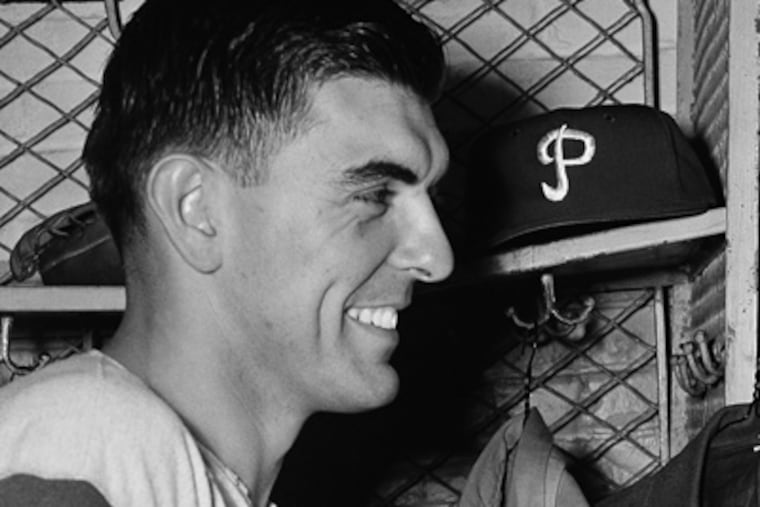
It turned out to be a fateful decision. More than 40 years later, he's still at the Limekiln Golf Club in Ambler. The youngest of the Whiz Kids - just 20 when that magical season began - he retired after playing 2 months for the Angels in 1967.
As time went on, he bought up more and more stock when the original partners wanted to sell.
"Because I had to have something to do when I was finished," he explained on a rainy January day, sitting at a table in the clubhouse dining room. "I really enjoyed the outdoors. I was more of a dirt man or a farmer. I didn't know that much about golf. But that's how I got started here as the manager in 1967. And I've been here ever since. It's come a long way. It was an abandoned golf course that they bought from an estate. It's worked out well for us. It's been a nice life for me."
Before 1950, Simmons was a hard-throwing but erratic lefthanded bonus baby with a 12-23 career record. That season his command arrived and he was 17-8 before his National Guard unit was activated with a month to go in the season.
He had his picture taken, in his Army uniform, on the bench before one of the World Series games against the Yankees. He pitched batting practice. "I think I put them in a slump," he said with a laugh; the Phillies batted just .203 as a team while being swept. But he had to watch from the press box once the action started.
"[Owner] Bob Carpenter, the old man, Ruly's father. He was running things then. Charlie Bicknell and I were both 18 in 1948. He said, 'I want you kids to join the National Guard because they're having a peacetime draft and this way you'll avoid the draft,' " Simmons recalled.
At first, it worked out fine. He had to go to Indiantown Gap, a camp near Harrisburg, for 2 weeks in the middle of the season. In the winter, he had to attend meetings once a week.
"Now it's 1950 and we're at Indiantown Gap for a couple of days and the Korean War is cranking up and they said, 'Everybody, you have 30 days to get your stuff cleared up. You're in the Army,' " he continued.
Traveling secretary Frank Powell told Simmons not to worry, that the team was working on getting him a 30-day deferment. It didn't happen.
"So we reported to the armory at Broad and Diamond. I think it was Sept. 5 or something like that," Simmons said. "Spent a week, 7 a.m. to 5 p.m. at the armory doing all kinds of Army stuff. Then I'd go to the ballpark. I pitched on a Wednesday night. That's the night [Brooklyn's Don] Newcombe pitched against [Robin Roberts] and beat him. Then [Newcombe] started the second game. He pitched seven innings and I'm winning, 2-0. A guy gets a base hit and I walked a guy and [manager Eddie] Sawyer came out. He says, 'I'm going to get you some help. I'm bringing in Jim [Konstanty].' And boom, boom, boom, we lose, 3-2. And I'm really hot. I'm upset or whatever."
Since he was leaving for boot camp in Indiana on Sunday, Simmons started again on Saturday and was hit hard. The next day, Powell was at the train station assuring him that the Phillies would get him back.
"Well, they didn't get me back," he said dryly.
He found out that the Whiz Kids won the pennant while playing touch football between the barracks when somebody listening on the radio called out the news. Later, he was summoned to the phone when some of his celebrating teammates called him from their party at the Warwick Hotel.
"Robbie [Roberts] sounded OK. But Willie Jones and a couple of those guys weren't too coherent. I just said, 'Way to go, boys,' and talked to them for maybe 10 minutes. And that was it," he said with a laugh.
The Army gave him a 10-day leave, without pay, to attend the World Series. He jumped at the opportunity. He isn't bitter about missing the postseason. "I knew it was coming. It wasn't a real surprise because they'd been talking about it. It was just one of those tough deals," he said philosophically.
Released by the Phillies a month into the 1960 season, Simmons caught on with the Cardinals, and won a World Series ring with St. Louis in 1964 when he went 18-9. He also pitched for the Cubs and Angels before retiring with a 193-183 career record.
Now 80, he watches most Phillies games on the big-screen television at his home. He joked that he can umpire better from that vantage point. His wife has been ill and he no longer likes to drive at night.
"I've had my ups and downs, a lot of them," he said. "But it was what I wanted to do as a kid, so I hung in there. Overall, it's been good. A nice life."