Philly kids are heading back to class Monday. Here are 4 things to know about the coming school year.
Half days are gone, 52 schools remain un-airconditioned, it's the last year before school closings happen, and there are lots of administrative changes coming as a new school year begins.
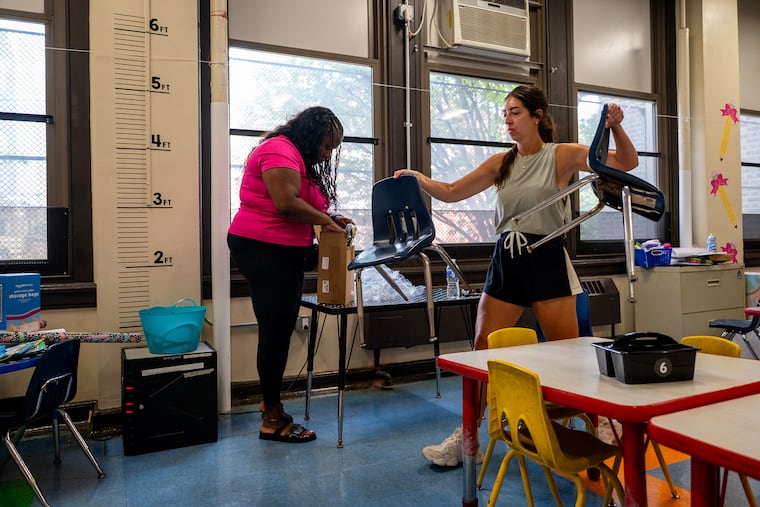
School begins Monday for about 113,000 Philadelphia School District students.
Janis Butler, the interim principal of Fanny Jackson Coppin Elementary in South Philadelphia, has decades of experience in teaching and administration.
But she is still thrilled at the prospect of personally welcoming back Coppin’s 500-plus students.
“It’s a rah-rah, we’re back in business now,” Butler said.
Here is what to know about the 2026-27 school year.
School is cool. (But 52 schools are not cool.)
District leaders said in 2022 they aimed to have all district schools fully air-conditioned by 2027.
But on the cusp of that cutoff, 52 schools remain inadequately cooled. That is likely to come into play as school starts in August, with weeks to go before temperatures cool down.
The district’s extreme-weather protocol calls for schools that lack sufficient air-conditioning in classrooms and other learning spaces to dismiss early if temperatures are forecast to reach or go past 85 degrees by noon. The protocol mandates remote learning if temperatures are expected to hit 85 degrees by 9 a.m.
That means an unequal experience for students across the system, with students in some schools not missing any instructional time when it’s hot, and those in a quarter of schools subject to interrupted schedules.
The holdup in air-conditioning all district schools is not related to the cost of air-conditioning units, but rather upgrading old electrical systems in the 52 schools.
Such upgrades are tricky. An HVAC project at Kensington High went awry this summer, triggering asbestos issues that forced students and staff to relocate for the rest of the calendar year.
Farewell, half days
The school board in March opted to cut all half days from the 2026-27 calendar, a move that Superintendent Tony B. Watlington Sr. would carry on “forevermore.”
Watlington cited dips in student attendance around half days, and said they are inconvenient for parents who must scramble to plan for childcare around the irregular schedule.
Eight half days had been previously scheduled for this year.
This is the final year before some schools close, and others merge
The school board voted in April to move forward with a $3 billion facilities plan that will close 17 schools and renovate 169.
The first closures are expected at the end of the school year. That means that this is a planning year for 50 schools — those that are closing, beginning phaseouts, or receiving students in the 2027-28 school year.
The district is forming transition committees at those 50 schools, and will begin accepting applications Aug. 31 for roughly 20 spots on each transition committee.
Plenty of administrative shifts have happened
Watlington has made a number of changes at the top of his administration, some as a result of departures. Other leaders were given new roles or responsibilities.
Among the changes are: a new chief of talent, Kristi Murphy Baldwin; a new deputy superintendent of academic services, Brenda Elliott; a new chief academic officer, Michael Farrell; and additional responsibilities for Nathalie Nérée, who becomes chief of special education, diverse learners, and wellness.
Nyshawana Francis-Thompson has a new title: senior adviser for strategic initiatives and innovation.
Jamina Clay-Dingle is now assistant superintendent of school management and organization.
There are some new assistant superintendents for various learning networks around the city: Kelly Espinosa and Kahlila Johnson will serve full-time, and Wilfredo Ortiz and Lucy Feria on an interim basis.
Noah Tennant is now associate superintendent for secondary schools, and Tomás Hanna is now associate superintendent for student life and school operations.
A number of schools have new principals, too: Adaire Elementary, Amanda Strain; Bridesburg Elementary, Louis Depa; Clemente Middle School, Regina Barr; Edison High, Albert Sniezevage; Benjamin Franklin Elementary, Ryan Sullivan; Heston Elementary, Kamia Smith; Lawton Elementary, Michelle Todd-Coleman; Memphis Street Academy, Wayne Diggs; Northeast High, Andrew Lukov; Southwark Elementary, Mason Luksch Wilson; Bayard Taylor Elementary, Claire Charles; Tilden Middle School, Jessica Culp; Waring Elementary, Cathryn Anderson.