What happens when kids who witness gun violence go to school? This Philly program aims to help.
It's a shift from when “the word trauma wasn’t really part of our vocabulary in policing or frankly, much of the conversations around children,” Police Commissioner Kevin Bethel said.
In the past, Principal Shauneille Taylor had no way of knowing when one of the children at Edward Gideon Elementary School had witnessed a shooting, or an incidence of domestic violence, or seen a parent arrested.
The child might walk into the North Philadelphia school the next day and act aggressively, or appear withdrawn, or shut down, and adults would wonder why — sometimes, they might even assign disciplinary consequences for acting out.
» READ MORE: Philly is getting $1 million to train 400 teachers, police officers to help students who experience trauma
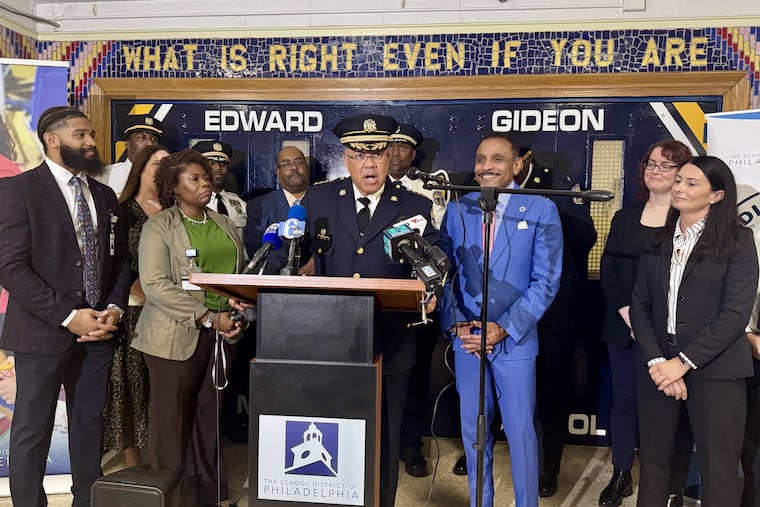
That changed with an initiative piloted at Gideon and 14 other city schools, now going district-wide, Philadelphia Pollce Commissioner Kevin Bethel and Superintendent Tony B. Watlington Sr. announced Monday.
The “Handle With Care” program allows officers to make referrals to schools attended by child witnesses to crimes. Schools are then alerted that one of their children may need extra attention, with staff trained in trauma-informed practices and poised to offer more support.
“Having that hands up has made a profound difference for our school,” Taylor said at a news conference in a Gideon hallway Monday.
The program is the brainchild of Bethel, a former district safety chief and longtime city officer, who dreamed for years about figuring out a way to better care for kids who witnessed traumatic events.
In 2024, the district used a $1 million federal grant to launch a “Handle With Care” pilot in 15 schools in North Philadelphia. That money paid for training and a dedicated staffer.
A $200,000 state grant will fund the staffer’s work going forward, officials said.
Officials “didn’t want to assume that everyone understands trauma, how to identify the warning signs, and how to provide that support,” Bethel said. “So we had the opportunity to provide training to Philadelphia police officers and school-based staff, not only on how to understand trauma, but on how to provide meaningful support. Through this pilot, we were able to provide that support to more than 70 students who may otherwise have walked into school carrying the weight of what they experienced without anyone knowing that they just needed a little extra care.”
It’s certainly a shift from years ago, Bethel said, when “the word trauma wasn’t really part of our vocabulary in policing or frankly, much of the conversations around children and their experiences.”
“But we understand today more than we do ever that young people experience and how those experiences affect their behavior, their ability to learn, their relationships, and their development. Our young people are exposed to significant levels of trauma,” he said.
When children witness traumatic events, officers have the ability to trigger Handle With Care alerts. A point person at the child’s school will then be alerted - not with the details of the incident, just that this student needs extra support because of an event.
It “gives the school an opportunity to intervene...rather than waiting until a child’s trauma manifests its way into a disciplinary action or academic, emotional problems,” Bethel said. “Early recognition creates an opportunity for early intervention.”