In a rare interview, Penn’s president opens up about leading the school under the Trump administration
Penn President J. Larry Jameson discusses the challenges he's faced during a tumultuous last two and a half years and his plans for Penn's future.
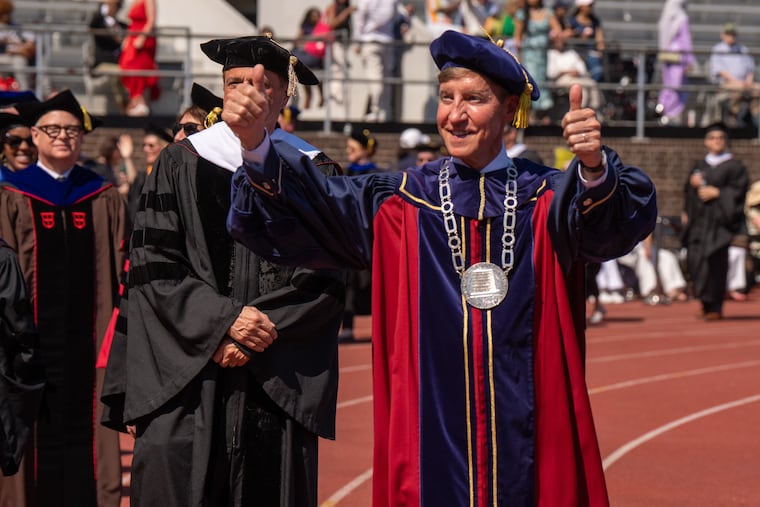
University of Pennsylvania president J. Larry Jameson did not complain or cry foul — as some college presidents have — when asked about leading Penn during President Donald Trump’s administration.
That’s even though the government has threatened Penn’s federal research funding, demanded lists of Jewish people on its campus, and pressured the school into an agreement over transgender athletes.
Instead, he wanted to talk about the positive visit Trump’s National Institutes of Health director recently made to campus and a prestigious international research prize that Penn won.
“I’m convinced that the federal government will continue to robustly support what we do,” Jameson told The Inquirer this month. “It doesn’t mean we don’t have to work to build trust and inform people about what we do.”
It was the kind of calm, carefully measured response Jameson has become known for — and one that some say should keep him in the job.
In a wide-ranging, 70-minute interview this month, Jameson explained his decisions to resist the Trump administration on some things and negotiate on others.
“My approach has been not just to complain,” Jameson said during his first interview as Penn’s president with a major media outlet, “but to say, ‘Well, here’s where we’re working together very effectively. Here’s where we’re not necessarily aligned, but let’s discuss how to move forward.’”
He acknowledged that is not always possible.
“Sometimes,” he said, “you have to accept the fact that you’re not fully aligned.”
Jameson, an endocrinologist who previously led Penn’s health system and medical school for more than 12 years, was thrust into the presidency in December 2023 after Liz Magill resigned following a bipartisan backlash over her congressional testimony about antisemitism.
And it didn’t get any easier, as Penn, along with other elite colleges, a year later found itself under intense pressure from the Trump administration to make changes that could cut at the heart of its values and mission or risk losing precious federal funding.
Many at Penn credit Jameson with stabilizing the university during a difficult time.
“Even if this were a good time to search for a new president — and it decidedly is not — I cannot imagine Penn finding a more effective leader,“ said Eric Feldman, faculty senate tri-chair and a law school professor. ”His deep knowledge of the medical school is a significant asset amid continuing pressures on federally funded research, and his extensive leadership experience, spanning decades, makes him uniquely well suited to guide the university through what are likely to be several more complex years.”
But Jameson, 71, would not say whether he wants to extend his contract beyond its June 2027 end date or whether he has been asked to stay longer. The board of trustees is likely to announce an extension or a search for a new president next month.
“My goal from the beginning has been to position the university to thrive,” Jameson said. “I feel pretty good about where things are right now. We’ll continue to discuss it and make a decision in June.”
Jameson earned total compensation of more than $8 million in 2024, the most recent tax year available. That included $5.4 million in “reportable compensation” and more than $2.5 million in other compensation.
And while running a university is not easy these days, Jameson underscored how much he is enjoying the job, especially interacting with students and faculty, and said it far overshadows the challenges.
“I feel like a freshman,” he said, smiling, “where every day, I’m learning in an exponential way.”
Jameson is also optimistic about Penn’s future. He touted Penn emeritus professors who last month won the international Breakthrough Prize for developing the first FDA-approved gene therapy for genetic blindness.
He also highlighted the recently launched Penn Forward, a strategic initiative that he said is designed in part “to build trust” in Penn at a time when higher education faces increased scrutiny and skepticism about its worth.
Finding compromise
Jameson notes he has been in leadership roles since age 33, but as Penn president, he has faced new challenges.
He watched closely last year as Trump’s administration cracked down on Harvard and Columbia Universities for failing to comply with its demands.
» READ MORE: Penn president says federal government has halted $175 million in research funding to faculty
Penn could have been next. The government paused $175 million in federal funding to the school and made demands regarding transgender athletes.
“We have a lot of interface with the federal government, and having them take strong actions, which we’ve seen at other institutions, against us is potentially very harmful,” Jameson said. “It’s something that I take seriously.”
Penn struck a deal last summer and met a number of the White House’s demands, including adhering to the Trump administration’s definitions of sex, female, male, women, and men, and sending letters of apology to female athletes who felt aggrieved by transgender swimmer Lia Thomas’ participation on their team during the 2021-22 season.
Penn pointed out at the time that the agreement was restricted to athletics and did not affect other university operations, and Jameson reiterated that stance during the interview.
Jameson also noted that as an endocrinologist he has treated transgender patients.
But the agreement upset some who felt the school was not defending transgender students.
“It was a compromise,” Jameson said. “We went back and forth a lot with them.”
The government banned transgender women from female sports only after Trump became president. So Jameson said it was “strange” that Penn was targeted for the prior participation of a trans athlete. The university, he said, was in compliance with the federal Title IX law before Trump’s ban and after.
» READ MORE: The story behind Penn’s deal with the Trump administration on trans athletes and Lia Thomas
“To me, this is like a small town changes the speed limit, and they decide it used to be 40 and we’re going to change it to 30,” he said. “They looked back and said, well, you were going 40 miles an hour and you should have known we were going to lower it.”
Also to comply with Trump policy changes, the university last year scrubbed its websites of diversity initiatives, a move many other colleges also took amid some criticism.
Penn has rejected the government on other asks, including refusing to sign a compact that would have given it preferential treatment for federal funding if it agreed to operational demands.
» READ MORE: Penn rejects Trump compact offered to colleges
The university also is actively fighting a demand by the Equal Employment Opportunity Commission to turn over lists of Jewish people on its campus for its investigation into alleged antisemitism at Penn. The agency sued Penn for not complying with its subpoena and a federal judge sided with the EEOC, but Penn is appealing the decision.
Former Penn president Amy Gutmann, who hired Jameson to lead the health system and medical school in 2011, praised his stance.
“Larry ultimately is the decision maker here,” said Gutmann, Penn’s longest-serving president, “and he said, ‘We will appeal. We cannot do this.’ That’s being both decisive and resilient.”
Gutmann called Jameson “totally unflappable” and “a really unifying force in a time that is very polarizing.”
‘The right balancing game’
Even some who do not agree with all of Jameson’s decisions credit him with stabilizing Penn during one of its greatest leadership crises and bridging division on campus.
“I think he’s playing the right balancing game, to be honest,” said Musab Chummun, a rising senior and student body president.
Chummun is among students and faculty who have been critical of some university decisions under Jameson, including removing DEI from websites and proposing new open-expression guidelines that they say are too restrictive and could chill free speech. Penn in 2024 released temporary new guidelines following a tumultuous semester capped by the establishment of a pro-Palestinian encampment, and established a task force to develop permanent rules. University officials plan to consider feedback before issuing a final version this fall.
“It’s a great example of a document that feels like it was written to protect the university from lawsuits or public attention rather than a document that is steeped in a liberal arts education where vigorous debates are hashed out,” Jessa Lingel, president of Penn’s chapter of the American Association of University Professors, said of the guidelines.
Jameson said the input from the community will be “incredibly valuable” and the university is taking the time to listen.
“We want to get this right for the Penn community, and we need to balance all sorts of things,” he said.
Many people would have preferred “a bolder defense” of the liberal arts than Jameson has mustered, said Lingel, an associate professor of communication and director of the Gender, Sexuality, and Women’s Studies Program.
“There are a lot of people who are looking at this moment where higher education is so politicized for a steady hand and a bold vision that lays out this is why a liberal arts education is worth fighting for and this is what a liberal arts education means at Penn,” Lingel said.
Scott L. Bok resigned as Penn’s board of trustees chair when Magill resigned, following the upheaval over the handling of antisemitism complaints, and he has been critical of some of the university’s past decisions.
» READ MORE: Former Penn board chair Scott Bok and President Liz Magill discuss the upheaval that led to their resignations
But he said Jameson has “performed admirably in a very difficult environment.”
Jameson has kept a low profile and avoided escalating conflicts, while not backing down or giving in on significant issues, he said.
He managed situations “in a way that lets the university continue to go about its business, without too much interaction with Washington that could impact its operations,” Bok said.
Touting Penn’s research
Sometimes the interactions with federal officials have been positive.
Jameson touted that Penn recently hosted NIH Director Jay Bhattacharya to showcase work such as a CAR-T lab that develops immunotherapies for cancer and to introduce him to patients helped by the lab. The NIH provides much of Penn’s federal research funding.
“Meeting the patients,” Jameson said, “goes a lot further than me going to the Hill and dropping some statistics in front of people.”
» READ MORE: Philly scientists win 2026 Breakthrough Prize for developing gene therapy for blindness
Penn’s federal funding fell 5.6% from $1.03 billion in 2024 to $976.7 million in 2025, the first year of Trump’s presidency.
Having been in the medical research field for decades, Jameson said, he has seen the NIH budget swing dramatically but eventually revert to something that benefits society.
“The fact that I’ve been on that ride before gives me some confidence that the federal policies will swing back and forth,” he said. “This, too, will get better.”
At one point, Penn stood to lose $250 million in federal funding from Trump’s proposed NIH cuts, though that effort was defeated in the courts. Congress has authorized generally flat funding for NIH this year, Jameson pointed out, but things are moving slowly.
“The NIH director assured us that by the end of the fiscal year, which is in September, that they’ll catch up,” Jameson said. “But people are worried. … You can sense on the ground that there is more anxiety.”
Small labs with graduate student workers and postdoctoral researchers rely on that funding, which Penn has been trying to bridge, he said. The university is looking to raise more research dollars from the private sector and philanthropic partners, he said.
Donations to Penn overall are up, he said, declining to provide numbers until the fiscal year’s end in June.
But that does not mean the school isn’t tightening its belt in preparation for potential federal cuts and increased legal and insurance costs. Penn in January asked schools and centers to pare 4% from their budgets for the next fiscal year, on top of a 5% cut last year.
Jameson said no broad or institutionally led layoffs are planned. But some Penn units could choose to eliminate positions to meet budget targets.
‘It’s a treatment plan’
Jameson said Penn, which operates on a $17.7 billion budget including its health system and has a $24.8 billion endowment, wants to remain in a strong financial position so it can reinvest in priorities such as the new Penn Forward plan.
The plan calls for everything from more transparent and predictable tuition and cost policies and improved student experience to more efficient operations, a focus on keeping Penn at the forefront of best uses of artificial intelligence, and a growing presence in the San Francisco Bay Area — where Wharton already has a campus.
The three main themes, he said, are to “build trust” in Penn, “catalyze discovery, and extend the reach” of a Penn education.
“Penn Forward in my view is not just a diagnosis, but it’s a treatment plan,” Jameson said.
It’s important, he said, for Penn to explain that while its tuition sticker price continues to rise, the school is doling out much more financial aid — the university provides about $350 million in undergraduate aid and about the same to graduate students — causing the net tuition cost for students receiving support to actually drop when adjusted for inflation. The school in 2024 made tuition free to families with typical assets and incomes of $200,000 — up from $140,000.
Penn needs to open its doors to a wider range of students, and that means convincing them Penn is affordable, he said.
Communicating better internally is something Jameson said he wants to work on, too.
“Sometimes people will feel like they’ve just not been kept in the loop,” he said, and sending written messages is not enough.
“So what I’ve been doing more of — and I think it’s working — as much as possible, I’m just on the ground face-to-face,” he said.
Sometimes that means standing with students to watch the solar eclipse. Other times, it’s attending a faculty senate meeting or an alumni event or visiting a research lab.
Jonathan Epstein, Penn’s medical school dean and health system executive vice president, said Jameson has listened carefully to all parties before making decisions, which has given people confidence that they are being heard.
“It’s tempting for people to get emotional or frustrated during times of crisis, but Larry just wants to hear the facts and steer the ship forward,” he said.
Now it is time for Jameson and the university to decide whether he will continue in the role beyond next year.
Ramanan Raghavendran, chair of Penn’s board of trustees, declined to comment on a potential contract extension but said Jameson’s presidency “is among the most consequential” in Penn’s history.
“He first brought a much-needed sense of calm and purpose, given the circumstances under which he took on the role,” he said. “But that was just the beginning. Under his leadership, Penn has expanded financial access, navigated a fraught landscape for higher education in the United States, and increased trust across the Penn community, on and off campus.
“And he is not done,” Raghavendran said.