At Villanova’s sustainability medal ceremony, people were ‘watching and waiting and praying’ for Pope Leo
The presentation of the medal was the signature event of the sustainability conference
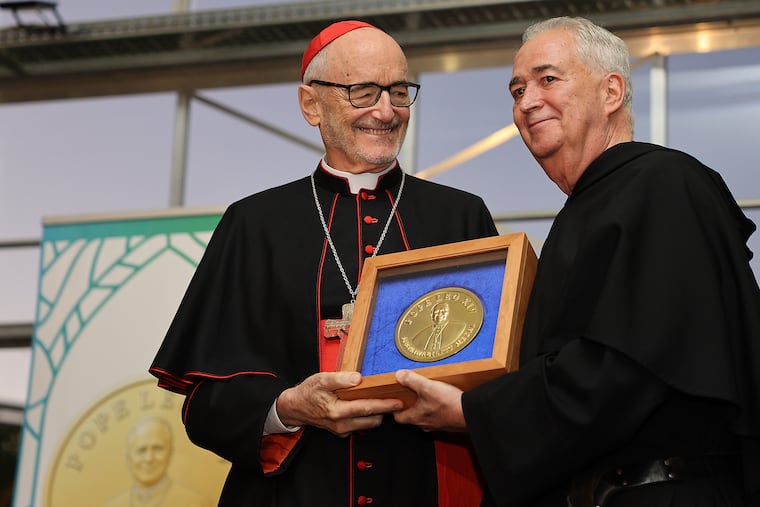
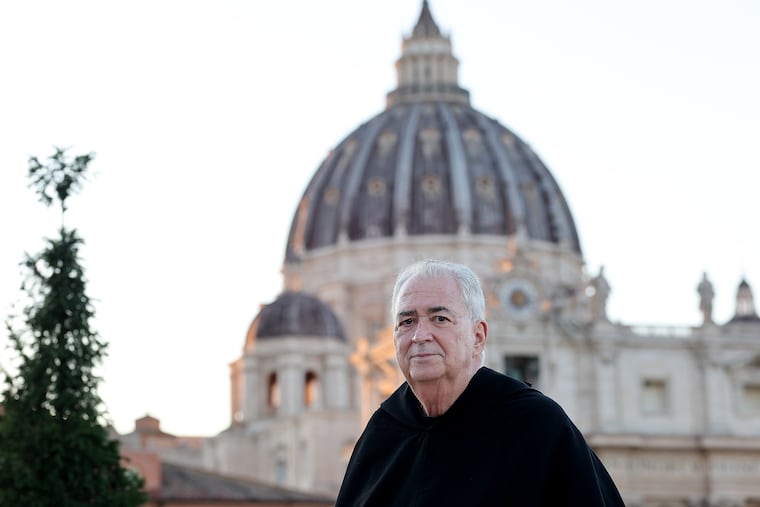
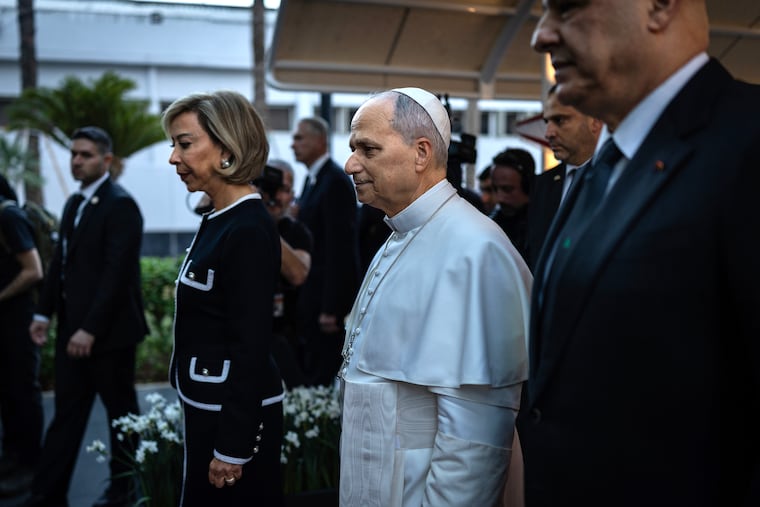
The scene couldn’t have been more beautiful as Villanova University awarded its inaugural sustainability medal to a cardinal at the papal retreat in Italy Tuesday evening.
Several hundred attendees, many of them from Villanova, filled the cavernous glass enclosed greenhouse with rows of Italian stone pine trees and lush lawns as a backdrop, the early evening sunlight softly streaming in.
But the absence of Pope Leo XIV was palpable. He was supposed to be at the ceremony and award the medal Villanova named for him, but instead was undergoing surgery to remove a nodule from his lung, which only after the ceremony was over would be revealed by The Vatican as lung cancer.
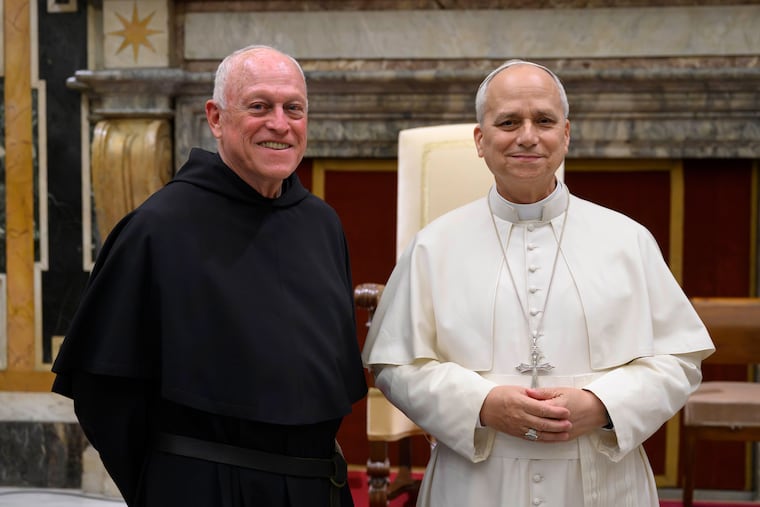
“I hope as you receive this award, you imagine somebody in white giving it to you,” said the Rev. Peter M. Donohue, Villanova’s president, who presented the medal to Cardinal Michael Czerny, the recipient.
» READ MORE: How Pope Leo has brought Villanova University closer to the Vatican
Czerny joked with the few reporters who attended the event - many who had been scheduled to come and instead were covering the pope’s surgery - “You know you can’t get the headline.”
“Like everybody else on the planet, we’re watching and waiting and praying,” Czerny said.
» READ MORE: Pope Leo is diagnosed with cancer, the day an award is presented in his name by Villanova’s president
The awarding of the medal took place at Borgo Laudato Si’, an educational ecology center on the grounds of the papal residence in the scenic hillside town of Castel Gondolfo.
Buses transported about 350 conference attendees from 30 countries - about 90 of them from Villanova - to the event.
“It’s been very amazing and eye opening,” Jaelan Howell, 20, a junior computer engineering major from Columbus, Ohio, said of the conference as he rode the bus to the medal ceremony. “I feel looking at the different backgrounds and the different research and programs that everyone’s involved in kind of gives me the inspiration to continue what I’m doing.”
Dozens of other Villanova students and professors are among those presenting their research, on topics such as illegal trash dumping and its impact on Philadelphia, health-related problems associated with air pollution and soil contamination in the Philadelphia region and challenges and opportunities that artificial intelligence presents in relation to sustainability.
“It’s really, really neat that they are having it in Rome because, particularly for me, it gave me the opportunity to bring our partners that we work with from around the world to attend,” said Jordan Ermilio, director of Villanova’s Center for Humanitarian Engineering and International Development. “That would have been really difficult to do if it was at Villanova.”
Dozens of Villanova students are currently working on a renewable energy project in Peru, a water infrastructure project in Panama, a water sanitation project at schools in Kenya and other sustainability efforts in Ghana, he said. Howell, the computer engineering major, has already worked on projects in Peru, Cambodia and Sri Lanka during breaks from school.
Among the conference attendees was Joshua Poole, a country representative for Catholic Relief Services, who has worked in Laos and Myanmar. He had some of Ermilio’s students on site working on challenges in countries with water infrastructure projects.
“Not only did they infuse the project with energy, but they were able to use their skills to tackle those challenges,” he said.
Poole’s is at the conference to talk about how to develop a successful partnership.
‘A question of justice’
Peleg Kremer, an associate professor in Villanova’s Department of Geography & the Environment, is presenting her work on documenting and protecting community gardens in the Philadelphia region, which face threats from gentrification and development.
“I cannot express how exciting it is to have the Pope so deeply invested in issues of sustainability and to make it such a priority,” she said.
The pope has repeatedly called for preventative action in responding to environmental concerns.
“The climate question is not merely an environmental challenge, it is fundamentally a question of justice, human dignity and solidarity between peoples and generations,” he said during a speech last month.
For Finley Gust, 20, a sophomore environmental science major from Drexel Hill, attending the conference marked her first time out of the country.
“There’s people from all over the world who are going to present their research, so I am honored to have gotten selected for this opportunity,” she said.
On Tuesday night at the medal ceremony, Czerny, the Czechoslovakian-born cardinal who was the recipient, was recognized for his work helping vulnerable people worldwide, including the founding of the African Jesuit AIDS Network in Kenya.
“I’m so very happy for it,” Czerny said.
Villanova established the award earlier this year to honor someone whose work shows “exceptional commitment to ecological responsibility, social justice, care for the most vulnerable and responsible stewardship of economic and human resources.”
The medal, which carries a $25,000 award to be used toward sustainability, is in part inspired by Pope Leo’s call to serve the poor and marginalized, Donohue said.
“In establishing this medal, we are uplifting the moral ethical dimension of sustainability,” the Rev. John Abubakar, Villanova’s chief sustainability officer, told the audience.
The medal features Pope Leo on one side and Villanova’s name on the other and is meant to highlight the pope’s commitment to sustainability.
‘We’re all praying for you’
Donohue early in his remarks at the ceremony acknowledged the pope’s health challenge.
“While we feel his absence deeply, deeply, our first concern is for his well-being,” he said. “On behalf of the entire Villanova community, I offer prayers for a swift and full recovery.”
After the buses departed the medal venue, word began to spread that Pope Leo’s operation had been successful. Cheers erupted on one of the buses.
“Relieved and hopeful,” the Rev. Bernie Scianna, a longtime friend of the pope and Villanova’s vice president for mission and ministry, said.
It wasn’t until later in the evening that the cancer diagnosis was announced.
“We all knew it was possibility,” Scianna said on Wednesday morning. “We were hoping against hope that it wasn’t.”
He said he texted the pope: “We’re all praying for you.”