Pinball machines were considered magnets for gambling and crime in Pa., decades before skill games
Decades ago, authorities warned that the machines offering free games to winners were really gambling devices.
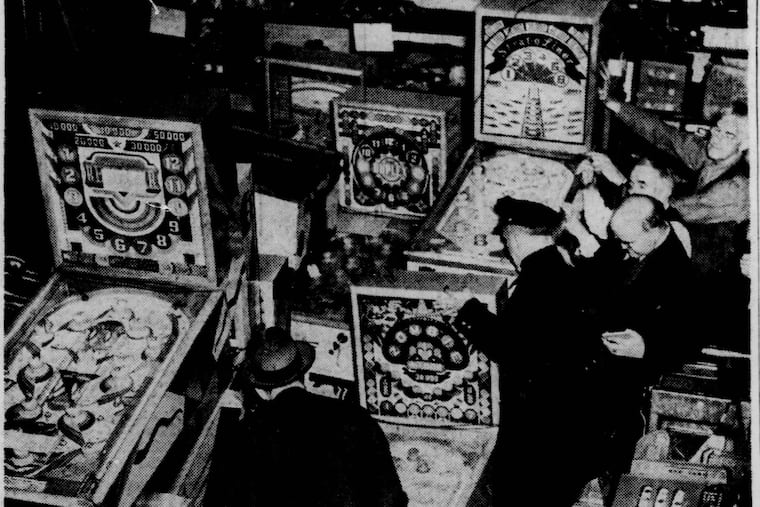
James Doran sat inside a Frankford Avenue restaurant, carefully watching a group of men for about an hour. A crime was unfolding in front of his eyes.
It was the early 1940s, and the Philadelphia police officer was investigating a crime magnet: pinball machines.
Doran saw one man win 10 free rounds, press a button under the machine to get a cash prize instead, and claim 50 cents from the restaurant’s counter. Police confiscated the establishment’s six pinball machines as part of a statewide crackdown against unregulated gambling.
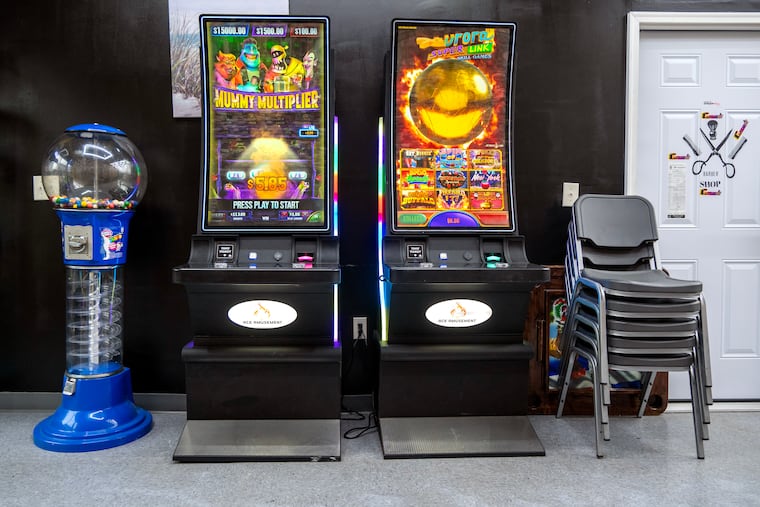
Nearly a century later, Pennsylvania is again targeting so-called skill game devices. But instead of pinball machines that require pulling levers, the devices are electronic and the players push a button.
» READ MORE: ‘Skill games’ could soon be seized from Pa. shops as Supreme Court deadline nears
The Pennsylvania Supreme Court ruled in June that the devices are slot machines and require new regulations from lawmakers to continue operating in corner stores, gas stations, and bars. But, barring a legislative breakthrough, law enforcement could start confiscating devices as of Wednesday.
While pinball machines are viewed today as retro arcade games, in the mid-20th century they were a main focus for Philadelphia’s vice squad.
Pinball can be played “as a pure matter of amusement,” the state Superior Court wrote in 1942, but the machines of that era were spiced up with “electrical contrivances and gadgets” that turned them into “gambling devices.”
The battle over pinball as a form of gambling culminated in a 1959 Pennsylvania Supreme Court ruling that remains an important precedent for courts that need to determine if a device is “intrinsically connected with gambling.” The opinion was cited by justices over the summer in the skill games ruling.
Not your mall arcade’s pinball machine
Pinball became a gambling alternative to outlawed slot machines in the 1930s, and concerns over crime followed.
The machines of the time were different from those later featured in arcades. Most importantly, they did not have the flipper buttons that allow the player some control over the ball’s trajectory.
Players would pay for a ball and could win free plays depending on the score, which they had no control over. The player could also press a button under the machine to cancel the free plays and receive 50 cents instead.
That made pinball ostensibly a slot machine, law enforcement and officials throughout the country argued at the time.
“This condition will lead to gang wars, gang fights, and killings,” Philadelphia Police Capt. John Murphy said in 1940. “The only sure preventive method is to drive out pinball machines completely.”
Officials were also concerned about the impact of the machines on youth. At a 1942 Pennsylvania Liquor Control Board hearing, students from Lower Merion testified that they had gambled on a pinball machine and bought beer at a local restaurant.
Police throughout the Philadelphia region seized machines during the late 1930s and 1940s, and courts had to grapple with the legality of the devices in cases that made their way up to the Pennsylvania Supreme Court.
And throughout World War II, Philadelphia extracted metals from seized pinball machines to aid in the war effort.
But the war on pinball outlasted World War II and spilled into the 1950s.
‘Clearly ... gambling devices’
The early court battles over pinball machines centered on free plays and whether police needed direct evidence of gambling on a specific machine before seizing and destroying it.
In a 1957 raid in Fayette County, Pennsylvania State Police seized 41 bingo-style pinball machines from various establishments. Unlike flipper machines, which were already popular, in these devices a player shot balls into holes on a bingo-card-like board.
State police did not have direct evidence of gambling for more than half of the machines, and establishments challenged their seizure.
» READ MORE: In major decision, Pa. Supreme Court rules ‘skill games’ are slot machines
The Pennsylvania Supreme Court adopted a previous Superior Court ruling that the machines “clearly are gambling devices” and “were set up to be used for that purpose.”
The ruling did not affect single-coin devices, but banned those in which a player could insert multiple coins to improve the odds.
A pinball wiz ends the war
The tone on pinball machines began changing in the 1970s. Seizures continued, as did violent crime that police connected to disputes over the devices.
Headlines about crime and gambling were replaced with stories about pinball wizards. The machines found their homes in arcades.
The fever eventually broke — often attributed to a 1976 demonstration in New York City Council by GQ journalist and pinball enthusiast Roger Sharpe, which led to overturning the city’s 35-year-old ban. He demonstrated that he could launch a pinball into a specific location, thus affirming that it was a game of skill.
In the years that followed, pinball exploded in popularity. But the goal of the game changed, and it was no longer winning money on a bet.
“Pinball is, after all is said and done, an ego trip,” Philadelphia Daily News columnist Gene Castellano wrote in 1977. “You play to win, to have a small success, to beat the game.”