Philadelphia is the birthplace of the all-American cupcake
Philly's Eliza Leslie was an accomplished 19th century cookbook author who helped define American cooking—including by introducing the humble cupcake.
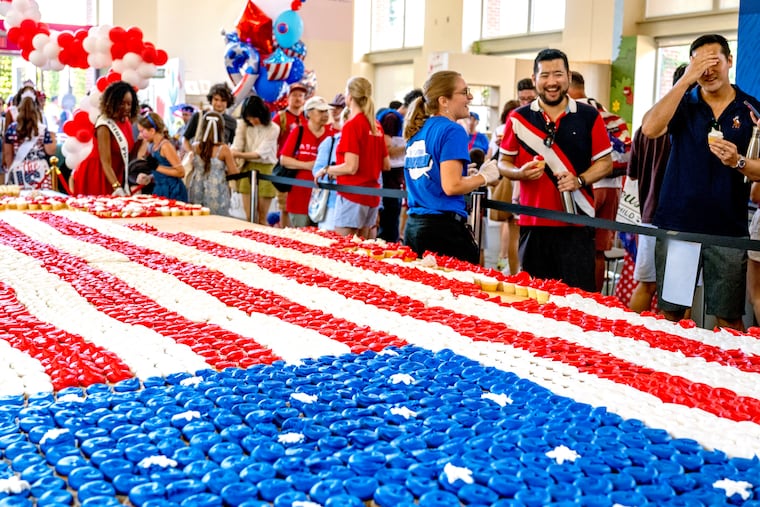
Birthdays call for cake and the country’s 250th is no exception.
America250, the federal agency behind the Semiquincentennial celebration, cut the official national birthday cake in a July 4th ceremony at the Library of Congress. Online, Goldbelly created “America’s Official 250th Birthday Cake Collection.” In Philadelphia, the Independence Visitor Center arranged 5,000 cupcakes into a flag formation.
When Philadelphia served cupcakes, it was doing more than choosing the simplest way to apportion cake. It was remaining true to its roots as the birthplace of all-American cupcakes.
The “cup cake” was the brainchild of Eliza Leslie, an accomplished Philadelphia author of cookbooks, fiction, and other prose. Leslie’s cupcake appears in her category-defining 1828 book, Seventy-Five Receipts for Pastry, Cakes, and Sweetmeats, considered the first baking book published in the U.S. and published at a time when recipes were called receipts.
The small-cakes genre predates Leslie; the first known American cookbook author, Amelia Simmons, included a “light cake to bake in small cups” in her 1796 American Cookery. Simmons didn’t specify the type of baking vessel, so the “small cups” reference in the recipe title is the only allusion to a cupcake-sized cake.
There are other records of similar baking practices, but Leslie was the first to call the petite cake a cupcake. Not only is her recipe titled “cup cake,” but she also includes specific instructions to bake in “small tins.” Cupcake history thus begins here, in this printed record of the name and form recognized today.
Leslie was born in 1787 in Philadelphia’s historic core. She learned to read by age 5, educated at home by her father, Robert Leslie. U.S.-born of Scottish ancestry, Robert was a polymath who owned a clock and watchmaking company. Her mother was an American of Swedish descent.
Eliza wrote that her father was an intellectual who “obtained the custom of the principal people [of Philadelphia], including that of Washington, Franklin, and Jefferson; the two last being his warm personal friends.” He likely debated revolutionary values with politicians, for “[i]t was by Mr. Jefferson’s recommendation that my father was elected a member of the American Philosophical Society,” Eliza wrote in her autobiography, published in Godey’s Lady’s Book in 1858.
In her late 30s, she enrolled in cooking school, a decision that would change the course of her life. She learned to bake from Elizabeth Goodfellow, a respected Philadelphia pastry chef who owned a bakery and candy store. Leslie took notes and kept the recipes from her studies at Mrs. Goodfellow’s cooking school.
In response to repeated requests to share the recipes she learned from Goodfellow, Leslie compiled them into a book, having grown tired of handwriting copies for friends. Seventy-Five Receipts was authored anonymously by “a lady of Philadelphia.” Leslie didn’t credit Goodfellow and Goodfellow herself never authored a cookbook.
Leslie acknowledged her teacher in later books and dropped the anonymity to write under her real name or the pen name of Miss Leslie. Bucking social norms, Leslie was a lifelong childfree, never-married woman who earned her living as a writer.
Leslie’s was the first American cookbook to list ingredients separately at the beginning of a recipe, a style she copied from Goodfellow. The previous convention was to state the ingredients within the narrative directions.
She intended to write simple, logical recipes that resolved the common pain points American cooks faced. “There is frequently much difficulty in following directions in English and French Cookery Books, not only from their want of explicitness, but from the difference in the fuel, fire-places, and cooking tools generally used in Europe and America,” she wrote in the Seventy-Five Receipts preface.
She prioritized locally grown, accessible, affordable ingredients and stressed the economic savings in home baking as opposed to buying cakes from a bakery. “Many of the European receipts are so complicated and laborious that our female cooks are afraid to undertake the arduous task of making anything from them,” she lamented. Confidently patriotic, Leslie affirmed that her recipes were, “in every sense of the word, American.” Her dishes could compete with the standard bearers, she insisted. They “will not be found inferior to any of a similar description made in the European manner,” she declared.
While statesmen instilled independence in the U.S. political culture, Leslie and other women adopted the same mentality in American cooking. Their DIY spirit was creative, rebellious, defiant, and nonconformist vis-à-vis European culture. For example, Leslie was among the authors to publish an Election Cake recipe, fusing the political and the culinary.
“Election Cake became the first food strongly associated with American politics,” wrote historian Gregg Mangan, who argued that this baking provided women with an opportunity to express themselves politically long before they got voting rights. Food and gender scholar K.C. Hysmith noted, “While women couldn’t vote, they could bend the ear of the voting-eligible men they hosted on election day. And at the very least, serving slices of cake allowed them access to political conversations they might otherwise miss.” More than just an item in the baker’s repertoire, Election Cake was an “exercise in everyday politics” and “statement of community organizing.”
“Through their production of Election Cake and other recipes, including Independence Cake, Franklin Gingerbread, and Democratic Tea Cakes, women projected their influence into the public sphere and helped ingrain patriotism into our national culture,” Mangan wrote.
Food historian Stephen Schmidt locates Leslie in the historical arc extending from America’s infancy to an evolving nation edging towards civil war. “By the end of her career, the tiny, parochial, overwhelmingly culturally English America of Leslie’s youth had been swallowed up by a far larger, rapidly industrializing and urbanizing, and increasingly diverse and factionalized America,” wrote Schmidt. “Food and cooking had changed in tandem, the prevailing taste of the times, at least as exhibited in the many cookbooks now on the market, having shifted from an essentially British, upper-class, 18th-century cuisine, freighted with rich, expensive ingredients and many practical difficulties, to a much simpler, easier, more naturalized cuisine that truly was ‘in every sense of the word, American.’”
Leslie would go on to write juvenile fiction, etiquette guides, short stories, and a novel, while continuing to author smash-hit cookbooks. There’s broad consensus that her third, Directions for Cookery, was the most popular American cookbook of the 19th century.
The must-have cookbook “passed through 60 editions from its first appearance in 1837 until 1870, a dozen years after the author’s death,” wrote Dover Publications in its 2013 reprint. According to historian Liz Susman Karp, it sold more than 150,000 copies.
Leslie spent her later years holding court in a fashionable hotel lobby, having established herself as a lifestyle influencer and public figure. “Long before her death, Miss Leslie had become a Philadelphia institution,” wrote Mary Tolford Wilson in a 1971 biography. “Grown portly and walking with difficulty, she lived for about a decade at the United States Hotel, where she not only met every visiting celebrity, but was herself sought out as one.”
More than one modern authority has likened Leslie to Julia Child, another American author and chef who taught Americans to cook. In the introduction to a 2022 reprint, chef and author Dorie Greenspan wrote, “As I read Seventy-Five Receipts, I was reminded over and over of Julia. Both are a pleasure to read. Both clearly love sharing what they’ve learned. Both have a generous spirit — you sense it each time they comfort and encourage us as we follow their instructions. And both have an intelligence that sparkles on each page and within each recipe.”
Leslie died in 1858 at the age of 70 and was buried at St. Peter’s Church in Philadelphia. Her 200-year legacy is baked into all the cupcakes Americans have eaten since she coined the term.
Andrea Adleman is a journalist specializing in the cultural history of cupcakes. Her forthcoming Cupcake Nation book is based on her award-winning Washington Post story “The psychology of cupcakes.”
Made by History takes readers beyond the headlines with articles written and edited by professional historians. Opinions expressed do not necessarily reflect the views of The Inquirer.