What does a black hole sound like? A Villanova scientist’s answer was turned into music.
A Villanova scientist translated data from black holes into sound. Her research formed the backdrop for a 13-minute musical composition performed on Saturday at the Chestnut Hill Skyspace.

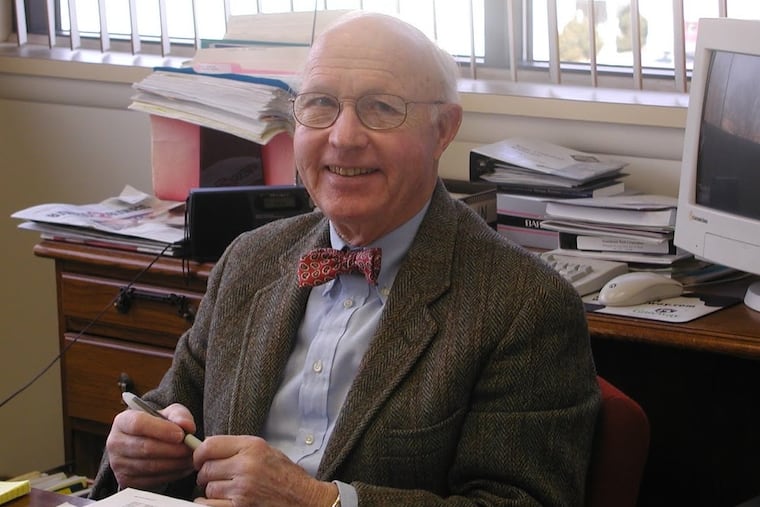
Villanova astrophysicist Becka Phillipson wondered what a black hole might sound like.
She found an answer by translating X-ray data from a black hole system into musical notes.
The first time she listened to the audio, the cacophony reminded her of someone pressing every key on an organ at once.
After roughly 30 seconds of this “chaos,” she heard a “coherent, beautiful major chord” ring out.
Her research formed the backdrop for a 13-minute musical composition performed on Saturday at the Chestnut Hill Skyspace, a venue and art installation. The black hole-inspired piece was one of three in an immersive concert, called “This Silent Music,” centered on collective listening.
The concert intended to create a space where people could sit with and work through discomfort, especially at a time when many feel overwhelmed and disconnected, said cocreator Liz Lang.
“I personally feel like I want to scream every time I open the news,” she said.
Massachusetts-based composer LJ White used black holes as a metaphor for this theme. He paired Phillipson’s sounds with singing, a marimba, and suspended cymbals.
To him, the chaos of the cosmic phenomenon reflected how marginalized groups can feel powerless and frustrated in society.
The title of his piece, “At the End of it All,” comes from the poem of the same name by Nicole M. Young-Martin, which is “about not being able to predict or control anything, but trying to be your best person regardless,” White said.
Sonifying a black hole
Coming from a family of professional musicians and singers, Phillipson felt like the odd one out in choosing a career in science.
She gravitated to researching black holes — areas of space where gravity is so strong, even light cannot escape.
She thought sonifying black holes could make for an interesting outreach activity for students, while also helping scientists uncover novel information about black holes.
When scientists sonify a black hole, they are not literally recording sound. Most of space is empty and “deathly silent,” Phillipson said.
Instead, they are interpreting the interactions around the black hole.
Using telescopes pointed at the night sky, scientists can collect information in the form of images. Those visual cues, such as brightness, can then be translated into sound. For example, Phillipson decided that, if something brightened, that would translate to a higher-pitched sound.
The environment around a black hole gets brighter and dimmer over time as material interacts with it — akin to a campfire brightening after being fed a log.
“I’m a translator between the light and the sound,” she said.
A metaphor
White produced and mixed Phillipson’s black hole sounds — piecing them together into a collage that served as the background of his 13-minute composition.
The audio had a “sort of circular sound” and “a lot of swooping,” he said, emulating the spin of a black hole. There was a sense of “things moving around you in a somewhat chaotic way,” he added.
In this, he saw a metaphor for the experiences of marginalized groups who may feel frustrated and helpless.
The piece featured parts where the singers scream with wild, unbridled vocals, as if reacting to catastrophe. Other sounds are associated with mourning.
“Things are happening that they can’t predict or control,” he said. “I want [the piece] to be cathartic in some way.”
It’s also meant to inspire.
Beneath the chaos of a black hole lies untapped energy that can suck objects inside if one gets close enough, White said.
A black hole behaves like an “infinitely deep funnel,” Phillipson said in narration included in the performance. Throw an object in, and it won’t come back out.
Black holes are also invisible — only detected by their interactions with other things.
“It’s not an energy source that is well understood or can be taken control of,” White said.
The same concept of invisibility could extend to groups of people who aren’t in power right now, White said. For example, he identifies with the transgender community, which he says frequently gets talked about in relation to mainstream society, but often remains misunderstood.
He hopes the piece helps people appreciate the power they have.
“There’s all this latent energy that we have that we could harness,” White said. “We’re not helpless.”
Lang hopes to expand beyond last weekend’s sold-out concert to perform in other Skyspace locations around the world. Light artist James Turrell has designed 100 Skyspaces globally, all featuring a room with an aperture in the roof, facing the sky.
Cocreator Katy Avery was moved by the audience’s reactions at the Philadelphia concert. People found themselves growling along and wanting to vocalize with the performers, embodying the kind of communal atmosphere she had hoped for.
The person sitting next to Phillipson told her he felt like he had to hold his breath the whole time. It was a “feeling like you have a strong emotion and you don’t know what to do with it,” Phillipson said.
She compared her own emotional experience to riding Space Mountain at Disneyland. At first it’s dark around the roller coaster, with eerie, ethereal, sci-fi sounds — much like the soundscape created with her black hole sounds. Unable to see the tracks, the rider feels as if they are going into darkness.
At some point in the piece, the singers came in with somber voices suggesting grief and mourning, with screams reminiscent of metal music.
Those tumultuous sounds gave way to an ending note of hope and power.
The two pieces that followed in the concert were more calming and contemplative.
The black hole composition “was like the precursor to meditation,” she said. “First you have to cry before you can calm down.”