Banking on Ball: Recruiting is the third rail of high school sports
Second in an occasional series.
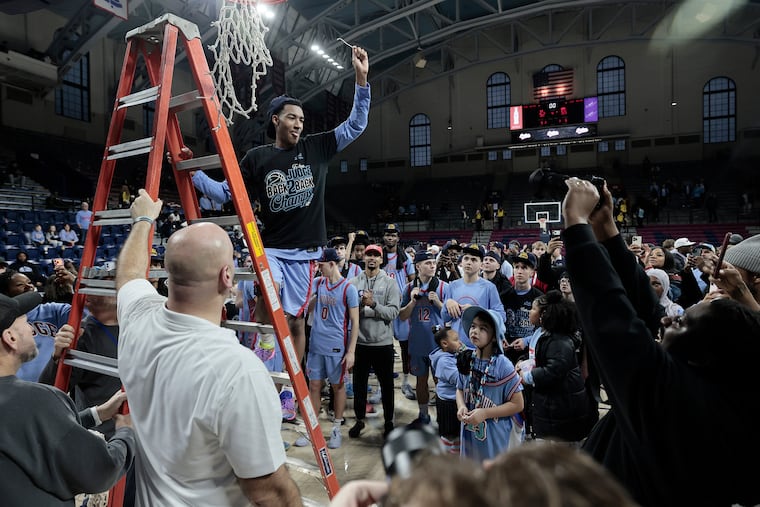
The sound inside the locker room was already overwhelming, Father Judge’s coaches and players shouting and singing after their 52-46 victory over Archbishop Wood in the Philadelphia Catholic League boys’ basketball semifinals last February. And every time someone opened the door to exit, the noise in the room rose, because a sold-out Palestra crowd was now roaring over the night’s second game: Neumann Goretti vs. Bonner-Prendergast.
Still, the kid who had been the primary cause of the celebration, the 6-foot-4 senior guard who had made the night his, was calm. Derrick Morton-Rivera had scored 27 points on an array of three-pointers and pull-up jumpers, leading the Crusaders back from an early 16-point deficit.
“Playing in front of 10,000 people every year, there’s nothing like it,” Morton-Rivera, now a freshman at Temple, said after the game. “I never knew about the PCL until my eighth-grade year. That’s when I learned.”
How did he end up at Judge?
The coaches “recruited me,” he said.
With that one verb, recruited, Morton-Rivera touched the live wire that crackles among coaches, parents, administrators, and players throughout the high school sports scene in Pennsylvania. House Bill No. 41 — a measure that would allow the PIAA to create separate postseasons, one for public schools and one for private, parochial, and charter schools — passed the Pennsylvania State House of Representatives in April. And of all the factors that play into the longtime dispute over whether boundary and non-boundary schools should compete against each other for championships, none generates as much heat and controversy as recruiting.
“It’s two different worlds,” longtime Lower Merion boys’ basketball coach Gregg Downer said. “If you don’t put massive talent out in basketball or football or soccer or lacrosse, you’re going to get run over.”
‘Philly is Philly’
Since the Catholic League joined the PIAA in 2008, just one of its coaches, Archbishop Ryan football coach Mark Ostaszewski, has been suspended for recruiting violations. At a January 2025 football camp, Ostaszewski asked a student from the Bensalem School District if he wanted to apply to Ryan. District 12, the association’s umbrella for the Philadelphia Catholic and Public leagues, banned Ostaszewski for a year; he has returned to his role this season.
Locally, recruiting accusations often put programs from District 12 at odds with those from District One, which comprises schools in Philadelphia’s suburbs. And that confirmed example is tame compared to the more intense efforts that coaches have allegedly made to coax athletes to their programs.
A former basketball standout who graduated recently from a District One public school and his father told The Inquirer on the condition of anonymity that, while the student was in eighth grade and throughout his high school career, representatives from three Catholic League programs pursued him. One head coach offered him free tuition, a stipend, and the use of an apartment near campus. The coach also had his team’s star player send several direct messages on Instagram to the player in an attempt to persuade him to attend the school.
Another program had an assistant coach and a parent take the player’s father out to lunch twice, telling him at both meals that he would not have to worry about paying any tuition for his son. The third program’s head coach told the father that, if his son helped the team win the Catholic League championship, a booster would provide a house for the player. Each of the three schools were located between 15 and 35 miles from the player’s home.
“They can twist this however they want,” Downer said. “These kids are targeted because they’re good at sports. I could list 50 examples of kids who have been recruited.”
Morton-Rivera’s path to Father Judge captures the murkiness of the entire issue. Jim Meredith, a 1992 Judge graduate who became its president in late July, noted in a recent interview that while in eighth grade, Morton-Rivera had visited the school and taken its entrance exam — and that he grew up and lived in Lawncrest, just a mile-and-a-half from Judge.
They can twist this however they want. These kids are targeted because they’re good at sports. I could list 50 examples of kids who have been recruited.
“I can say with full confidence that we’re following PIAA rules and regulations,” Meredith said. “We’re trying to put out an excellent product for our school and our students. Part of that is making sure we adhere to the guidelines that are prescribed to us.”
When asked how Morton-Rivera ended up choosing Judge, head coach Chris Roantree pointed out that Morton-Rivera’s background and family history made it natural for him to consider attending a school with a strong basketball program. D.J. Rivera, his father, finished his high school career in 2006 as Neumann Goretti’s all-time leading scorer before playing Division I ball at St. Joseph’s and Binghamton.
“Philadelphia basketball is a very small community,” Roantree said. “There are different relationships that everybody has. When somebody shows interest in us, we sell the school. When we bring guys in, we show them our career-pathway center. We show them our academic center. …
“Ultimately, ‘recruiting’ is a very broad thing. It’s going to be questioned because we’re a Catholic and private school. He’s within a mile or two of the school. To me, that’s no different from [a public-school coach] talking to someone from a Plymouth Whitemarsh middle school or an Abington middle school. He’s not a transfer. We didn’t aggressively go after him like that.”
Under Article VI, Section 11 of its bylaws, the PIAA forbids “recruiting [that] is materially motivated in some way by an athletic purpose. Recruiting for athletic purposes is directly contrary to fundamental interests of PIAA and its member schools, and any school engaged in such conduct should do so with the expectation that it will be treated harshly upon proof of such conduct.”
As clear as that excerpt might seem, determining whether a student’s decision to attend a particular school was “materially motivated” by athletics requires hard and fast evidence, such as text or direct messages between a coach and the athlete, said Sean Kelly, District One’s vice-chairman.
If a principal or athletic director files a formal complaint charging an opposing program with violating PIAA bylaws, the association’s corresponding district committee will hold a hearing on the matter.
“Sometimes I’ll get a call from a coach or an AD or somebody who’s associated with one of the schools who says, ‘Hey, this is what we’re hearing. We’re hearing Student A is going to go to this school,’” Kelly said. “I just ask them, ‘What evidence do you have? Are you saying they’re just transferring, or are you saying they’re being recruited?’ We take some time to make sure we pump the brakes because people get very sensitive and very emotional.”
Article VI, Section 11 applies to both boundary and non-boundary schools, but suburban public school coaches bemoan what they see as an inherent imbalance in the system: To play a varsity sport at a public high school, a student-athlete must live in that school district. But private, parochial, and charter schools, such as those in the School District of Philadelphia and the Archdiocese of Philadelphia, can draw their student-athletes from anywhere. Too many of those institutions, several District One coaches said, bend the rules to do it.
“It’s just not fair,” said Joe Dempsey, who has been the boys’ basketball coach at Spring-Ford High School in Royersford since 2021. “They have the ability to go and get players, to which I say: Let them do that. If they want to go play in that sandbox, let them go.”
Dempsey had previously coached at La Salle College High School for 27 years, including 14 as the program’s head coach. At CYO games, he would see a promising seventh- or eighth-grader, he said, then approach the player’s parents without talking to the player.
“La Salle made it very clear: Don’t step over the line. Don’t get us in trouble,” Dempsey said. “Once a couple of schools took the gloves off, the pressure came. The pressure was on me at La Salle. I went to the administration: ‘Are you looking around the Catholic League? I can’t just sit on my hands and wait on some wonderful 6-foot-7 kid who can pay a lot of tuition and go to school with all boys and get bused here. It ain’t going to happen by accident.’”
That archdiocesan schools compete for students within District 12’s open-enrollment landscape only complicates matters further. Consider one example: Bonner-Prendie, nestled in Drexel Hill in Delaware County, won the 2024 PIAA Class 4A football championship. Of the top six zip codes from which the school drew students that year, five were within Delco, and the other was just nearby — the Overbook section of Philadelphia — according to Steve Clement, the chief administrative officer of the archdiocese’s Office of Catholic Education.
How many of its football players did Bonner-Prendie recruit, if any? How many did it have to recruit, given the school’s proximity to West Philadelphia? And if a school such as Bonner-Prendie draws students from the city or St. Joseph’s Prep draws them from Camden — less than five miles away — how different is that from the dynamic at a public school in an especially large district?
“The reality,” Clement said, “is that these schools are still serving the areas they were intended to serve.”
Similarly, parents can and do contact the School District of Philadelphia to ask what high schools would best fit their children’s skills and interests: maybe sports, maybe drama, maybe career and technical education. Starr Davenport, the district’s director of finance for athletics, said she frequently fields phone calls from parents of rising ninth-graders who ask her about the quality and array of athletic programs at a particular school, and she is happy to answer their questions.
“It’s not a recruitment strategy,” Davenport said. “It’s just transparency. When they want to know, it means they’re trying to find their school home. That selection process seems equitable because we’re not putting it out there, ‘Go to this school if you like football.’ But if a parent or student-athlete inquires, we are definitely transparent in terms of the full gamut of what is offered at a school.”
As for making competition across the state and the Delaware Valley more equitable — that is, giving boundary schools a better chance of beating non-boundary schools — it doesn’t matter much whether gifted student-athletes who already live within the city’s borders attend public or non-public schools. As long as it stays in Philadelphia, that talent will reveal itself in the results one way or another.
“Here’s the thing: Philly is Philly,” Roantree said. “So if you want all the Philly kids to go to public schools, they’re still going to dominate. There are six, seven, eight, 10 good teams in the Catholic League. If they’re in the playoffs, they’re going to make some noise” in the state tournaments.
The primary complaint among suburban public school coaches and administrators, of course, is that non-boundary schools don’t limit themselves to drawing talent from the city or the neighborhoods that surround them. To some public-school coaches, the notion of recruiting is an alien concept, one they wouldn’t consider if for no other reason than they or the athletes’ families would have to make the necessary arrangements for the athletes to live within district boundaries — say, finding a long-lost aunt whose house was within walking distance of a school bus stop.
Liz Potash, who retired earlier this summer after 13 years as Central Bucks East’s girls’ basketball coach, said she never sought out players to refill her program’s talent pool. “If I wanted to recruit, I wouldn’t be a public-school coach,” she said. “I’m not going to beg an eighth-grader to come to East.”
But another coach might.
“Everyone’s doing it,” said Daniel DiBerardinis, who spent 11 years as a Catholic League athletic director — six at Roman Catholic, five at St. Joe’s Prep — before becoming Penn Charter’s AD last year. “Public schools are recruiting. They recruit. People move to different zip codes all the time.
“I’m not going to put any school on blast, but I know intimate situations — I know families who got an address to be a part of a district. I’m not going to say any schools, but I do know it happens. The rules are super-gray, and people are always going to find workarounds.”
Technicalities
Football, boys’ basketball, girls’ basketball: It’s within the worlds of those three sports that the debates and bickering around recruiting are the loudest and have the most relevance. Rep. Scott Conklin (D), who introduced House Bill No. 41 and represents the 77th district, in State College, all but admitted that the bill was aimed at stopping private, parochial, and charter schools from recruiting — and from continuing to move into the next frontier: wielding sponsor dollars or name, image, and likeness deals to entice athletes.
“Technically, yes, public schools could cheat,” he said in a phone interview. “But we know how difficult that is. I’m 67 years old, and I can win the high-jump competition — technically. But we all know it’s never going to happen.”
In that Palestra locker room back in February, Roantree snickered at the mere mention of the subject. “Everybody says it’s an unfair advantage,” he said. “What I say is, every kid’s got a dream of playing Division I, and there are a lot of coaches in our league who can make that happen. We don’t have to recruit as much as kids want to come and play for us.”
Four days later, behind a team-high 14 points from Morton-Rivera, Father Judge beat Goretti to win its second straight PCL championship. The Crusaders advanced to the semifinals of the PIAA Class 6A tournament, where they lost to a city rival, Imhotep Charter, which then lost in the championship game to Harrisburg’s Central Dauphin.
A public school.