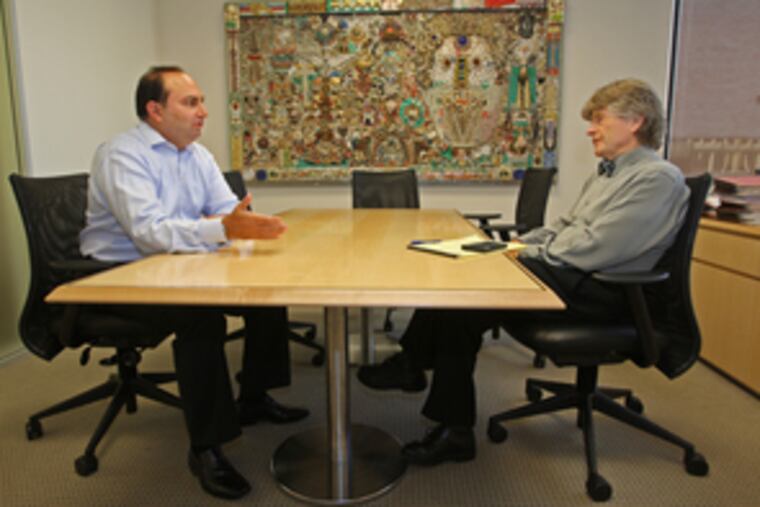
A typical day for WolfBlock law firm chairman Mark Alderman might include a meeting with a public relations consultant, a stop at a reception, a phone call from a client, and a strategy session with the firm's public finance group.
He might lead a seminar at the University of Pennsylvania Law School, where he is on the faculty, travel to one of the firm's eight offices outside of Philadelphia, or huddle with a partner from another firm he's trying to recruit to WolfBlock.
He would practice little if any law.
"It's all about making money," Alderman says about the operations of law firms like WolfBlock, Schorr & Solis-Cohen L.L.P., which he runs full time. "To put it in its most elemental terms, these are for-profit enterprises. We are very philanthropic, but we are not here to be [charitable]. We are here to make a living."
Adds Alderman, "I don't yearn for the good old days of practicing law."
A joke that once made the rounds in the cloistered halls of the city's most august firms was that the chairman was the guy - and it always was a guy - who missed the partners meeting the day they chose a new leader.
Managing partners were inevitably part time, mediating disputes among fellow lawyers and representing the firm at charity balls and other events. They left much of the day-to-day management to paid administrative staff who labored in the shadows.
Not anymore. At the biggest firms, the job of the lawyer who is also chief executive has evolved into something approaching a corporate CEO, with much of the same clout and responsibility.
It often has little to do with the law. Law-firm chief executives now manage budgets approaching a billion dollars or more, hammer out strategic plans, and oversee workforces of hundreds if not thousands of employees.
They puzzle over leases, agonize over partners with emotional or substance-abuse problems, and try to figure out how to market their firms and undercut competitors.
The changes, which began slowly about a decade ago, have lately been accelerating.
John J. Michalik, executive director of the Association of Legal Administrators, said membership in his organization of full-time lawyers who are chief executives has grown to more than 100 from only a handful a decade ago.
"Law firms have prided themselves in the past for not adopting corporate-style hierarchies," said Elizabeth Chambliss, a law professor at New York Law School, who focuses her research on law firm management. But, she says, "the resistance to the full-time CEO model is fading."
The changes in law firm management are being driven by larger economic trends. Time was when firms functioned like mini-cartels. Partners rarely, if ever, switched firms, and firms themselves rarely lost clients to competitors.
But as law firms sought to secure their futures by scaling up operations and generating ever more revenue, the need to recruit or grow through mergers created ever more complexity, ever more bottom-line pressure.
"You have to understand how . . . law firms work; law firms are reactive institutions," says Alderman, of WolfBlock. "Law firms are not leaders in business. They are followers in business. In the history of the world, I have never heard a client say, 'Hey, my law firm is doing this, maybe we should look into that.' It is always the opposite. It is the law firm saying, 'This is how our clients do it, let's learn from them.' "
Following are snapshot descriptions of how the jobs of a few lawyers who have become the chief executives of their firms have evolved as the firms grew and their responsibilities multiplied:
Mark Alderman
When Alderman, 54, was named the firm's sole chairman in 2000, WolfBlock was in the midst of an unprecedented growth spurt. From 1923 until 1997, the firm had only one office, its Philadelphia headquarters, in the Packard building in Center City, where it had been since the beginning.
The firm has since added eight offices, and the number of lawyers more than doubled to 326. Total employment at WolfBlock grew from 436 to 817.
Although he still maintained contact with clients, Alderman largely stopped practicing law; the firm had become too intricate and the management demands too pressing.
The change meant that Alderman had to adopt a different mind-set. Now that he was running the firm, and not billing clients, results were not immediately obvious.
"It took some getting used to," Alderman said, a member of Barack Obama's national fund-raising committee. "You are trained as a lawyer to measure your life in six-minute increments, and you're told from the moment you arrive what matters is billable hours."
One of the first things that Alderman did as chief executive was to develop the firm's lobbying business. The firm had done some lobbying before, but hadn't systematically billed clients for services like introductions to policymakers. That was changed.
He says that if the legal profession has sharper edges, then the experiences of law firms more closely mirror what is going on in business overall.
"We inhabit the same world and reality as our clients," said Alderman.
Sheldon Bonovitz
Sheldon Bonovitz practiced for years at the 650-lawyer Duane Morris L.L.P. as a corporate lawyer focusing on mergers and acquisitions and arcane tax questions for his clients.
Now, Bonovitz, as the firm's chairman and chief executive officer, easily unspools statistics on how many square feet of office space his firm leases per lawyer, about 600, and what it would cost if that number went up to 700 square feet - about $3.5 million more a year.
He says Duane Morris' billing procedures have driven down the average time it takes for the firm to receive payment from its clients to 57 days, and he notes that the firm is saving millions by making sure that payments are collected promptly - money that goes straight to the equity partners' bottom line.
When Bonovitz was named chairman and CEO in 1998, Duane Morris had 225 lawyers, revenue of about $73 million, and a handful of offices outside of Philadelphia. Bonovitz saw it as his mandate to guide the firm into more complex and lucrative work for larger clients and to avoid simpler cases that smaller firms could handle at lower costs.
The firm launched an expansion and now has revenue of roughly $336 million. It grew mostly through recruiting, but did engineer one large merger, with a 70-lawyer firm in San Francisco. It also opened offices in London, Singapore and Vietnam.
Bonovitz has made it plain he will not tolerate partners' throwing their weight around, even and perhaps especially if they are major rainmakers. One Duane Morris office lost nearly half its lawyers several years ago when a top producing partner was effectively forced out after Bonovitz concluded that the partner had become too territorial.
"We have a 'no jerks' rule at Duane Morris," Bonovitz said.
Mark Silow
Mark Silow, 54, was a tax and estate lawyer with Fox Rothschild L.L.P., gradually transitioned to firm management, and was named in 2005 its second full-time chief executive.
He's had to deal with recruiting and rapid growth like the other firms. He also had to focus on how to position the 400-lawyer Fox Rothschild firm in a legal market where it competes with mammoths like Philadelphia's Dechert L.L.P. and Morgan Lewis & Bockius L.L.P. on the one hand and smaller firms with lower fees and a more local focus.
The strategy has been to target high-end legal work, but at a lower price point than, say, some of the big New York firms, where some partners charge a $1,000 a hour.
"Our highest partner billing rate is $540 [per hour], but we like to keep it to between $400 and $500," he said.
He says the firm has never been more profitable - average partner compensation is about $515,000. The highest-paid partner earns more than $1 million a year.
Silow says the most difficult issue he has to face is dealing with a partner whose performance has slipped because of family conflicts, emotional problems, or simply burnout.
Sometimes, it is the client who brings the matter to the law firm's attention. Sometimes, it's visible because a partner's billable hours have gone through the floor.
"We have had lawyers that we call in, and they say, 'You know what, you are right. I am relieved that you called me because I have been trying to hide this or I have a problem at home and I have been trying to keep it inside and now I am glad that I am able to talk about this,' " Silow said. "Usually, they get back on their feet."