A new program in North Philadelphia aims to train workers in the trades for free
The initiative is a partnership between the nonprofit Esperanza, Thaddeus Stevens College of Technology, and the Tec Centro Workforce Network.
Andre Rodriguez, 32, said he worked “a dead-end job” until this summer, when a pastor at his church handed him a flyer for a new workforce development program in North Philadelphia.
“I wanted more out of my life,” said Rodriguez, who grew up in Kensington . “[I] wanted to find a career that would be able to propel me and to do greater things.”
The flyer led Rodriguez to the free training program for in-demand jobs in the trades. The initiative is a partnership between Esperanza, a nonprofit based in North Philadelphia where instruction is taking place; Thaddeus Stevens College of Technology; and the Tec Centro Workforce Network.
“I decided to give it a shot and see if it would change my life,” Rodriguez said at a recent ribbon-cutting ceremony for the workforce training site for the program.
Rodriguez is part of the first cohort of students enrolled in the new program, which is intended to train currently unemployed or underemployed people. Students opt for one of four training tracks designed toward qualifying for in-demand, high-wage jobs. Each track has room for 12 students per six-month session.
“What you basically have is people who are looking for an opportunity to improve their situation,” said the Rev. Danny Cortés, executive vice president at Esperanza. “They may be in a job and they don’t see a future in that job. They don’t see a family-sustaining wage in that job. They’re hustling, but the hustle ain’t long-term.”
Rodriguez is in the metals fabrication and welding track. Students can also choose to pursue training in HVAC, plumbing, or facility maintenance technology.
After the program, Rodriguez said, his goal is to land an apprenticeship with Navy Yard shipbuilder Hanwha. Philadelphia has been facing a welding shortage recently, and Hanwha has been expanding hiring.
“We’ve already engaged with Hanwha in discussion about what we’re doing,” Cortés said. “They have appetite to hire given their needs.”
Beyond Hanwha, Rodriguez is also open to applying his new skills at a small fabrication shop. Both of those goals are ones he “never thought would be possible,” he said. “But now it seems like it’s becoming more apparent that I’ll be able to do that.”
A career pivot into welding
Esperanza, founded in 1986, today employs roughly 800 full-time staff. The faith-based nonprofit’s services span education, workforce, immigration, and housing. Esperanza has a charter school, an arts and culture center, and a college where students can earn associate’s degrees. It also offers a housing counseling service.
Esperanza wanted to launch a trades training program, but the organization did not have the technical expertise, Cortés said. When the opportunity arose to bring this new program to life, “we jumped in,” he said.
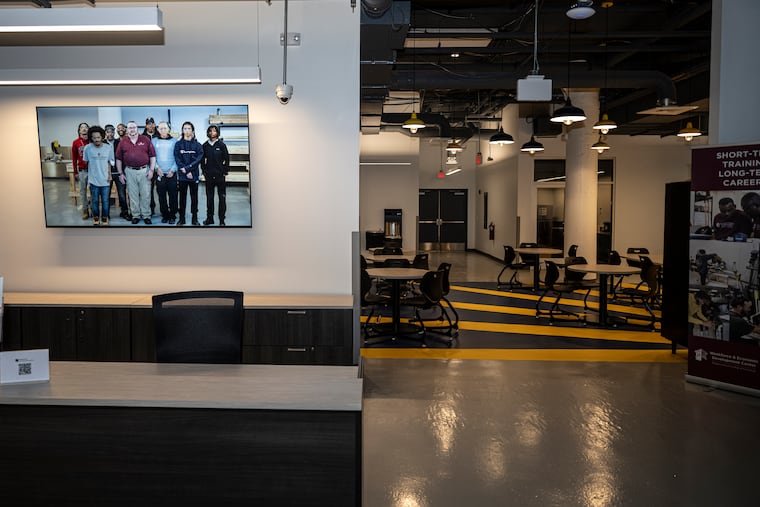
What was once a storage area in the ground floor of Esperanza’s building at North Fifth and West Bristol Streets now includes a computer lab, welding stations, a drafting room, and more. The $4 million construction work is funded with state dollars by the Tec Centro Workforce Network.
The workforce training costs roughly $2 million in the first year, Cortés said. The program’s operating cost is being covered by federal and philanthropic dollars through Philadelphia Works, the city’s workforce development board, as well as state funds.
Tec Centro Workforce Network, which provides workforce development across several locations in the state, invests state funds into centers, with the hope that the money is a starting point to attract other funders, CEO Carlos Graupera said.
“This needs to be a community-wide effort to elevate individuals who are underemployed, locked in poverty, needing to get away from a menial job to a career path — that is not something that is done by government alone,” he said.
Rodriguez is part of the first cohort of students at the new Esperanza program, which started in July and will wrap up in December. Officials want to offer instruction in the evenings or weekends in the future.
For Lancaster-based Thaddeus Stevens College of Technology, the site is the first outpost in Philadelphia. The school offers two-year associate’s tracks in trades and technology at its main campus, and many of those programs are already at capacity, said Pedro Rivera, its president. Some of the short-term programs the school offers also have waiting lists, he said.
“We pretty much have filled all of our labs and classroom space on the main campus,” Rivera said.
Some of that demand is already apparent at the Esperanza location. Employers have committed to hiring two current students, Cortés said.
Judith Ghebremichael, 53, is one of them. Ghebremichael graduated from Temple University in 2007 and spent roughly 20 years employed in social work. While she loved helping people, she said, “you can get burned out.”
She found out about the workforce program through her son-in-law and said she can make triple the amount she once did in social work through welding. Ghebremichael immigrated to the United States from Ethiopia when she was 5 years old and her uncle, a welder, helped her family, she said. His career inspired her to look into the trade.
Now she commutes 45 minutes by car from Delaware County to attend the program and has taken up bartending while she completes her classes.
She is still a couple of months out from graduating, but she said she already has a job waiting for her at the Philadelphia Pipe Bending Co., which fabricates the poles SEPTA riders hold onto.
“You don’t realize how much welding affects the whole infrastructure of the United States until you start walking and see fences,” she said. “Now being in the welding field, I see welds everywhere.”
Cortés said the program puts students on a career track in industries with opportunity for growth, noting that as people retire, the demand rises for new workers to refill the workforce pipeline.
“Esperanza’s been in this neighborhood for many years,” Cortés said.
The new program is “just adding one more way to make opportunities available and produce what we call transformative moments for folks who are trying to improve their lives,” he said.