PhillyDeals: Commerce Secretary talks stimulus
Gary Locke, President Obama's secretary of commerce, came to the National Conference of State Legislators in Philadelphia like Santa Claus yesterday, talking up the federal stimulus.
Gary Locke, President Obama's secretary of commerce, came to the National Conference of State Legislators in Philadelphia like Santa Claus yesterday, talking up the federal stimulus.
"Washington will deploy $3 billion in grants to jumpstart the manufacture of electrical vehicle batteries and other energy-efficient cars," he told delegates at the Convention Center.
"Over $15 billion in grant funds for three visionary Recovery Act programs - broadband Internet, high-speed rail, and smart electrical grid . . . "
Locke's department will dent the unemployment rate when it hires 1.5 million people, the most ever, for next year's U.S. Census.
"The number that go door-to-door has increased, as the mail response rate keeps going down," to about 65 percent in 2000, he told me later. "It certainly provides some good-paying jobs for a struggling person or a young person between jobs."
I asked Locke whether any of the state honchos crowding Center City this week complained to him about the expensive competition between states, and among cities, for taxpayer-funded "economic development" subsidies to corporations.
"I really think that's a states-rights issue," said the former Washington governor. "I understand companies wanting to move, looking for a better business climate . . .
"When we lost Boeing's headquarters, from Seattle to Chicago, we didn't lose much money, other than the prestige," Locke said. "In the end, it was just 300 people, and a lot of them kept their homes" in Seattle.
"When they put the Boeing 787 up for bid, we gave them a huge tax break," he said. Even with the cost, "it was still a net benefit to the state of Washington."
Still, Obama is trying to nudge states and communities toward cooperating.
"The 2010 budget has money for assistance to regions to form economic 'clusters'" focused on industries like manufacturing or technology or tourism or universities, Locke explained.
"We have a lot of Economic Development Administration grants for that. For business incubators," Locke added. "For planning assistance. People are excited about that." Neighbor states can join forces and get a federal subsidy, instead of raiding each other.
That's an Obama theme: Use the carrot, not the stick.
Hospital wars
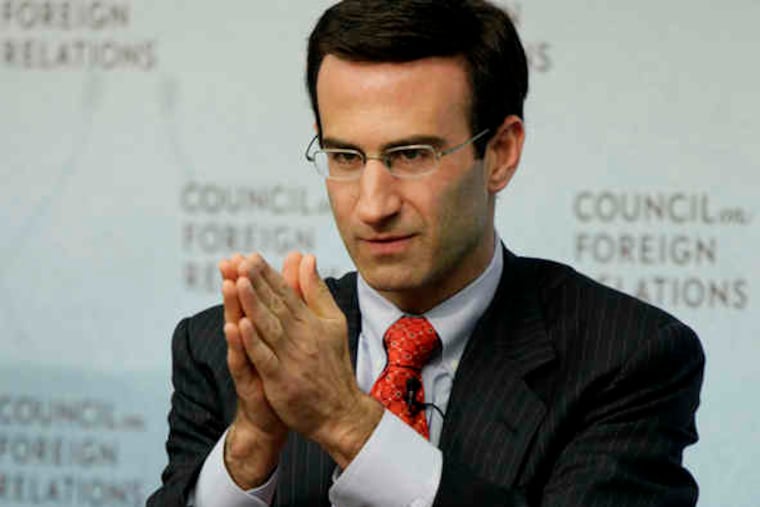
"Health care costs are the key to our fiscal future," Office of Management and Budget Director Peter Orszag told a group of us "regional media" writers in a conference call yesterday.
The costs are wrecking government budgets. Obama's prescription includes putting medical records online, where it's easier to track treatments and avoid duplicate testing; putting Medicare deals up for bids by rival insurers; and taxing rich people to fund $1 trillion in health payments for poor people over 10 years.
I asked Orszag what Obama-care would mean to, say, Camden's Cooper Hospital, which has been building new wings and taking over a medical school and suing its suburban competition and promising to steal business from its Philadelphia rivals, all of which taxpayers and insurance plans will be helping pay for, along with similar moves by competitors.
The problem is, we offer "incentives for more rather than better care," Orszag said.
He sees two ways to stop costly overbuilding: Have government control medical-facility expansion by issuing permits, or change "the incentives for building hospitals and adding capacity." By penalizing hospitals that keep readmitting patients, you might slow a wasteful building race, Orszag suggested. That's more Obama's way.
Orszag singled out Ohio's Cleveland Clinc for offering "a better combination of higher quality and lower health-care costs" than most U.S. systems. "The goal is to make those practices universal," he said.
Lubert bank buy?
Philadelphia real estate fund Lubert-Adler Partners LP is among those weighing a bid for assets of troubled condominium lender Corus Bankshares Inc., Chicago, Bloomberg LP reports. Lubert-Adler is the largest fund in investor and Valley Forge casino developer Ira Lubert's $12 billion Independence Capital Partners group, which is backed by $1 billion from Pennsylvania state pension funds.