Grand jury exonerates Phila. police in beating video
To Police Commissioner Charles H. Ramsey, then newly arrived in Philadelphia, last year's news video of police officers beating three suspects was a black eye for the department.
To Police Commissioner Charles H. Ramsey, then newly arrived in Philadelphia, last year's news video of police officers beating three suspects was a black eye for the department.
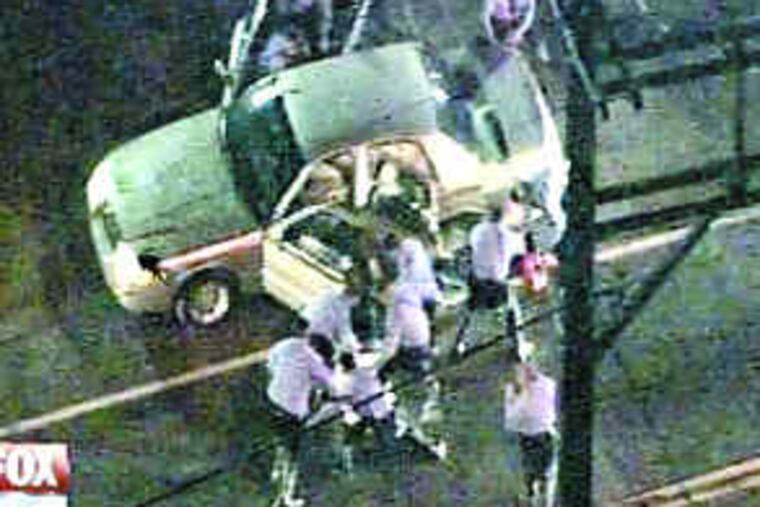
In the days after May 5, 2008, when police stopped a fleeing car and arrested the three men, the Fox29 news helicopter video was telecast locally, nationally, and internationally. Ramsey took prompt action, firing four officers and disciplining four others.
Yesterday, a Philadelphia grand jury vindicated the officers who arrested Dwayne Dyches, Brian Hall, and Pete Hopkins. The grand jury recommended that no criminal charges be filed and decided that the officers used only the force necessary to subdue three men they had reason to believe were armed and had just fired into a crowd, wounding three others.
"The video, in fact, did not speak for itself," District Attorney Lynne M. Abraham said in announcing the grand jury report.
"We found that the design of the force applied by the police was helpful rather than hurtful," the grand jury report concluded.
"The kicks and blows, in other words, were aimed not to inflict injury, but to facilitate quick and safe arrests. We found that the kind of force administered was completely consistent with police training and guidelines and the laws of the commonwealth."
The report closely followed the July 1 verdict of a Common Pleas Court jury, which acquitted the three men of the charges that police say were the reason for the two-mile pursuit: attempted murder after more than a dozen shots were fired into a crowd at Fourth and Annsbury Streets in North Philadelphia's Feltonville section.
The video was played for the jury during the trial.
Yesterday, two of the three men who were arrested said they were shocked and upset by the grand jury report.
"This is crazy. The police are going to feel they are above the law," said Hopkins, 21, of Kensington, who city prosecutors alleged was the triggerman who shot into the crowd.
"The grand jury has made it clear, and this kind of [police conduct] is just going to continue going on and on," Hopkins said.
"I don't feel safe in this city," added Dyches, 26, of North Philadelphia.
Brian Hall, 24, of North Philadelphia, who drove the gold 2000 Mercury Marquis that police stopped, could not be reached for comment.
All three are preparing to file civil lawsuits against the police and city, said Mary T. Maran, the lawyer who represented Hopkins in the criminal trial.
Police representatives praised the grand jury report.
"We were confident from Day One that these officers would be cleared," said John McNesby, president of Lodge 5 of the Fraternal Order of Police. "The grand jury did a great job."
McNesby cited a 2000 incident in which police swarmed over carjacking suspect Thomas Jones, hitting him 50 times to subdue him.
"Not one disciplinary action was affirmed by an arbitrator," McNesby said, predicting that the four officers who were fired and the four who were disciplined in the 2008 case would get back their jobs, lost pay, and benefits.
Ramsey, who voluntarily testified before the grand jury, stood by his disciplinary decision yesterday, saying, "There's a big difference between internal disciplinary action and the potential for criminal charges."
He said his decision to discipline the eight officers - 10 others on the scene that night were not reprimanded - was based on department policies and procedures.
"I still feel comfortable with the decision I made," Ramsey said. "I didn't rush to judgment. It was a careful, deliberative process."
The grand jury report did not disagree with the commissioner. It found that he - like the media and others who had only the video to work from - could not afford to wait for the outcome of a formal investigation.
Ramsey faced a crisis, the grand jury found, as a new commissioner working for a new mayor under media scrutiny because of the video and the killing two days earlier of Sgt. Stephen Liczbinski.
"He explained that he took his actions in part out of concern for the department's image and the need for the police to have the public's confidence," the report reads.
"What we might have described as a rush to judgment, he defended as a necessary action early on to set standards for officers' behavior," the report continued. "We were persuaded of the commissioner's belief that the actions he took were for the good of the department and the good of the city."
The incident initially increased tensions between police and the city's African American community. The grand jury addressed that issue, finding that "the video offered no evidence of anger, racial prejudice, or other ill will. . . . It was the suspects, not the police, who were defying the rule of law."
The report also stressed the grand jury's diversity: 15 women and eight men; 14 African Americans, eight whites, and one Hispanic.
The grand jury report says its 23 members had the full video, not just the beating excerpt, and that it had been enhanced to show detail not visible in the original.
The report also notes that the grand jury heard from all the officers involved, all three defendants, Ramsey, and experts in felony stops and use of force.
Though the grand jury acknowledged the shocking nature of the video, it said the context that witnesses provided proved that the officers used only the force needed to subdue and handcuff the three men.
All three men, the grand jury determined, fled the shooting scene, ignored a line of pursuing police cars, refused to get out of the car after it was stopped, and resisted being handcuffed after they were on the ground.
The three men either refused to answer questions from the grand jury, invoking their Fifth Amendment right against self-incrimination, or gave answers that were not believable, the report reads.
"For all the apparent ferocity, the defendants suffered no substantial injuries, no broken bones. . . . They were in and out of the hospital in under an hour," Abraham said.