Ben Franklin published the results of his kite-and-key experiment on this week in Philly history
On Oct. 19, 1752, Franklin announced the results of his electricity experiment in a short blurb that ran in his Pennsylvania Gazette.
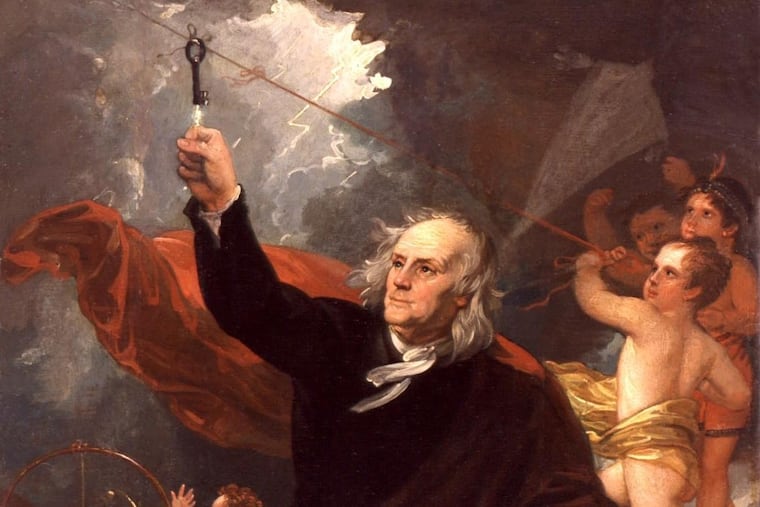
Let’s first clear up a few factual errors.
Benjamin Franklin, despite what you’ve heard, did not discover electricity while playing with a kite and a key in an open field in Philadelphia in the mid-1700s.
By that point, electricity had been known to humans for at least 2,000 years.
Lightning most likely didn’t strike the actual key, and Franklin himself wasn’t struck, either, which would have probably killed him.
The Founding Father was a lot of things, but as productive as he was, he routinely gets attached to scores of breakthroughs that he had no hand in developing.
But for this iconic bit of folklore, strip away the legend and you’re left with this: a significant, though much humbler, scientific contribution.
Light bulb
Another correction: Franklin wasn’t the first person to ask the question, is lightning a form of electricity?
He was part of a pool of thinkers, scientists, and philosophers who looked up at the heavens and saw similarities between a flash of lightning and the friction-generated electricity they made in their furnace-heated laboratories.
This was Franklin’s contribution: He was the first person to propose an experiment that could actually answer the question.
During stormy conditions, he wrote in 1750, a researcher could use a lightning rod to catch a high-voltage electrical charge, and then store it in their primitive version of a battery: a metal-lined and water-filled glass jar.
In the jar, if the lightning charge behaved and responded like the lab-made electricity, the experiment would prove that they shared the same DNA.
Franklin decided he would wait for Christ Church at Second and Market Streets to install its new steeple to test his experiment.
While he waited, two French scientists beat him to the punch, and following his instructions, proved Franklin’s theory right. Even if he had no way of knowing.
Lightning rod
After deciding he had waited long enough, Franklin reached for the kite and key.
At some point in the late spring or early summer of 1752, Franklin, 46, and his son William, 22, reportedly tied the silk kite fitted with a pointed wire on one end of a wet hemp string. On the other, they tied a metal key through which Franklin could feel the charge.
On Oct. 19, 1752, Franklin announced the results in a short blurb that ran in his Pennsylvania Gazette, “Experiment has succeeded in Philadelphia,” and left instructions to follow.
Because the blurb wasn’t full of details, and Franklin didn’t lay out concretely when the experiment occurred or whether he actually conducted it, some modern historians have doubts about whether the experiment happened at all.
Still, the legend of his experiment lives on.