Lonegan says he would cut budget 20 percent
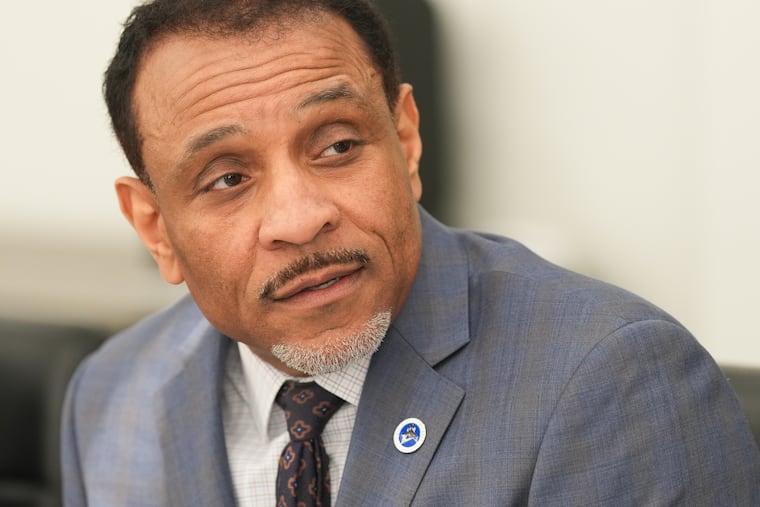
Republican Steve Lonegan, who is running in a crowded field for New Jersey governor, says if he wins he will cut the state budget by about 20 percent in his first year, and knock back corporate and personal income taxes.
Republican Steve Lonegan, who is running in a crowded field for New Jersey governor, says if he wins he will cut the state budget by about 20 percent in his first year, and knock back corporate and personal income taxes.
Eventually, he would cut the 7 percent sales tax to 6 percent, he said. Though Lonegan could not estimate how much money his cuts would save taxpayers, he promised they would see more money in their pockets.
"I feel like a kid in a candy shop," he said. "There are so many places to cut."
Budget experts, though, say cutting the state budget isn't so easy and that most of it covers programs and services the public wants, including aid to schools and local governments, drug subsidies for the elderly, and prison guards. They suggest that much of Lonegan's plan relies on assumptions.
Lonegan is joined in the Republican primary by Assemblyman Rick Merkt (R., Morris), former U.S. Attorney Christopher J. Christie, and Franklin Mayor Brian D. Levine, each of whom has promised to change state budgeting.
Lonegan said there are so many departments, bureaus, programs, commissions and offices in the state government, "I can close down whole departments and nobody would know the difference."
The bureaucracy accounts for only about 20 percent of the overall budget, according to the Treasury Department. About 40 percent is devoted to state aid to schools and local governments. And 34 percent covers grants in aid, which includes Medicaid costs, prescription-drug subsidies to the elderly, nursing homes, and higher education. About 6 percent goes to paying off state debt.
Richard Keevey, who directs Princeton University's Policy Research Institute for the Region and who has helped write budgets for former governors Thomas H. Kean and Jim Florio, said the most expensive elements of the bureaucracy "are tied up in areas most people would say they want to keep - prison guards, nursing homes, mental hospitals."
The first bureaucracies to feel Lonegan's budget ax would be the Department of Environmental Protection, the state comptroller, inspector general and public advocate. Though Lonegan would cut back the DEP considerably, he said he would fold some functions of the other departments into other agencies, making it difficult to figure out how much he would save.
None of these departments are the big spenders in state government. The public advocate gets $17 million, the inspector general $1.8 million, and the comptroller $8.2 million out of a $33 billion state budget.
"I want to go department by department, look at their original purposes, and see if they are meeting them," Lonegan said. If not, it's curtains.
Lonegan can expect resistance to any cuts he makes, starting with the DEP, which environmentalists say is underperforming, especially in monitoring toxic sites.
"We need strong environmental oversight everywhere, but especially in a place like New Jersey because of our population density and industrial past," said David Pringle of the nonpartisan Environmental Federation. The state "has more than its fair share of problems," he said.
In 1994, there were 12,000 contaminated sites in the state and the DEP had 270 staffers to force cleanups, he said. Now there are 20,000 toxic sites and 150 case managers. The result, Pringle said, was the state's inability to protect infants and children at a Gloucester County day-care center from exposure to mercury left behind by an old thermometer factory, and Little Leaguers from skin lesions they got playing on Hudson County ball fields laced with chromium.
Lonegan also would cut spending by curtailing the power of the state Supreme Court. He said court decisions on affordable housing, school aid and state debt had cost taxpayers millions. Gov. Corzine and the Legislature changed the rules last year on state debt, extending voters' rights to approve debt taken on by independent authorities.
"The governor and the legislature have used the court as their excuse to capitulate on these programs," he said. "We didn't elect the court. The court doesn't have the ability to tax. It's not held accountable to voters in any way. The governor and the legislature needs to have the backbone to stand up to the court and say, 'We're not going to fund your mandates.' "
To fight decisions he doesn't like, Lonegan said he would propose constitutional amendments. He also would use the governor's veto power, refusing to fund programs that he sees as out of step with his conservative views.
Jon Shure, president of the New Jersey Policy Perspective, said that Lonegan's proposals weren't impossible to implement that they were unprecedented and relied on a lot of assumptions.
To change the state constitution, Lonegan would need a majority of the Legislature to go along with him, which means he would need to bring a majority of conservative Republicans to the Assembly in this election year and to the state Senate in 2011. Then he would need a majority of voters to agree.
If he were to deny funding to affordable-housing programs or schools, he could expect a slew of lawsuits.
"There's nothing to stop the governor from simply saying he's not going to appropriate funding, but that's probably not the end of the story," Shure said.