Alice Tully: A model for Kimmel to follow
NEW YORK - In its every point of contact with the public these days, classical music wants to be more solicitous than ever, and with an impressive stretch of glass flaunting enormous vitality inside, the new Alice Tully Hall has arrived at 65th and Broadway as one glamorous welcome mat.
NEW YORK - In its every point of contact with the public these days, classical music wants to be more solicitous than ever, and with an impressive stretch of glass flaunting enormous vitality inside, the new Alice Tully Hall has arrived at 65th and Broadway as one glamorous welcome mat.
New York comes late to the idea that less formidable is more. A stroll by Lincoln Center plaza doesn't particularly compel you to experience opera or ballet - the Metropolitan Opera House and Koch Theater extend only the most formal of hands, their glass facades upstaged by uptight presentation.
Philadelphia's answer to Lincoln Center was to have been an antidote. When planners announced the Kimmel Center, they evoked both a new town square and a concert venue that finally would give the city a hall as great as its orchestra.
When critics noticed that neither was true, Kimmel leaders, still trying to raise money to pay off construction debt, denounced them. But last month the Kimmel revealed that it had engaged a new acoustician to remake Verizon Hall. And next month, Kimmel president Anne Ewers expects to see a master plan that starts the work of enlivening public spaces to the degree once dreamed of. These two acts are all the confirmation any critic needs that the Kimmel fell far short of its admirable ambition.
Kimmel leaders deserve credit for trying to get it right. Alice Tully, which celebrated its first opening night Sept. 11, 1969, held a series of reopening nights last month. After $159 million in aesthetic and acoustical work, it has hit on an experience that has exactly the spirit Philadelphia should be seeking.
Many visitors don't think specifically about what makes for a satisfying night out, but Alice Tully - newly envisioned by a design team including Diller Scofidio + Renfro and FXFOWLE Architects - spells it out.
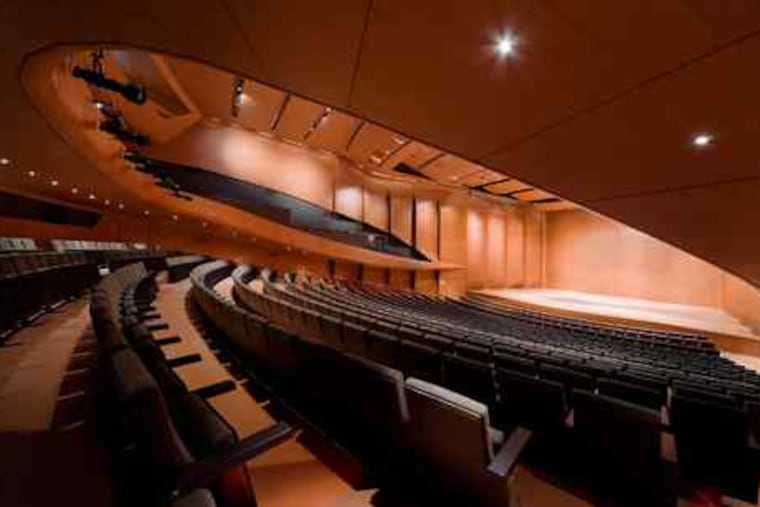
As I walked up to 65th and Broadway one recent evening, Tully's interior, bubbling with cafe life, had a way of waving me over. The auditorium itself offered close contact with the sound. Intermission was a snug but not claustrophobic experience. Overheard conversations tended to be about the music.
The Kimmel isn't quite like this, not yet. No one knows what the center's remake will cost, but it's not unreasonable to suspect that a fund-raising campaign encompassing remedial acoustics, physical reworking of public spaces, and additional endowment to support more active programming of those public spaces will be in the same ballpark as Alice Tully's $159 million.
To be sure, there are important differences in scale and context between Lincoln Center's remake, of which Alice Tully is just one component, and the Kimmel's impending one. Alice Tully was not generally considered to be a poor hall, just one that didn't live up to its potential. I'd guess that it is larger than most listeners want for chamber music, but with a scaled-down London Philharmonic Orchestra in the U.S. premiere of Vladimir Martynov's Vita Nuova (in a concert-opera version), it had warmth, clarity, balance, and presence.
What's interesting about Tully is that at roughly a thousand seats, it's the size the Kimmel and other users need to make certain presentations economically viable. Some artists will clearly sell more than the 650 seats of the Perelman Theater but not enough to fill up the 2,500 spots in Verizon Hall, and fees for some artists cannot be justified with 650 paying customers.
Nothing can be done about that now, nor should anyone advocate for it. The Perelman has problems for some presentations in which an acoustical shell could keep sounds from escaping into the fly space when the large-stage configuration is being used. For chamber music, it is dry but absolutely satisfactory.
The Kimmel, in part at the behest of the Philadelphia Orchestra, has correctly focused on improving the sound of Verizon Hall. Large-hall acoustics may be harder to control than small-hall ones, but in terms of putting listeners into close contact with the sound, Tully represents the kind of ambitious ideal that Kimmel Center leaders should be striving toward.
The Kimmel has some advantages over Lincoln Center. At least when you walk into the plaza of the Kimmel Center, the footpath to music is completely legible. Walk into the lobby of Avery Fisher Hall for the first time and you have about as much a chance of finding your way to the New York Philharmonic performing Leonard Bernstein as you do of running into Leonard Bernstein himself. Unless you've been there before, it might take you awhile to figure out that the hall is not there at all, but on the second level. And Verizon Hall, whatever its acoustical shortcomings, is visually superior to Avery Fisher.
Some of the Kimmel's unfriendliness has to do with how the space is managed. The little sofas and umbrellas recently placed there create much-needed privacy nooks. But the Kimmel has sent mixed messages on the kind of loitering most public venues are happy to have, lamenting lack of traffic at times when no performance is happening but apparently instructing security to approach visitors with "Can I help you?" (Translation: "Please leave.")
Better host manners will get the Kimmel only so far. KieranTimberlake, the well-regarded Philadelphia architecture firm that has been awarded the master plan, will have to propose major surgery if it wants to match the vitality of Tully. In how it relates to the street, the Kimmel Center takes its cue from the Gallery on Market Street, which is to say it cuts itself off.
The newly diaphanous Alice Tully, with a lobby like a glass display case, marries its public and private responsibilities in a particularly elegant way: It puts both on display. There's a point beyond which only ticket holders can roam, but the larger part of the lobby has a cafe and seating for everyone.
If the Kimmel is going to lure visitors from Broad Street, it will have to become more permeable. It needs to figure out a way to make itself irresistible. That it is evolving beyond its defensive "please leave" stage is good news. Leaders finally realize that the job won't be done until they have a building that says two more things:
In bricks and mortar, that's "Please stay."
And in acoustics that give listeners a visceral, memorable sensation, it's "Come back soon."