The Morris House is a restaurant Bermuda Triangle. Can the new Soufiane finally break the curse?
The secluded garden and historic aura of the Morris House craves a distinct menu. But translating the Moroccan-French magic of the new operators' tiny cafe to this much larger space hasn't been easy.
The Morris House Hotel has always had the bones to host a hit restaurant. Its Georgian-style brick buildings boast some genuine historic character dating back to 1787, when the Consitution was being written just a few blocks away. There’s a gracious courtyard oasis tucked behind an iron gate with room for 75 diners beneath a garland-draped tent ringed by dogwood and magnolia trees. A cozy indoor space with room for 45 more beside that garden and a plush bar offer a dramatic view through red curtains onto 8th Street. Situated close to Washington Square, surrounded by residential neighborhoods and the vital pulse of a hospital district, it’s not lacking for foot traffic.
And yet, the Morris House has long been the Philadelphia restaurant equivalent of a Bermuda Triangle. Over the past 20 years since it was refurbished into an elegant inn, several talented chefs have come along in hopes of unlocking its potential as a destination dinner hideaway — only to succumb to its more profitable use as a wedding party factory. The fits and starts of multiple new operators, most recently the bistro-style Morris, which closed after less than a year in 2023, have continued to cloud the public’s perception of what happens at 225 S. 8th St.
What this space needs is a restaurant with a distinct identity. So I could not have been more excited to learn that Soufiane Boutliliss and Christophe Mathon of Sofi Corner Cafe were bringing a more expansive expression of their Moroccan-French magic to the fine-dining setting of the Morris House.
I still daydream of the couscous royale I once ate at Sofi Corner, the casual, counter-service breakfast-lunch cafe this married couple still operates for daytime service a few blocks away on Locust Street. I was thrilled to find another rendition of that cultural keystone dish celebrated here, a deep-green painted terracotta platter of mounded couscous scented with nutty aged butter draped with heaps of stewed veggies, tagine-braised chicken and lamb, sesame-speckled dried fruits and a cuminy link of merguez rocking over top like a sausage seesaw.
But something was missing. It wasn’t just the need for a more generous splash of the deeply steeped broth kissed with rose water that should unite these disparate elements. (You can always ask for extra broth with your couscous.) This centerpiece to our dinner also arrived 90 minutes after our arrival, pointing to much bigger issues of service and inexperience with a project this large that are hampering this duo from realizing their vision at the Morris House.
The restaurant was so completely unprepared on a midweek evening for a busy room that what might be a boon of customers for most restaurants became a crisis here. The frantic staff was so stretched thin that it took a server nearly 30 minutes to take our drink orders, and then only with a sigh while leaning halfway through the doorway to the patio, where several more customers awaited. Menu items kept dropping out of our reach before we could ask for them. The Moroccan briouats pastries? Gone. The piperade roast peppers and toast? Gone.
“Let me send you a roasted marrow bone compliments of the house!” a manager offered my unlucky-in-ordering guest as a consolation. It never came. Neither did the duck confit, substituted without mention by a seared duck breast, which was salty, tough and small for $37.
“A couple people did not show up in the kitchen today,” conceded yet another staffer who ultimately took our order. That might also explain why an otherwise wonderfully seasoned duck pâté en croûte marbled with pistachios and herbes de Provence arrived with its underbaked pastry crust still pale and doughy.
It does not take skilled kitchen labor, however, to realize that four hungry diners could use more than a few miserly slices of baguette to dig into a trio of flavorful Moroccan eggplant and carrot salads. “Some more bread, please?” we begged politely, knowing it would be at least another 20 minutes until we saw them at all.
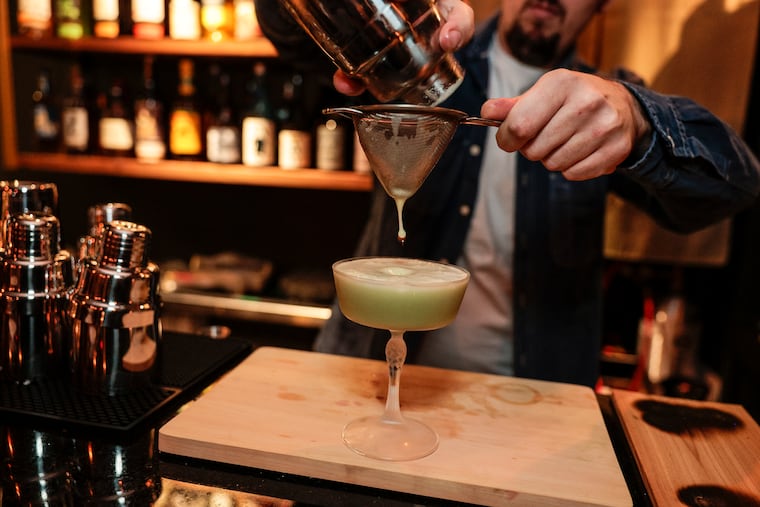
All new restaurants go through growing pains, and some will take longer to sort them out than others. But it would be unfair to suggest that Soufiane at the Morris is not worth the trouble. To the contrary, there were several glimmers of hope in my first meal here. The bar has been beautifully refurbished with wood paneling and pilasters salvaged from Lynnewood Hall along with a gilded antique French Rococo mirror. The cocktails served to the diners in cushy barstools there incorporate fun Moroccan touches, from a gin-infused mint tea to an Old Fashioned that arrives inside a dome of cinnamon and bay wood smoke.
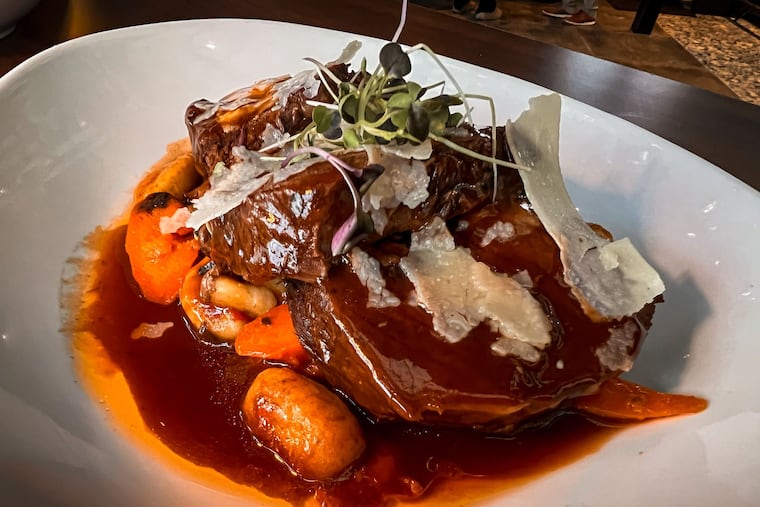
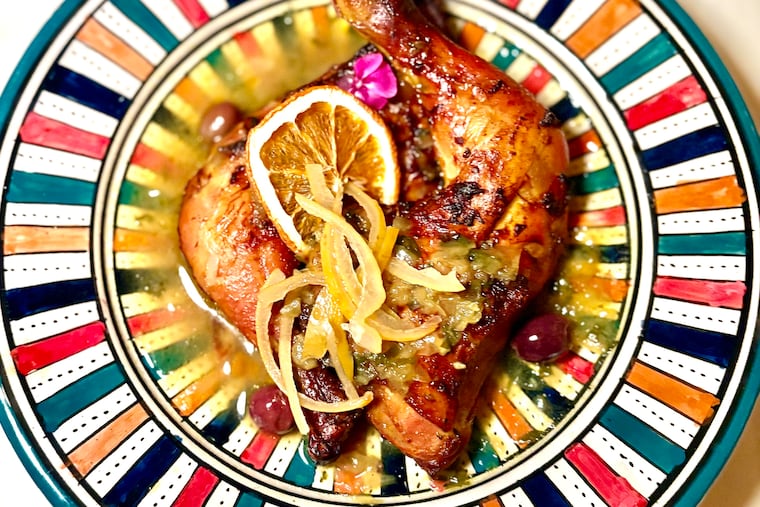
The kitchen also delivered some memorable plates, including a soulfully stewed chicken tagine scented with cardamom, olives and preserved lemon. We also especially loved an obscure French standby called veal Marengo, a wine-stewed tumble of tender meat, mushrooms and pearl onions with silky mashed potatoes. It’s a dish that Coast Guard veteran-turned-chef Henry McGuigan (Zahav, Laser Wolf, Lucky’s Last Chance, June BYOB, Tavern on Camac) has been mastering for years. They were both so good we would come back just for them.
In fact, we did. A few weeks later, the service was far more focused and the menu’s bicultural aspirations (with both hits and misses) came into clearer view. The menu is a split concept, more than pure fusion, and is very much a reflection of the couple behind this restaurant, the Tangier-born, Paris-raised Soufiane Boutliliss, and his husband, Christophe Mathon, a Frenchman who moved to the States as an executive with Coty.
With McGuigan digging deep into his repertoire of French standards, some of the Gallic flavors were among the most satisfying, from a standout beef tartare with a quail egg shrouded in rosemary smoke to some tender escargots broiled with garlicky breadcrumbs inside their shells (worth it just to use the pincer-like escargot tongs!) I’d place Soufiane’s French onion soup among Philly’s best. Made over the course of two days with slowly caramelized onions and both beef and veal stocks steeped in house, this soup has Cognac-splashed layered depth and the satisfaction of a generously cheesy molten Gruyère lid.
The steak frites is also a winner, a perfectly cooked prime-grade hanger lavished with a garden green spoonful of a zesty parsley purée enriched with shallots, confit garlic and anchovies. Those shoestring frites cooked in beef tallow were also a crucial, sauce-soaking vehicle for la mouclade de moules, one of the most distinctive mussel dishes in town that taps a traditional preparation from the French coastal town of La Rochelle, its shellfish jus enriched with crème fraîche and curry.
Where this kitchen most frequently fell short was on the Moroccan side of the menu, where the flavors were often good, but the execution and touch were off — a symptom, perhaps, of the fact that Boutliliss is less involved in the kitchen’s day-to-day operations.
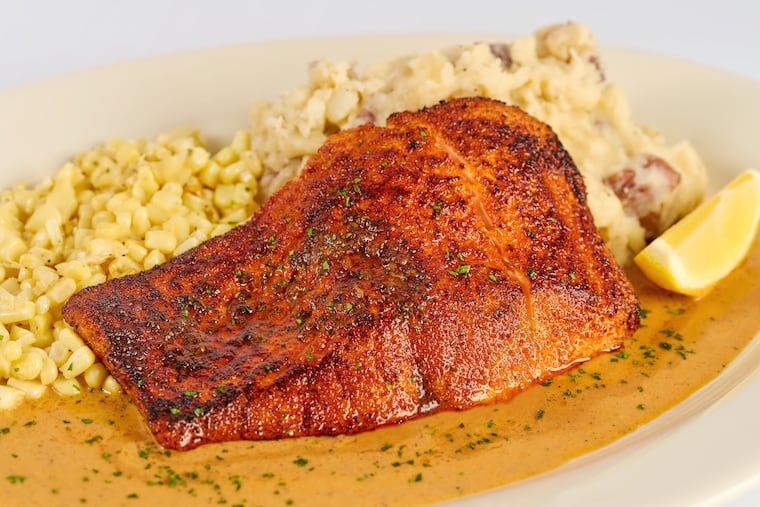
The fish tagine’s tomato-based sauce was appealingly fragrant with cumin and smoked paprika, but the red snapper fillet was overcooked and dry. Chermoula sauce is one of Boutliliss’ family treasures, a velvety green purée of cilantro, parsley, lemon and olive oil whose aromatics of garlic and cumin must be added in order and in proper balance. (“You have to respect the grandmother’s touch,” says Boutliliss.)
But the tiny bay scallops that arrived inside a terracotta crock of that bubbling hot chermoula were terribly overcooked. In both cases, though, McGuigan has recognized the flaws and altered the dishes since my visits, changing the technique on the fish and subbing in larger sea scallops to better showcase the flavors.
When it came to dessert, however, it was the Moroccan-inspired flavors that were most successful, a “pain perdue” French Toast soaked in orange blossom syrup with caramel and pistachios, as well as a simple lemon tart inspired by Boutliliss’ grandmother with a lime zest-dusted condensed milk custard set into a crust of crushed Biscoff cookies.
It was a pleasant enough finale, but Mathon and Boutliliss must have sensed things had not gone smoothly and could be seen circulating among the room’s lingering guests with complimentary pours of Rémy Martin 1738 Cognac.
“We know we can do better,” Mathon told our table, tipping the brandy our way. “We never want you to leave without a smile.”
That kind of personal touch, the one that earned them fans at tiny Sofi Corner, is certainly the right idea, and when a Frenchman breaks out the Cognac you know he means it. But if they hope to change two decades of precedent and transform the larger challenge of Soufiane at the Morris into a lasting restaurant success, they’ve got bigger issues of staffing and kitchen consistency to solve.
Soufiane at the Morris
225 S. 8th St., Philadelphia, PA 19106, 646-724-9667; soufianeatthemorris.com
Dinner Tuesday through Sunday, 4:30 p.m.—12 a.m.
Wheelchair accessible through garden entrance.
About 35% of the menu is gluten-free or can be modified.
Entrees, $30-$48 (couscous for two)
Menu highlights: beef tartare; Moroccan briouats; escargots; chermoula scallops; French onion soup; couscous Royal; chicken tagine; steak-frites; veal Marengo; la Mouclade curried mussels; tarte au citron.
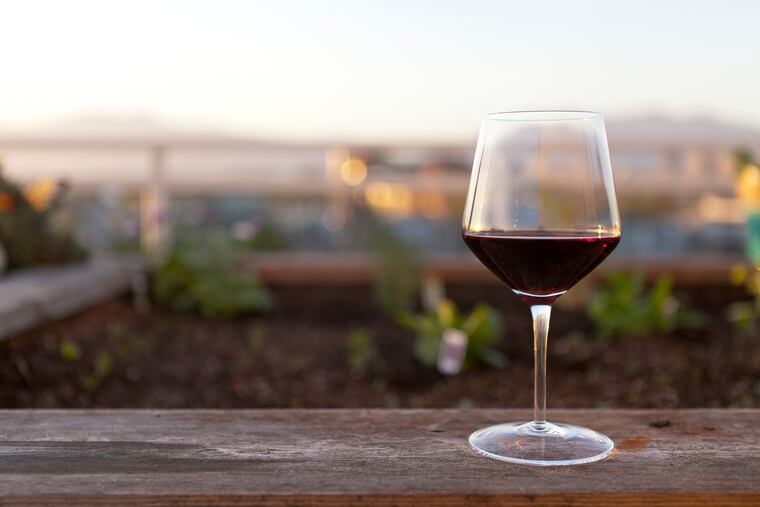
Drinks: Cocktails are the focus, with a range of classic ideas executed with a North African flourish, from a Casablanca Old Fashioned smoked with cinnamon and bay wood to a gin- and Carpano-infused Moroccan mint tea. About a dozen wines by the glass, largely French, offer a solid range of standard choices for $16 or less.